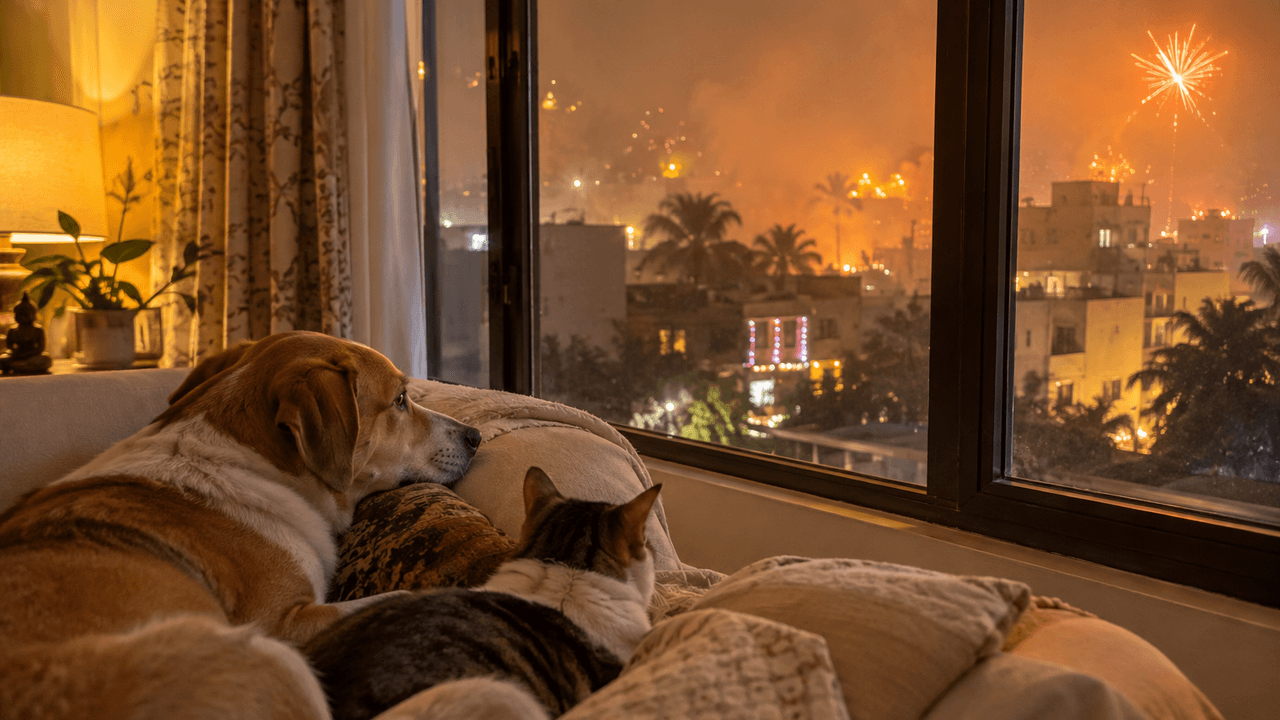
Yes. Firecracker smoke contains fine particulate matter, sulfur compounds, and heavy metal residues that irritate a dog's or cat's airway within minutes of exposure and can trigger coughing, laboured breathing, or an asthma-like attack for hours afterward. Keep pets indoors with windows and doors closed during peak firing hours, use an air purifier if you have one, and treat any breathing difficulty as an emergency, not something to wait out.
Why this matters in India
Indian Diwali air quality is not a mild seasonal inconvenience; in most major cities, PM2.5 levels on Diwali night and the following morning regularly spike to multiples of the already-elevated baseline, and this is well documented year after year by India's own Central Pollution Control Board monitoring stations in Delhi NCR, Mumbai, and other metros. Dogs and cats breathe faster than humans at rest and have a proportionally larger lung surface area exposed relative to body size in smaller breeds, meaning the same smoke-laden air affects them meaningfully. Brachycephalic (short-nosed) breeds increasingly popular in Indian homes, such as Pugs, Persian cats, and Shih Tzus, are especially vulnerable because their already-narrowed airways have less reserve capacity to cope with additional irritation. Unlike Western firework-smoke content, which usually treats this as a minor discomfort, Indian Diwali smoke exposure is compounded by the pre-existing high ambient air pollution in most Indian cities during the same October-November window, making the combined respiratory load genuinely higher here than in most other markets Critzo's international counterparts write for.
What actually happens inside your pet's airway
Firecracker smoke is a mix of fine and ultrafine particulate matter, sulfur dioxide and other sulfur compounds from the gunpowder, and trace heavy metals (including barium, strontium, and copper compounds used for colour effects) that become aerosolised during combustion. When inhaled, the smallest particles bypass the nose and upper airway's natural filtering and travel deep into the bronchioles and alveoli, the smallest air sacs in the lungs. There, they trigger local inflammation: the airway lining produces excess mucus, the smooth muscle around the airways can constrict (bronchoconstriction), and in sensitive individuals this cascade closely resembles an asthma attack, sometimes called reactive airway disease when seen in cats.
In dogs and cats with pre-existing airway sensitivity, whether from brachycephalic anatomy, prior kennel cough or feline asthma, or simple individual susceptibility, this irritation can escalate from mild coughing to genuinely laboured breathing within the same evening. Sulfur dioxide specifically is a known respiratory irritant even in healthy airways at high enough concentrations, which is exactly the concentration Diwali night smoke reaches in enclosed urban areas with dense firecracker use.
Clinical signs, in the order they usually appear
- Within minutes to an hour of smoke exposure: watery eyes, sneezing, and a dry, occasional cough are usually the earliest signs, similar to how a person's eyes and throat react to standing near a bonfire.
- As exposure continues: the cough becomes more frequent and can turn moist or honking, and you may notice increased respiratory rate (counting breaths per minute at rest, more than 30 to 40 breaths per minute in a resting dog is a useful red flag) even without obvious distress yet.
- Moderate to severe irritation: open-mouth breathing in a dog who does not normally pant at rest, exaggerated abdominal effort with each breath, or a cat breathing with its mouth open (cats very rarely pant, and open-mouth breathing in a cat is always a significant warning sign, not a normal response to warmth or exercise).
- Severe reaction: blue or pale gums, collapse, or extreme distress, indicating the airway irritation has progressed to genuine respiratory compromise requiring emergency oxygen support.
Brachycephalic breeds may show signs of distress at a lower smoke concentration and progress through these stages faster than other breeds, because their airway anatomy already operates with less spare capacity even on a normal day.
The time window that matters
Mild eye and throat irritation from brief smoke exposure often settles within an hour or two once the pet is moved to cleaner air, similar to how a person's irritated eyes clear after leaving a smoky room. However, once a pet shows increased respiratory effort, open-mouth breathing (especially in a cat), or any blue or pale tinge to the gums, this is a genuine emergency requiring oxygen support and, in some cases, bronchodilator or corticosteroid treatment at a veterinary hospital; this is not a "give it some time and see" situation, because airway inflammation can continue to worsen for hours after the smoke exposure itself has ended, even after you've moved the pet to cleaner air. Cats in particular can decompensate from respiratory distress faster and with less warning than dogs, so any open-mouth breathing in a cat warrants immediate veterinary contact rather than home monitoring.
Reducing exposure before and during Diwali
Keep pets indoors during peak firing hours, which in most Indian cities runs from early evening through late night across the main Diwali days, with windows and doors closed to reduce smoke infiltration. If you have an air purifier, running it in the room where your pet is sheltering measurably reduces indoor particulate levels; a wet towel placed along the base of doors and windows also helps reduce infiltration in homes without purifiers. Avoid walking dogs during the smokiest hours; shift walks to early morning before firing typically resumes, and keep walks shorter than usual if the air is visibly hazy. For cats, simply ensuring they cannot access balconies or open windows during the peak hours is usually sufficient, since most cats will already seek shelter from the noise and smoke on their own if given the choice.
What it costs in India (2026)
Item | Metro (Mumbai, Delhi, Bengaluru, Hyderabad) | Tier-2 (Nagpur, Coimbatore, Lucknow, Indore) |
|---|---|---|
Emergency respiratory consult | ₹800–₹2,000 | ₹400–₹1,200 |
Oxygen support (per session/few hours) | ₹1,500–₹5,000 | ₹800–₹3,000 |
Nebulisation/bronchodilator treatment | ₹1,000–₹3,000 per session | ₹600–₹2,000 per session |
Overnight hospitalisation for observation | ₹4,000–₹12,000 | ₹2,500–₹7,000 |
Chest X-ray (if pneumonia or fluid suspected) | ₹1,500–₹3,500 | ₹900–₹2,200 |
What affects the range: whether the pet is a brachycephalic breed needing more intensive monitoring, whether oxygen support is needed for hours or overnight, and how quickly the pet was brought in after distress began, since earlier intervention generally means shorter, less intensive (and less expensive) treatment.
When to see a vet
- Go now: open-mouth breathing in a cat, exaggerated abdominal breathing effort, blue or pale gums, or collapse in any pet.
- Go now: a dog who does not normally pant at rest is panting heavily and cannot settle even once moved away from smoke and noise.
- Book within 24 hours: persistent coughing, watery eyes, or mild increased respiratory rate that has not resolved within a few hours of being in cleaner air.
- Monitor at home: brief sneezing or mild eye irritation immediately during exposure that fully resolves within an hour of moving indoors, with normal breathing, appetite, and energy afterward.
Frequently asked questions
Kutte ko patakhon ke dhuein se saans lene mein problem ho rahi hai, kya karein?
Turant apne pet ko saaf hawa wali jagah le jaayein aur agar mooh khol kar saans le raha ho, gums neela ya pale ho, ya saans lena bahut mushkil lag raha ho, to turant vet ke paas jaayein. Yeh emergency hai, ghar par wait mat kariye.
Are cats more sensitive to Diwali smoke than dogs?
Cats can decompensate from respiratory distress faster and with less obvious warning than dogs, and open-mouth breathing in a cat is always significant since cats rarely pant. Both species need the same avoidance precautions, but cats warrant a lower threshold for immediate veterinary contact.
Does an air purifier actually help during Diwali?
Yes, running an air purifier in the room where your pet is sheltered measurably reduces indoor fine particulate levels compared to an unfiltered room, though it will not fully eliminate exposure if doors and windows are frequently opened.
My dog coughed a bit during the fireworks but seems fine now. Do I need to worry?
Brief, mild coughing during active smoke exposure that fully resolves once your dog is in cleaner air, with normal appetite, energy, and breathing afterward, does not typically need emergency care, but keep an eye out over the following day for any delayed cough or lethargy.
Are brachycephalic breeds like Pugs and Persian cats at higher risk?
Yes. Their airway anatomy already has less reserve capacity even on a normal day, so smoke irritation can push them into breathing difficulty at lower exposure levels and faster than other breeds.
Should I give my pet any medication before Diwali to protect their lungs?
There is no standard preventive medication given specifically for firework smoke exposure. If your pet has a known respiratory condition such as feline asthma or a history of breathing difficulty, discuss a specific management plan with your vet before Diwali rather than starting any medication on your own.
Sources
- WSAVA respiratory medicine references for small animals
- MSD Veterinary Manual, respiratory disease section
- Central Pollution Control Board (India) seasonal air quality monitoring data, referenced generally for Diwali-period particulate spikes in Indian metros
A note from Critzo (please read): This article is general educational information written and reviewed by qualified veterinary professionals for Indian pet parents. It is not a substitute for an in-person consultation with your own veterinarian, who knows your pet, their history, and their current clinical state. Pets are individuals — breed, age, weight, pre-existing conditions, medications, and local disease patterns all change what is safe and what is not. Do not start, stop, or change any medication, vaccination schedule, diet, or treatment based on what you read here without first speaking to a registered veterinary practitioner. If your pet is showing emergency signs — collapse, seizure, severe bleeding, suspected poisoning, breathing difficulty, bloated abdomen, repeated vomiting or no urination for more than 12 hours — stop reading and go to the nearest 24-hour veterinary hospital immediately. You follow any guidance from this article at your own risk and at your pet's risk. Critzo, its authors, and its reviewers accept no liability for outcomes arising from decisions made without veterinary supervision.