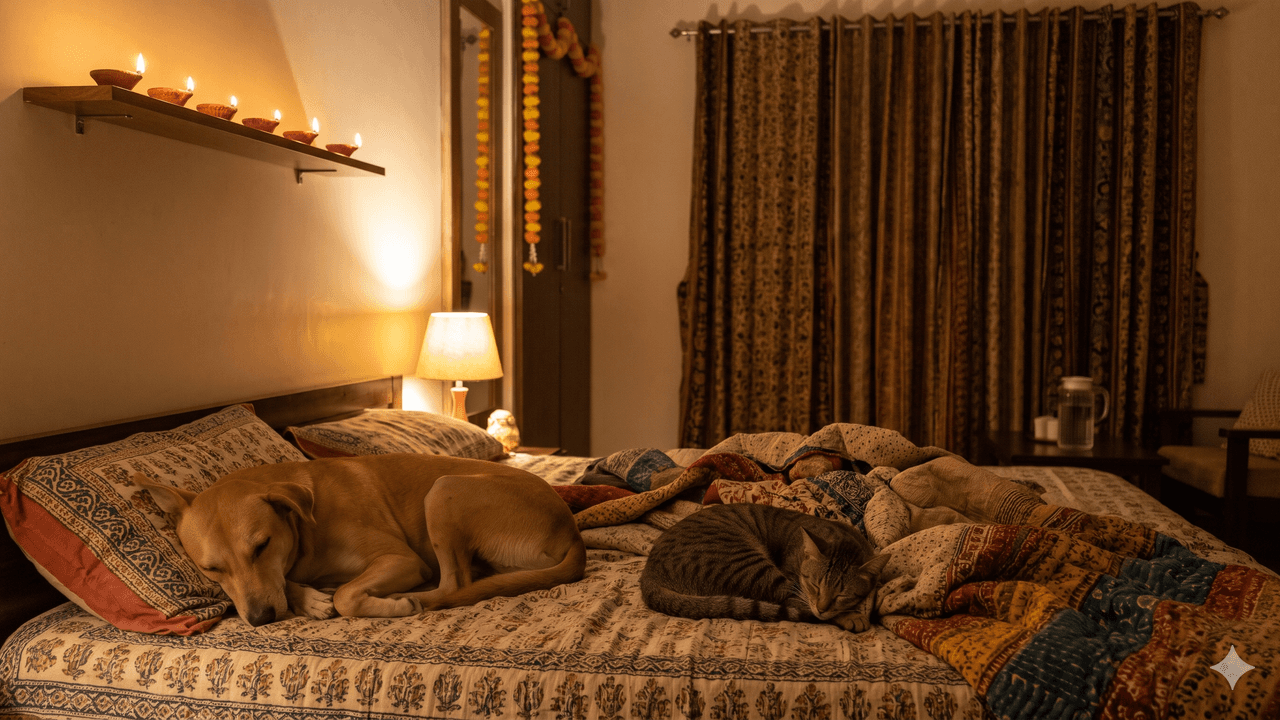
Keep dogs and cats indoors in a closed, quiet room from dusk, with windows shut, curtains drawn and a fan or TV on. Walk dogs before sunset on a secure harness with an ID tag. Keep mithai, chocolate, dry fruits, diyas and crackers out of reach. If your pet eats sweets or crackers, or collapses, go to a vet now.
Why this matters in India
Diwali 2026 falls on Sunday, 8 November, but the bursting usually runs for several nights, from Dhanteras to Bhai Dooj and often beyond. In apartment blocks the noise bounces between buildings, so even "green" crackers sound like a war zone to a dog or cat. Indian homes also add risks Western guides miss: boxes of kaju-kishmish, sugar-free mithai made for diabetic relatives, ghee-heavy snacks, diyas at floor level, rangoli on the doorstep and community dogs with nowhere to hide. Rules on crackers differ by city. For Delhi-NCR, the Supreme Court has allowed certified green crackers on 7 and 8 November 2026, with bursting reportedly limited to 6 to 7 am and 8 to 10 pm. Many clinics also run reduced hours on festival nights, which is why planning now matters.
How to keep pets safe during Diwali: a day-by-day plan
- Today: save the number and address of the nearest 24-hour veterinary hospital, and call to check its Diwali hours.
- Today: check your pet's ID tag carries your current phone number, and confirm the microchip registration details if your pet has one.
- 2 to 3 days before: if your pet panicked last year, book a vet visit now to discuss a medication plan and try it once before the big night.
- Every evening of the festival: walk dogs and finish toilet breaks before sunset, feed dinner early, and bring cats indoors.
- Diwali night: keep pets in their safe room with doors and windows shut, and keep the main door closed while guests come and go.
- The morning after: walk dogs on a short leash and steer them away from cracker debris, rangoli and food waste on the road.
Why are dogs and cats so scared of firecrackers?
Dogs and cats hear quieter and higher-pitched sounds than people do, so a cracker that is loud to you is overwhelming to them. The bangs are also unpredictable, come with flashes and a burning smell, and seem to come from every direction at once. That triggers the body's fight-or-flight response: stress hormones such as adrenaline flood the system, the heart races, and the animal tries to escape or hide.
Signs usually build in this order: ears pricked and body alert, pacing and panting, trembling, hiding or clinging to you, drooling, then frantic attempts to escape, chewing doors or crates, and loss of bladder or bowel control. Cats tend to hide, flatten their bodies, have wide pupils and stop eating or using the litter box. Fear often gets worse each year rather than better, which is why it is worth treating early. Our guide to Diwali firecracker anxiety in dogs covers longer-term desensitisation.
How to set up a safe room for your pet
- Choose an inner room with the fewest windows, ideally away from the road and the building compound.
- Shut windows, draw thick curtains and switch on a fan, AC, soft music or the TV to mask the bangs.
- Add your pet's bed, a blanket that smells of you, water, a few toys and a long-lasting chew.
- For dogs who like dens, an open crate covered with a sheet works well; never lock a panicking dog in a crate.
- For cats, add a litter box, a high shelf and a covered hiding spot such as a cardboard box.
- Let your pet hide if it wants to. Don't drag a cat out from under the bed.
- Stay home if you can. Calm comfort and gentle stroking help many pets and don't "reward" fear.
Should I give my dog medicine for Diwali crackers?
For pets with real panic, the most effective help is often a short-acting anti-anxiety medicine prescribed by your vet and given before the bursting starts. Vets may consider options such as gabapentin (human brands include Gabapin and Gabantin) or trazodone, sometimes combined, depending on your pet's health and other medicines. Your vet will set the dose and timing, and will usually ask you to give a trial dose a few days before Diwali to see how your pet responds.
Two cautions matter here. Acepromazine on its own is no longer recommended for firecracker fear: European veterinary behaviour specialists note it sedates the body without reducing the fear, so the pet may be terrified but unable to move. And never use human medicines from your own cabinet. Doses for pets are very different, and some human liquid medicines contain xylitol, which is toxic to dogs.
Calming wraps, pheromone diffusers and snug T-shirts help some pets and are low-risk add-ons, but they are not a substitute for medication when fear is severe.
Diwali foods that are dangerous for pets
Food | Why it is harmful | Signs and timing |
|---|---|---|
Chocolate and chocolate gift boxes | Theobromine and caffeine overstimulate the heart and nervous system; dark chocolate is the most dangerous | Vomiting, restlessness, racing heart, tremors; usually within a few hours |
Sugar-free mithai and sweets with xylitol | Xylitol triggers a surge of insulin in dogs, crashing blood sugar, and can damage the liver | Weakness, wobbling, collapse or seizures, often within an hour |
Raisins, grapes (kishmish in dry fruit boxes) | Can cause sudden kidney injury in dogs; the toxic amount varies and is unpredictable | Vomiting, low energy, then drinking and urinating less over 1 to 3 days |
Ghee-rich mithai, fried namkeen, leftovers | High fat can trigger pancreatitis | Vomiting, painful belly, hunched posture, often 1 to 4 days later |
Onion and garlic in curries and snacks | Damage red blood cells in dogs and especially cats | Weakness, pale gums, red-brown urine, often days later |
Alcohol at card parties | Lowers blood sugar, body temperature and breathing | Wobbling, vomiting, drowsiness within an hour |
Foil, strings and toothpicks from sweet boxes | Can block or injure the gut | Vomiting, not eating, straining |
Keep sweet boxes on high shelves, ask guests not to share snacks, and empty dustbins with lids on. Our separate guides on chocolate and xylitol poisoning explain the treatment in detail.
Diyas, candles and lights
Diyas placed on the floor, steps or a low balcony ledge are at tail height for dogs and on the walking path for cats. Fur and whiskers catch fire quickly, and a curious cat can knock a burning diya onto curtains. Put diyas and candles on high, stable surfaces your pet cannot reach, or use LED diyas indoors. Keep oil and wax away from pets, since licking them can cause stomach upset.
Electric fairy lights bring a different risk: puppies and kittens chew wires, which can cause burns in the mouth and, in serious cases, fluid in the lungs. Run cords out of reach and switch lights off when you can't supervise.
If your pet gets a minor burn, cool it under gently running cool (not ice-cold) water for about 10 minutes, then call your vet. Burns on the face, paws or larger than a coin need a vet visit the same night.
Rangoli colours, cracker debris and smoke
Rangoli: cheap synthetic colours can contain industrial dyes, and some festival colours sold in India have been found to contain heavy metals. Pets walk through rangoli and then lick their paws. Keep rangoli outside the area your pet uses, or make it with rice flour, flower petals and natural colours, and wipe paws after walks.
Cracker debris: unburnt and half-burnt crackers on the road contain potassium nitrate, sulphur, charcoal and metal salts used for colour. A dog that eats them usually gets vomiting and diarrhoea, sometimes bloody. Larger amounts can cause tremors, seizures, kidney injury, or methaemoglobinaemia, where the blood cannot carry oxygen properly and the gums turn brown or grey. Don't try to make your dog vomit at home; call your vet.
Smoke: Diwali smoke adds to an already poor air season in many cities. Flat-faced breeds such as Pugs, Shih Tzus and Persian cats, pets with heart or airway disease, and pet birds are most at risk. Keep windows shut, run an air purifier if you have one, and keep walks short. Our article on Diwali smoke covers breathing problems in more detail.
Cats, birds and small pets during Diwali
Cats rarely show fear as obviously as dogs, so watch for hiding, not eating, and accidents outside the litter box. Keep indoor-outdoor cats inside for the whole festival, and check for them before you shut doors and windows. Pet birds are very sensitive to smoke and sudden noise: move the cage to an inner room away from the kitchen, partly cover it, and never light diyas or burn incense near it. Rabbits, hamsters and guinea pigs can die of shock from sudden fear, so keep their enclosures in the quietest room with extra hiding spots.
Community dogs and cats in your society
The dogs and cats in your colony have nowhere to escape to. Ask your RWA to keep bursting away from the parking areas and stairwells where they shelter, leave water out, and let them rest undisturbed in quiet corners. Tying crackers to animals or throwing crackers at them is cruelty under the Prevention of Cruelty to Animals Act, 1960, and should be reported to the police and local animal welfare groups. If you see an injured animal, call a local rescue or animal hospital rather than trying to handle a panicked dog yourself.
If your pet goes missing during Diwali
Frightened pets usually run and then hide close by, silently, rather than travelling far. Search your building's staircases, parking, shafts and under cars first, with a torch, calling softly. Then alert your society WhatsApp group and security guards, ask the RWA to check CCTV, put up posters with a clear photo and phone number, and contact local animal welfare groups and clinics. A microchip and an ID tag with your number greatly improve the chance of getting your pet back.
What it costs in India (2026)
Item | Metro (₹) | Tier-2 (₹) |
|---|---|---|
Pre-Diwali vet consult for an anxiety plan | 500–1,200 | 300–700 |
Vet-prescribed anti-anxiety medicine for the festival | 300–1,200 | 200–700 |
Calming wrap or vest | 800–2,000 | 700–1,800 (mostly online) |
ID tag with phone number | 200–800 | 150–600 |
Microchip with registration | 1,000–3,000 | 800–2,000 |
Emergency consult on a festival night | 800–2,000 | 400–1,000 |
Poisoning stabilisation (decontamination, IV fluids, a few hours) | 2,000–6,000 | 1,200–3,500 |
Overnight hospitalisation for observation | 4,000–12,000 | 2,500–7,000 |
What affects the range: the clinic, after-hours charges on festival nights, and how quickly treatment starts. Figures are approximate and vary by clinic.
When to see a vet
- Go now: your pet ate chocolate, sugar-free sweets, raisins or grapes, crackers, or more than a lick of rangoli powder; it vomits repeatedly, trembles violently, has a seizure or collapses; gums look pale, blue, grey or brown; it has a burn on the face or paws or larger than a coin; it is breathing hard or a cat is breathing with its mouth open; or it is injured after trying to escape.
- Book within 24 to 48 hours: one or two vomits or soft stools after rich food that then settle; limping after a panic episode; a cat that hasn't eaten for a day; or a pet whose fear was severe enough that it needs a plan before New Year's Eve and next Diwali.
- Monitor at home: mild trembling or clinginess that settles within an hour of the bursting stopping, as long as your pet then eats, drinks and toilets normally.
Frequently asked questions
दिवाली पर कुत्ते को पटाखों से कैसे बचाएं? (Diwali par kutte ko pataakhon se kaise bachaayein?)
Walk your dog before sunset, then keep it indoors in a closed room with windows shut, curtains drawn and a fan or TV on to mask the noise. Give it a bed, water and a chew, stay nearby and comfort it calmly. If your dog panics badly every year, ask your vet about a prescribed anti-anxiety medicine a few days before Diwali.
Can I give my dog a little mithai on Diwali?
It is best not to. Most mithai is high in sugar and ghee, which can upset the stomach or trigger pancreatitis, and sugar-free sweets may contain xylitol, which is dangerous for dogs. Many sweets also contain raisins, chocolate or nuts. Give a dog treat or a piece of plain boiled chicken instead.
Should I sedate my dog for Diwali?
Don't use leftover or human medicines. Some old sedatives, such as acepromazine on its own, calm the body without reducing fear, which can make things worse. A vet can prescribe a short-acting anti-anxiety medicine suited to your dog and suggest a trial dose before the festival to check how your dog responds.
Is it okay to comfort my scared dog?
Yes. Calm comfort, gentle stroking and staying close do not reward or increase fear; they help many dogs feel safer. Avoid scolding, forcing your dog out of its hiding place, or taking it outside to "get used to" the crackers, which usually makes fear worse.
How do I keep my cat safe during Diwali?
Keep your cat indoors for the whole festival, with windows shut and a litter box, water and a covered hiding spot in a quiet room. Place diyas and candles where a cat cannot jump onto them, keep sweets, and any lilies used in decorations, out of reach, and let your cat hide without disturbing it.
My dog ate a firecracker. What should I do?
Remove any remaining pieces, note what was eaten and how much, and call your vet or the nearest 24-hour hospital straight away. Don't try to make your dog vomit at home. Crackers contain chemicals and metal salts that can cause vomiting, bloody diarrhoea and, in larger amounts, tremors or breathing problems.
Sources
- Supreme Court of India, order permitting certified green crackers in Delhi-NCR for Diwali 2026, as reported by LiveLaw and Bar & Bench (November 2026)
- European Society of Veterinary Clinical Ethology (ESVCE) position statement on medications for acute phobic states in dogs as an alternative to acepromazine, published via FECAVA
- New Zealand Veterinary Association guidance on fireworks season
- MSD Veterinary Manual: chocolate, xylitol, grape and raisin, and onion and garlic toxicity in dogs and cats
- ASPCA Animal Poison Control and Pet Poison Helpline guidance on firework ingestion in pets
- Prevention of Cruelty to Animals Act, 1960 (India)
A note from Critzo (please read): This article is general educational information written and reviewed by qualified veterinary professionals for Indian pet parents. It is not a substitute for an in-person consultation with your own veterinarian, who knows your pet, their history, and their current clinical state. Pets are individuals — breed, age, weight, pre-existing conditions, medications, and local disease patterns all change what is safe and what is not. Do not start, stop, or change any medication, vaccination schedule, diet, or treatment based on what you read here without first speaking to a registered veterinary practitioner. If your pet is showing emergency signs — collapse, seizure, severe bleeding, suspected poisoning, breathing difficulty, bloated abdomen, repeated vomiting or no urination for more than 12 hours — stop reading and go to the nearest 24-hour veterinary hospital immediately. You follow any guidance from this article at your own risk and at your pet's risk. Critzo, its authors, and its reviewers accept no liability for outcomes arising from decisions made without veterinary supervision.