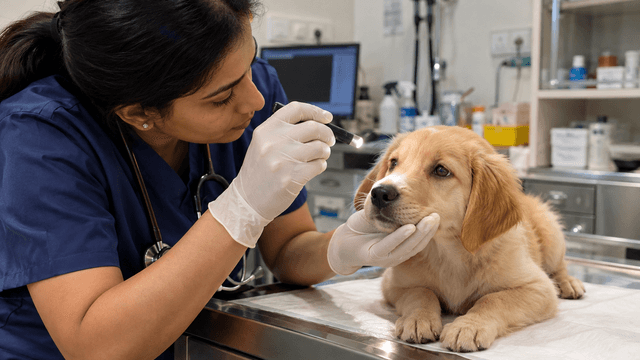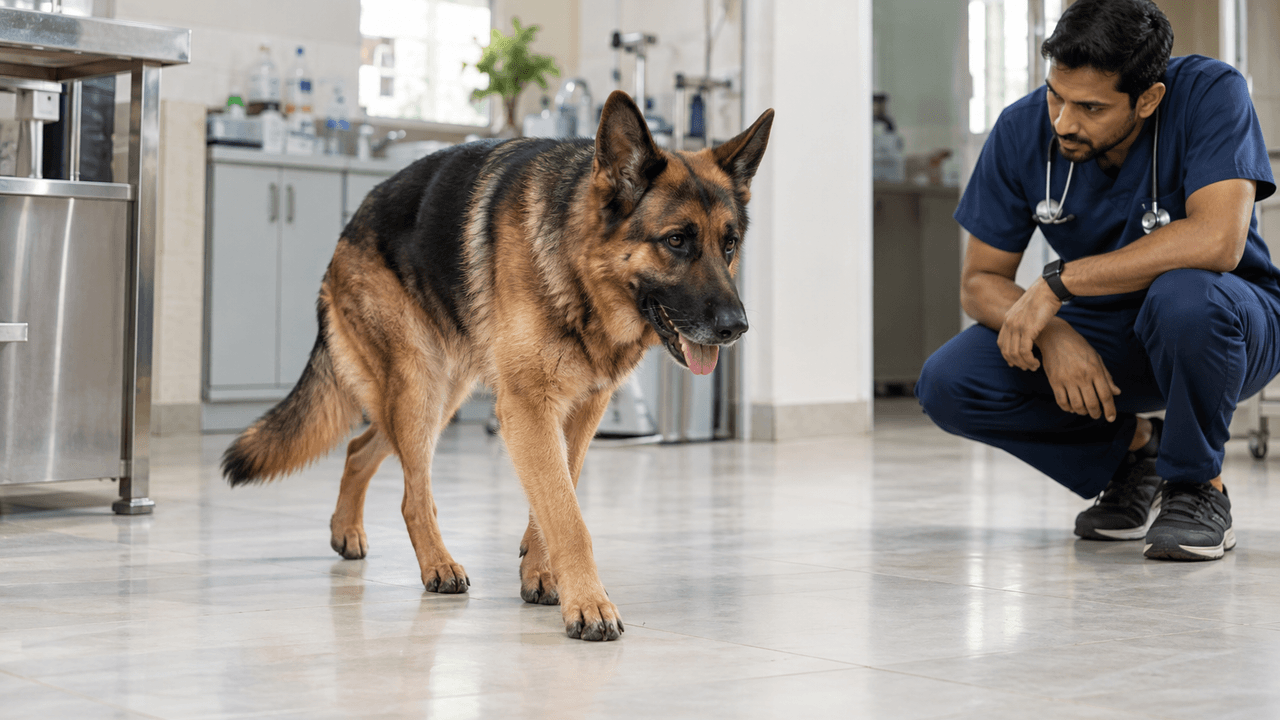
Hip dysplasia is a developmental joint condition, not an injury, and it is one of the most common orthopedic problems in German Shepherds worldwide, including in India. It happens when the ball and socket of the hip joint do not fit together properly as a puppy grows, leading to instability, abnormal wear, and eventually arthritis. Signs often appear between 5 months and 2 years of age: a bunny-hopping gait, reluctance to climb stairs, or stiffness after rest. This is manageable, often without emergency surgery, but it needs a vet's evaluation and X-rays to confirm and grade, not a wait-and-see approach at home.
Why this matters in India
German Shepherds are consistently one of the most popular large breeds in Indian homes, often kept for both companionship and home security, which means Indian vets see a genuinely high volume of hip dysplasia cases in this specific breed. Indian flooring adds a real, underappreciated risk factor: smooth marble, tile, and granite floors, common in Indian apartments and houses, offer poor traction for a growing large-breed puppy's developing joints, and repeated slipping and sliding during the critical growth period (roughly 4 to 12 months) is now understood by orthopedic veterinary specialists to contribute to abnormal joint loading in predisposed dogs. Combine this with a common Indian feeding pattern of over-supplementing large-breed puppies with extra calcium, protein, or "growth" supplements believing more is better, and you have a set of modifiable risk factors that are more prevalent in Indian homes than the veterinary literature (mostly generated in the West) tends to emphasise.
What is actually happening inside the joint
The hip is a ball-and-socket joint: the head of the femur (the ball) should sit snugly within the acetabulum, a cup-shaped socket in the pelvis. In a healthy hip, the ligaments and muscles around this joint develop in coordination with bone growth, keeping the ball centred and stable within the socket through every stage of the puppy's growth.
In hip dysplasia, this coordination fails. The joint capsule and supporting ligaments are looser than they should be relative to the rate of bone growth, allowing the femoral head to move abnormally within the socket, a state called joint laxity. Over time, this abnormal movement causes the socket to become shallower and the femoral head's shape to change (remodelling) as the body responds to the abnormal forces. The joint surfaces, which should glide smoothly against each other, instead grind and wear unevenly, triggering progressive osteoarthritis. This is why hip dysplasia is fundamentally a developmental and biomechanical problem that starts in puppyhood, even though the arthritis it causes may not become obviously painful until later.
Genetics play the largest role (hip dysplasia is polygenic, meaning multiple genes contribute, which is why breeding parents with certified healthy hips reduces but does not eliminate risk in offspring), but environmental factors during the rapid growth period, including excess weight, overly rapid growth from calorie-dense diets, over-supplementation, and repeated slipping on smooth floors, can meaningfully worsen the severity of dysplasia in a genetically predisposed puppy.
Clinical signs, in the order they usually appear
- Early signs, often 5 months to 1 year: a subtle "bunny hopping" gait when running (both back legs moving together rather than independently), reluctance or hesitation before jumping into a car or onto furniture, and stiffness after rest that improves somewhat with gentle movement.
- Progressing signs, roughly 1 to 2 years: visible difficulty or reluctance climbing stairs, a swaying or "loose" hip movement visible when walking, and reduced exercise tolerance compared to littermates or other dogs of the same age.
- Established arthritis, often from 2 years onward but highly variable: persistent stiffness especially first thing in the morning or after rest, muscle wasting over the hindquarters (visible thinning of the thigh muscles from reduced use), and a noticeably narrower hind-leg stance.
Severity and age of onset vary enormously between individual dogs, even littermates; some German Shepherds with radiographically severe dysplasia show minimal outward signs for years, while others show obvious lameness as young puppies. This is why a vet examination and X-ray, not just watching the dog's gait, is the only reliable way to actually assess the joint.
The time window that matters
Hip dysplasia is a chronic developmental condition, not an acute emergency in most cases, so the "time window" here is about developmental intervention rather than minutes-to-hours urgency. Diagnosis is typically confirmed with hip X-rays, ideally taken under sedation for accurate positioning, ideally once the puppy is at least 12 to 18 months old for a reliable adult assessment (though earlier imaging can sometimes detect laxity in very young puppies using specialised techniques like the PennHIP method, available at select referral centres in India's larger cities).
Early diagnosis matters because management options are broader and more effective before severe arthritis sets in: controlled exercise, weight management, and joint-support strategies started early can meaningfully slow progression, whereas a dog who is only brought in once severe arthritic pain and muscle wasting have developed has fewer non-surgical options left.
Treatment options, from conservative to surgical
Mainstream veterinary orthopedic management follows a spectrum based on severity, age, and the individual dog's activity demands.
Weight management is the single most impactful conservative intervention; excess body weight directly increases load on an already-compromised joint, and even modest weight reduction in an overweight dog measurably reduces pain scores in clinical studies.
Controlled, low-impact exercise such as regular leash walks and swimming (where available) builds supportive hindquarter muscle without the joint-jarring impact of running, jumping, or rough play, which should generally be limited in a diagnosed dysplastic dog.
Joint supplements and anti-inflammatory medication, prescribed and monitored by a vet, are commonly used for pain and inflammation management in mild to moderate cases; specific drug choice and dosing depend on the individual dog and must come from your vet, not over-the-counter human anti-inflammatories, which can be dangerous for dogs.
Surgical options exist for more severe cases or younger dogs with significant laxity, ranging from procedures that reshape the pelvis in young dogs before arthritis sets in, to total hip replacement or femoral head osteotomy (removing the head of the femur to allow a "false joint" to form) in more advanced cases. Surgical decisions depend heavily on the dog's age, severity on X-ray, and activity goals, and should be discussed with a veterinary orthopedic specialist, not decided from an article.
What it costs in India (2026)
Item | Metro (Mumbai, Delhi, Bengaluru, Hyderabad) | Tier-2 (Nagpur, Coimbatore, Lucknow, Indore) |
|---|---|---|
Orthopedic consult + gait assessment | ₹800–₹1,800 | ₹400–₹1,000 |
Sedated hip X-rays (both hips) | ₹2,500–₹5,000 | ₹1,500–₹3,000 |
Ongoing joint supplement + anti-inflammatory management (monthly) | ₹1,000–₹3,000 | ₹600–₹1,800 |
Femoral head osteotomy (one hip) | ₹15,000–₹35,000 | ₹10,000–₹22,000 (availability varies, may need referral) |
Total hip replacement (one hip, specialist referral) | ₹80,000–₹1,80,000+ | Usually requires referral to a metro specialty hospital |
What affects the range: severity on X-ray, whether both hips need intervention, and whether the case is managed conservatively (ongoing but lower per-visit cost) versus surgically (higher one-time cost, availability concentrated in larger cities with veterinary orthopedic specialists).
When to see a vet
- Book within 24 hours: sudden inability or refusal to bear weight on a hind leg, or acute, obvious pain when the hip is touched or moved.
- Book within a week: a bunny-hopping gait, reluctance to jump or climb stairs, or reduced exercise tolerance noticed consistently over several days to weeks in a German Shepherd puppy or young adult.
- Monitor at home, but schedule a routine check soon: mild, intermittent stiffness after long rest that resolves quickly with movement and does not affect overall activity or mood.
- Go now regardless of the above: any sign of severe distress, collapse, or inability to stand at all.
Frequently asked questions
Jarman Shepherd puppy peeche ke pair mein lung raha hai, kya yeh hip dysplasia hai?
Ho sakta hai, lekin limping ke aur bhi karan ho sakte hain jaise chot ya growth pain. Sahi diagnosis ke liye vet se X-ray karwana zaroori hai, ghar par guess karke wait mat kariye agar limping consistent ho rahi hai.
Can hip dysplasia be prevented completely?
Not completely, since genetics play a major role, but risk and severity can be meaningfully reduced by choosing puppies from parents with certified healthy hips where possible, avoiding over-supplementation and excess calorie intake during the rapid growth period, and reducing repeated slipping on smooth floors in young large-breed puppies.
Does every German Shepherd with hip dysplasia need surgery?
No. Many dogs, especially those diagnosed and managed early with weight control, controlled exercise, and appropriate medication, live comfortably for years without surgery. Surgery is typically reserved for more severe cases or dogs whose quality of life is significantly affected despite conservative management.
At what age should I get my German Shepherd's hips checked?
Discuss timing with your vet based on your puppy's growth and any early signs, but many vets recommend a baseline assessment around 12 to 18 months, when hip X-rays give the most reliable read on adult joint conformation, alongside earlier check-ins if any gait abnormality appears sooner.
Are smooth floors really a risk factor in Indian homes?
Yes, repeated slipping on smooth marble, tile, or granite flooring during a large-breed puppy's rapid growth period is considered a contributing environmental risk factor by veterinary orthopedic specialists. Adding rugs or mats along frequently used paths during puppyhood is a low-cost, practical precaution.
Is hip dysplasia only a German Shepherd problem?
No, it occurs in many medium and large breeds, including Labradors, Golden Retrievers, and Rottweilers, though German Shepherds are among the breeds most commonly affected and most studied for this condition.
Sources
- WSAVA musculoskeletal and orthopedic disease references
- MSD Veterinary Manual, musculoskeletal system section on canine hip dysplasia
A note from Critzo (please read): This article is general educational information written and reviewed by qualified veterinary professionals for Indian pet parents. It is not a substitute for an in-person consultation with your own veterinarian, who knows your pet, their history, and their current clinical state. Pets are individuals — breed, age, weight, pre-existing conditions, medications, and local disease patterns all change what is safe and what is not. Do not start, stop, or change any medication, vaccination schedule, diet, or treatment based on what you read here without first speaking to a registered veterinary practitioner. If your pet is showing emergency signs — collapse, seizure, severe bleeding, suspected poisoning, breathing difficulty, bloated abdomen, repeated vomiting or no urination for more than 12 hours — stop reading and go to the nearest 24-hour veterinary hospital immediately. You follow any guidance from this article at your own risk and at your pet's risk. Critzo, its authors, and its reviewers accept no liability for outcomes arising from decisions made without veterinary supervision.