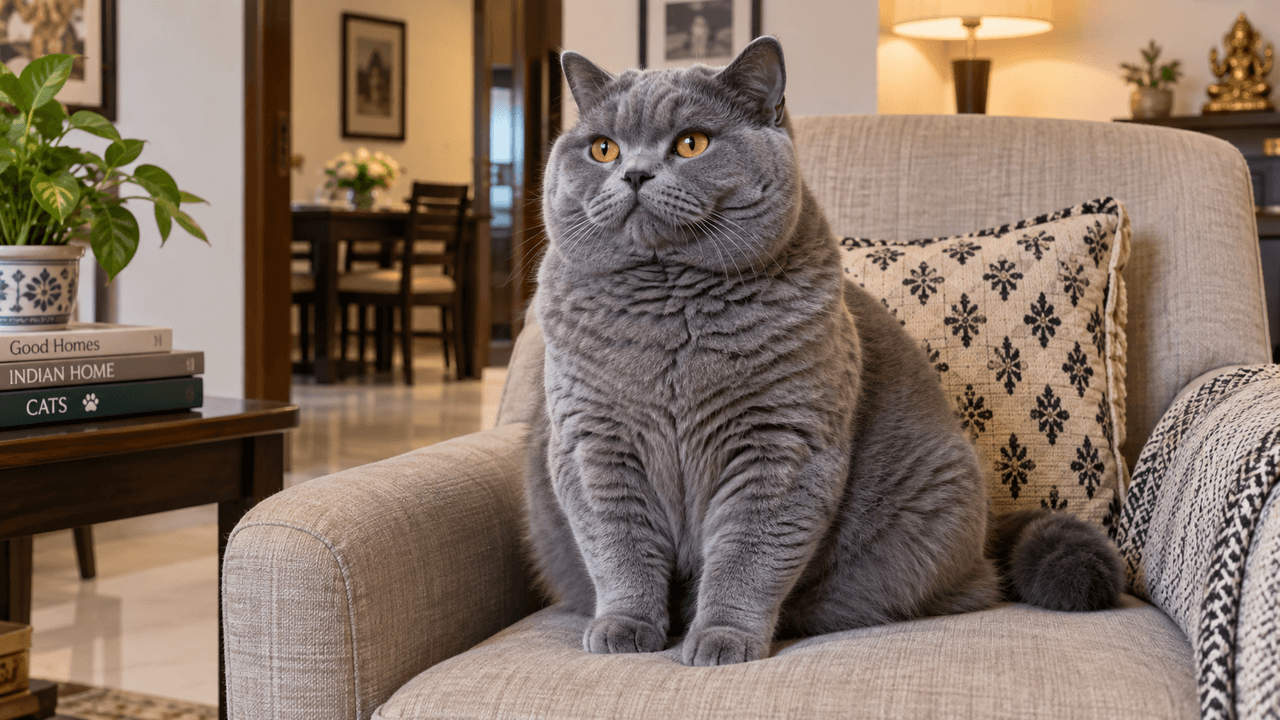
A British Shorthair kitten in India costs roughly ₹30,000–₹1,00,000+ in 2026: metros typically ₹45,000–₹90,000 and tier-2 cities ₹30,000–₹60,000 for pet-quality. Show-quality and rare-colour bloodlines cross ₹1,00,000+. Plan ₹2,200–₹5,500 monthly upkeep. The breed is a strong fit for Indian apartment life: calm, robust and grooming-light: with HCM cardiac screening as the key health investment.
Why this matters in India
The British Shorthair is a quiet success story in Indian cat ownership: a short-haired, dignified, calm cat that handles Indian climate well and demands very little day-to-day fuss. Breeder availability has grown across metros, prices are settling, and the cat-internet's love affair with the "blue" colour variety has driven steady search demand. This guide gives you the honest cost band, the climate verdict and the breeder-quality questions worth asking.
British Shorthair price in India by city
City | Pet-quality (₹) | Show-quality (₹) | Notes |
|---|---|---|---|
Mumbai | 50,000–90,000 | 90,000–1,50,000+ | Most reputable catteries |
Delhi NCR | 45,000–85,000 | 85,000–1,40,000 | Largest market |
Bengaluru | 45,000–80,000 | 80,000–1,30,000 | Strong cat community |
Hyderabad | 40,000–70,000 | 70,000–1,20,000 | Growing |
Pune | 38,000–65,000 | 65,000–1,15,000 | Metro-adjacent |
Chennai | 35,000–60,000 | 60,000–1,10,000 | Steady |
Kolkata | 32,000–55,000 | 55,000–95,000 | Lower mean |
Tier-2 | 30,000–50,000 | 50,000–90,000 | Limited reputable supply |
A "British Shorthair" advertised at ₹10,000–₹20,000 is rarely a registered British Shorthair. Authentic CFA/TICA/GCCF-papered British Shorthairs are scarce in India and accordingly expensive.
What affects the British Shorthair kitten price?
- CFA / TICA / GCCF registration: the biggest lever
- Bloodline / cattery reputation
- HCM-screened parents: cardiac ultrasound clearance
- Coat colour: British blue (grey-blue) is the most iconic and mid-priced; black, cream, white, lilac and rare colourpoint variants are more expensive
- Eye colour intensity: deep copper or gold preferred
- Body type: heavy cobby build is the breed standard
- Age: younger within the 12-week safe window
- Vaccination and health screening status
Are British Shorthairs good for Indian climate?
Excellent. The British Shorthair's plush short double coat, normal muzzle (not brachycephalic) and medium-large robust build give it strong climate tolerance:
- Not heat-vulnerable like Persians or Maine Coons
- No grooming-driven matting issues in monsoon
- Apartment-suited body type: calm, not hyperactive
- Standard cat-summer precautions only: AC during peak summer, no outdoor afternoons, fresh water
Of the popular pedigreed cat breeds in India, the British Shorthair is one of the most climate-comfortable.
British Shorthair temperament
A British Shorthair is famously:
- Calm, dignified, quiet: they observe more than they participate
- Reserved with strangers, devoted to family
- Independent but affectionate: they prefer to sit beside you rather than on you
- Low-energy compared with Bengals or Maine Coons
- Tolerant of children and other pets when socialised early
- Not lap cats by default: they like proximity, not contact
For first-time Indian cat owners who want a calm, undemanding adult-cat presence without the grooming burden, the British Shorthair is a strong fit.
How much does a British Shorthair cost monthly in India?
Cost head | Metro (₹) | Tier-2 city (₹) |
|---|---|---|
Monthly food (premium cat kibble + wet) | 2,000–3,800 | 1,500–2,800 |
Cat litter | 600–1,200 | 500–900 |
Grooming (low: weekly home brush) | At home | At home |
Annual vaccinations + booster | 1,800–3,500 | 1,200–2,800 |
Annual deworming + parasite prevention | 1,500–3,000 | 1,200–2,500 |
Cardiac (HCM) screening once / 1–2 years adult | 3,000–8,000 | 2,500–6,000 |
Optional pet insurance | 700–8,000/yr | 700–8,000/yr |
For food brand context see [Whiskas vs Me-O](/articles/whiskas-vs-me-o). For full kitten vaccinations see [kitten vaccination schedule India](/articles/kitten-vaccination-schedule-india).
Common British Shorthair health considerations
- Hypertrophic Cardiomyopathy (HCM): known predisposition; screen parents
- Polycystic Kidney Disease (PKD): less common than in Persians, still screened in some lines
- Hemophilia B: heritable bleeding disorder; DNA test available
- Dental disease: periodic vet checks
- Obesity: the breed's calm low-activity lifestyle in apartments makes weight gain common; portion control matters
- Urinary issues: wet-food inclusion helps
A British Shorthair from an HCM-screened bloodline with annual cardiac monitoring has a meaningfully better long-term outlook.
British Shorthair vs Persian vs Ragdoll
Trait | British Shorthair | Persian | Ragdoll |
|---|---|---|---|
Climate suitability India | Excellent | Demanding (brachycephalic + heavy coat) | Good |
Coat type | Short plush double | Long full | Medium semi-longhair |
Grooming need | Very low | Very high | Moderate |
Temperament | Calm, reserved | Quiet, dignified | Docile, dog-like |
First-time owner | Easy | Demanding | Excellent |
Brachycephalic concerns | No | Yes (punch-face especially) | No |
Average price India | ₹40,000–₹90,000 | ₹12,000–₹40,000 | ₹50,000–₹1,00,000 |
Adult size | Medium-large (cobby) | Medium | Large |
See [Persian cat price in India](/articles/persian-cat-price-in-india) and [Ragdoll cat price in India](/articles/ragdoll-cat-price-in-india) for detail.
How to buy a British Shorthair kitten safely
The five non-negotiables:
- CFA / TICA / GCCF registration papers
- HCM cardiac clearance of at least one parent within last 12 months
- Signed vaccination card with dates
- See the kitten with its mother
- 7-day vet-check return policy
Verify papers with the registry if you're spending six figures. A legitimate breeder will not hesitate.
What to do in a British Shorthair emergency
If your British Shorthair shows open-mouth breathing, laboured breathing, sudden lethargy, or collapse:
- Keep the cat calm and minimise handling: stress worsens cardiac symptoms
- Do not force food or water
- Move to a cool, quiet space
Take to a vet within 48 hours.
When to call the vet
Promptly for:
- Open-mouth breathing or laboured breathing: possible cardiac sign
- Lethargy beyond a day
- Vomiting or diarrhoea lasting over 24 hours
- Refusal to eat for more than 24 hours
- Difficulty urinating (urgent in males)
- Sudden weight loss or gain
- Bleeding from any opening
Annual vet check from age 1; six-monthly from age 7. Cardiac screen at year 1, then every 1–2 years thereafter.
FAQ
British Shorthair cat ka real price kya hota hai India mein?
CFA/TICA-registered British Shorthair metros mein ₹45,000–₹90,000 mein milta hai pet-quality ke liye. Show-quality ₹90,000–₹1,50,000+. Tier-2 cities mein ₹30,000–₹60,000. ₹10,000–₹20,000 mein "British Shorthair" bikta hua almost never asli hota hai: registration papers verify kar lijiye.
Is the British Shorthair good for Indian climate?
Yes: one of the most climate-comfortable pedigreed cat breeds for India. Short plush coat, normal muzzle, medium-large robust build means no brachycephalic concerns and no monsoon-grooming nightmares. Standard summer AC and indoor management; nothing breed-specific demanding.
How long do British Shorthairs live in India?
12–17 years on average. HCM-screened bloodlines, weight management, periodic cardiac monitoring and indoor living protect the upper end. The breed is generally robust: HCM is the leading premature-death cause, which parent screening helps reduce.
British Shorthair vs Persian: kaunsa lena chahiye?
British Shorthair zyada climate-friendly hai (short coat, no flat face, robust body). Persian zyada striking dikhata hai aur calmer hota hai indoor, lekin grooming aur brachycephalic care zyada demanding hai. British Shorthair pehli baar pet le rahe Indian cat parents ke liye easier choice hai.
Are British Shorthair cats good with children?
Yes: calm, tolerant and patient. They are not aggressive and rarely scratch unprovoked. Standard precautions still apply, toddlers must handle gently, never leave any cat alone with a young child, supervise rough play. Excellent family cat profile.
How much grooming does a British Shorthair need?
Very low: a weekly brush at home with a soft slicker is enough. Twice-weekly during the spring/autumn shedding seasons. No professional grooming required for most British Shorthairs. The plush coat looks dense but does not mat the way a Persian's does.
Sources
- iCatCare: feline welfare and breed health.
- WSAVA: vaccination guidelines.
- MSD Veterinary Manual: HCM, PKD, hemophilia references.
- CFA, TICA, GCCF: British Shorthair breed standards.
A note from Critzo (please read): This article is general educational information written and reviewed by qualified veterinary professionals for Indian pet parents. It is not a substitute for an in-person consultation with your own veterinarian, who knows your pet, their history, and their current clinical state. Pets are individuals — breed, age, weight, pre-existing conditions, medications, and local disease patterns all change what is safe and what is not. Do not start, stop, or change any medication, vaccination schedule, diet, or treatment based on what you read here without first speaking to a registered veterinary practitioner. If your pet is showing emergency signs — collapse, seizure, severe bleeding, suspected poisoning, breathing difficulty, bloated abdomen, repeated vomiting or no urination for more than 12 hours — stop reading and go to the nearest 24-hour veterinary hospital immediately. You follow any guidance from this article at your own risk and at your pet's risk. Critzo, its authors, and its reviewers accept no liability for outcomes arising from decisions made without veterinary supervision.