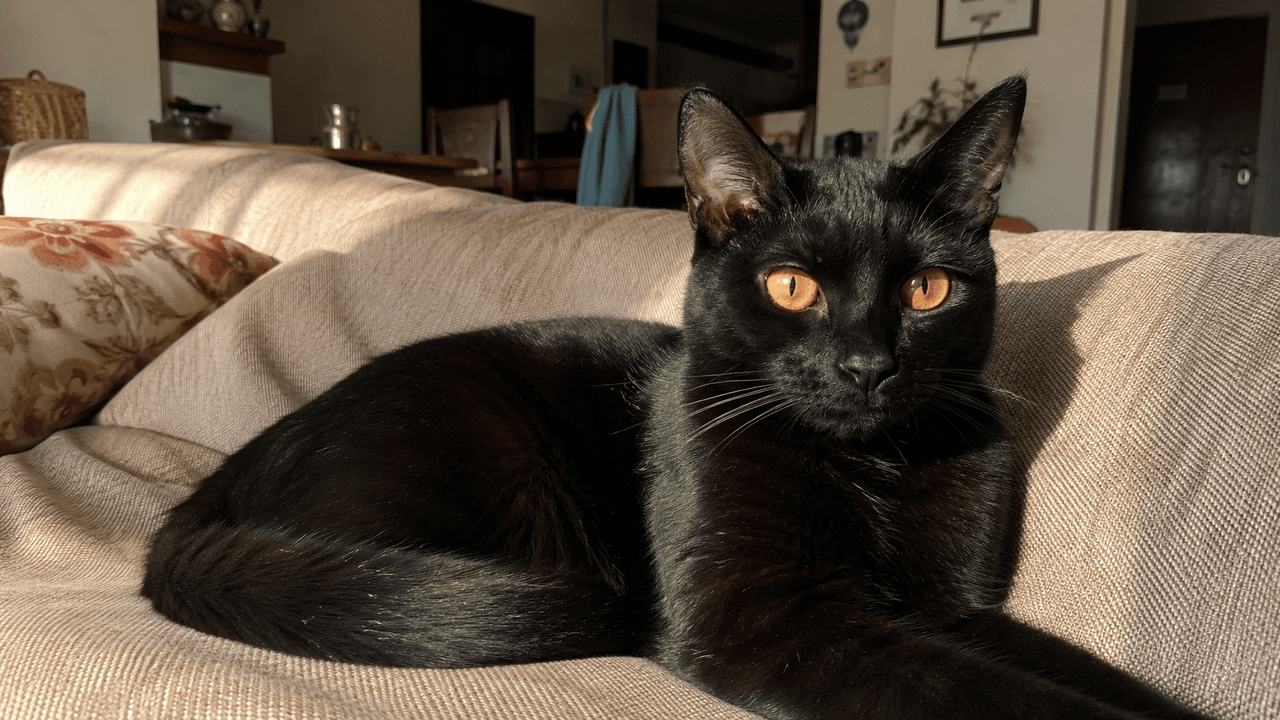
The international Bombay cat (a small, deeply black short-haired breed with copper eyes) costs roughly ₹15,000–₹60,000 in India in 2026. Most "Bombay cats" advertised in Indian classifieds are actually Indian short-haired black domestic cats, which are equally lovely and often free to adopt. Both make excellent low-maintenance Indian apartment cats.
Why this matters in India
The Bombay cat is one of the most charmingly confused breeds in the Indian market. The name is Indian (coined in the United States in the 1950s as a tribute to the leopards of "Bombay") but the breed is a deliberate cross of a Burmese and a black American Shorthair, not native to India. Meanwhile, India is full of beautiful short-haired black domestic cats that look very similar and are often the actual cat for sale when classifieds advertise "Bombay kittens". Both deserve homes. This guide untangles the breed, the price band and the adopt-vs-buy decision honestly.
What is a real Bombay cat?
The Bombay cat (officially recognised by CFA and TICA in the US) is a small to medium short-haired breed:
- Coat: short, deeply black, satin-shiny
- Eyes: copper to gold, never green
- Build: compact, muscular, medium-boned
- Weight: 2.5–5 kg adult
- Temperament: affectionate, sociable, dog-like, vocal in a low chirpy way
A genuine pedigreed Bombay cat in India would come from a registered cattery with CFA or TICA papers: extremely rare in India, and accordingly expensive. Most "Bombay" listings in Indian classifieds are non-pedigreed.
Bombay cat price in India by city
City | Pedigreed Bombay (₹) | Bombay-type domestic (₹) | Indian black domestic (₹) |
|---|---|---|---|
Mumbai | 30,000–60,000+ | 8,000–20,000 | 0–2,000 (adoption fee) |
Delhi NCR | 28,000–55,000 | 7,000–18,000 | 0–2,000 |
Bengaluru | 25,000–50,000 | 6,500–16,000 | 0–2,000 |
Hyderabad | 22,000–45,000 | 5,500–14,000 | 0–1,500 |
Pune / Chennai | 20,000–40,000 | 5,000–13,000 | 0–1,500 |
Kolkata | 18,000–35,000 | 5,000–12,000 | 0–1,500 |
Tier-2 cities | 15,000–30,000 | 4,000–10,000 | 0–1,000 |
The honest take: unless you have specifically verified CFA/TICA pedigree from a registered Indian cattery (a tiny number, well-known by name in the cat-show community), the kitten you are buying is most likely a black domestic short-hair that happens to look like a Bombay. That is not a bad thing. It is information.
Bombay cat vs Indian black domestic cat
This is the comparison most "Bombay cat" buyers in India actually need to make:
Trait | Pedigreed Bombay | Indian black domestic short-hair |
|---|---|---|
Coat | Specifically deeply black, satin shine | Often black, sometimes with white markings |
Eye colour | Copper to gold (breed standard) | Varies: gold, green, hazel |
Build | Standardised compact muscular | Varies: naturally diverse |
Temperament | Standardised dog-like, vocal | Wonderfully varied; mostly sociable |
Cost | ₹15,000–₹60,000+ | ₹0–₹2,000 |
Health predispositions | Some heritable cardiac (HCM) | Generally robust |
Lifespan | 12–16 years | 13–18 years |
If you fell in love with the Bombay look (sleek, black, copper-eyed, dog-like personality) there is a very good chance an Indian black domestic cat in your nearest shelter will give you 95% of the experience at 1% of the price. And often live longer.
What affects pedigreed Bombay cat price?
If you specifically want a registered Bombay:
- CFA / TICA registration: the biggest lever
- Bloodline: known international or established Indian cattery
- HCM-screened parents: a parent with cardiac ultrasound clearance within the last 12 months
- Age: younger within the 12-week safe window
- Coat depth of black: true uniform satin black is the breed standard
- Eye colour intensity: deep copper preferred over pale gold
How much does a Bombay-type cat cost monthly?
Cost head | Metro (₹) | Tier-2 city (₹) |
|---|---|---|
Monthly food (good cat kibble + wet) | 1,500–3,000 | 1,200–2,200 |
Cat litter | 600–1,200 | 500–900 |
Grooming (low: short coat) | At-home brushing | At-home brushing |
Annual vaccinations + booster | 1,800–3,500 | 1,200–2,800 |
Annual deworming + parasite prevention | 1,500–3,000 | 1,200–2,500 |
Optional pet insurance | 500–7,500/yr | 500–7,500/yr |
Bombay-type cats are some of the cheapest to keep among recognisable "breeds" because the short coat removes professional grooming costs almost entirely. For food choices see [Whiskas vs Me-O](/articles/whiskas-vs-me-o).
Bombay cat temperament
A Bombay (and most Bombay-type Indian black cats) tends to be:
- Affectionate and people-seeking: they will greet you at the door
- Dog-like in social investment: they follow you around
- Vocal but soft-voiced: chirpy rather than yowly
- Playful into adulthood
- Good with respectful children and other socialised pets
This is one of the easier cat profiles for a first-time cat owner. Unlike a [Persian](/articles/persian-cat-price-in-india), there is no grooming burden. Unlike a [Maine Coon](/articles/maine-coon-price-in-india), there is no size or budget shock.
Is a Bombay cat good for Indian climate?
Excellent. Short coat, normal muzzle (not flat-faced), medium body size: climatically about as well-suited as a domestic short-hair gets. Standard summer precautions apply (fresh water, cool resting spots, no balcony-AC-off afternoons) but the breed has no specific heat sensitivity beyond any other short-haired cat.
Common health considerations
- HCM (Hypertrophic Cardiomyopathy): known predisposition in the Bombay's Burmese ancestry; screen the parents if you are buying a pedigreed cat
- Dental disease: typical cat dental aging; periodic vet checks
- Obesity: Bombays love food; portion control matters
- Routine cat conditions: FIV/FeLV testing for any rescued cat is sensible
How to choose a Bombay-type kitten safely
If you are buying:
- Verify pedigree papers if claimed (CFA or TICA registration)
- See the kitten with its mother
- Ask for HCM clearance of at least one parent (pedigreed Bombays)
- Get a signed vaccination record
- Confirm a 7-day vet-check return policy
If you are adopting (recommended for most Indian buyers):
- Visit shelters and adoption events: black cats are statistically harder to rehome than other colours, often available
- Health-check the kitten at intake: eyes, ears, mouth, coat
- Take to a vet within 48 hours of bringing home
- Start vaccination schedule as advised
- Spay/neuter at the right age
When to call the vet
Promptly for:
- Open-mouth breathing or laboured breathing (possible HCM sign)
- Lethargy beyond a day
- Vomiting or diarrhoea over 24 hours
- Refusal to eat for more than 24 hours
- Difficulty urinating (urgent: possible urinary obstruction in males)
- Sudden weight loss
Annual vet check from age 1; six-monthly from age 7.
FAQ
Bombay cat ka real price kya hota hai India mein?
Asli pedigreed CFA/TICA-registered Bombay India mein ₹25,000–₹60,000+ ka padta hai aur bahut kam catteries breed karti hain. Zyadatar "Bombay" classifieds par milne wali black short-haired domestic cats hain (₹5,000–₹15,000 mein. Aur Indian black domestic cats shelters mein free mein milte hain) same look, same wonderful temperament, kabhi-kabhi zyada healthy.
Is the Bombay cat good for Indian climate?
Yes: it is one of the best-suited cat breeds for Indian climate. Short coat, normal muzzle, medium build, no specific heat sensitivity. Standard cat-summer precautions (water, cool resting, no afternoon outdoor heat) apply but no breed-specific climate management needed.
What is the temperament of a Bombay cat?
Affectionate, sociable, dog-like and vocal in a soft chirpy way. Bombays follow their humans around the house, greet you at the door and play well into adulthood. One of the easier cat profiles for first-time cat owners, with effectively no grooming burden.
Are Bombay cats the same as Indian black cats?
No. The Bombay is a recognised breed in the US (a Burmese x American Shorthair cross). Indian black domestic cats are non-pedigreed short-haired cats that happen to be black. Look-wise they can be almost identical. Genetically and registration-wise they are different. For most pet purposes, the difference matters less than the marketing implies.
How long do Bombay cats live?
Pedigreed Bombays typically 12–16 years; Indian domestic black cats commonly 13–18 years, with the longer mean of mixed-breed genetics. Annual vet checks, vaccination, parasite control, weight management and prompt response to breathing or urinary changes protect the lifespan in both.
Should I adopt or buy a Bombay-type cat?
For most Indian buyers, adoption is the kinder, cheaper and statistically healthier choice. Indian black domestic short-haired cats fill shelters and look indistinguishable from pedigreed Bombays. If you have your heart set on a registered CFA/TICA Bombay specifically for cat-showing or pedigree breeding, buy from a verified cattery.
Sources
- iCatCare: feline welfare and breed health guidance.
- WSAVA: vaccination guidelines.
- CFA and TICA: Bombay cat breed standards (international).
A note from Critzo (please read): This article is general educational information written and reviewed by qualified veterinary professionals for Indian pet parents. It is not a substitute for an in-person consultation with your own veterinarian, who knows your pet, their history, and their current clinical state. Pets are individuals — breed, age, weight, pre-existing conditions, medications, and local disease patterns all change what is safe and what is not. Do not start, stop, or change any medication, vaccination schedule, diet, or treatment based on what you read here without first speaking to a registered veterinary practitioner. If your pet is showing emergency signs — collapse, seizure, severe bleeding, suspected poisoning, breathing difficulty, bloated abdomen, repeated vomiting or no urination for more than 12 hours — stop reading and go to the nearest 24-hour veterinary hospital immediately. You follow any guidance from this article at your own risk and at your pet's risk. Critzo, its authors, and its reviewers accept no liability for outcomes arising from decisions made without veterinary supervision.