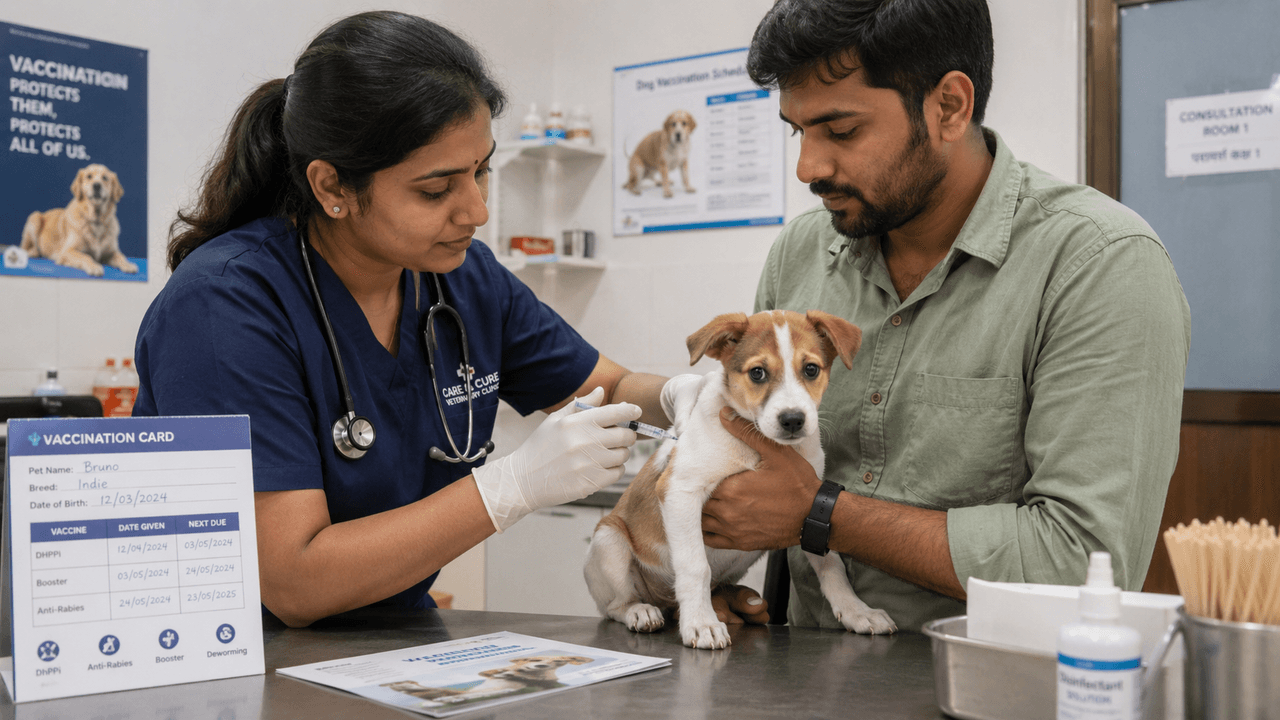
An Indian puppy's core vaccination schedule starts at 6–8 weeks with the first DHPPi (Distemper, Hepatitis, Parvovirus, Parainfluenza) shot, with boosters at 2–4 week intervals through 16 weeks, the addition of Leptospira (DHPPi+L) at 10–12 weeks, and Rabies at 14–16 weeks. Annual boosters of DHPPi+L and Rabies follow. Year-1 vaccination typically costs ₹2,500–₹6,000 in 2026; annual boosters ₹1,500–₹3,000.
Why this matters in India
Vaccination is the single most consequential health decision an Indian dog parent makes, and the one most often gotten partly wrong. India is rabies-endemic: we account for roughly a third of global rabies deaths, and parvo continues to kill thousands of unvaccinated puppies every year. The standard pet-shop advice ("teen vaccine de do") misses critical details, which pathogens are actually covered by each shot, when to add Leptospira (a real monsoon problem in India), how kennel cough fits in, and what to do if your puppy missed a dose. This guide is the WSAVA-aligned, Indian-practice schedule I follow in clinic, explained for first-time owners.
What are core vs non-core vaccines for puppies?
The World Small Animal Veterinary Association (WSAVA) and AAHA classify dog vaccines as:
- Core: recommended for every dog regardless of lifestyle. In India that means DHPPi+L (Distemper, Hepatitis, Parvovirus, Parainfluenza, Leptospira) and Rabies.
- Non-core / lifestyle: recommended based on exposure risk. In India relevant non-core vaccines include Kennel Cough (Bordetella bronchiseptica + Parainfluenza), and in some areas Canine Influenza.
Why "core" exists: the core diseases are either widespread, severe, fatal, or have public-health implications (rabies in particular). Skipping core vaccination is a category of decision distinct from skipping a non-core booster.
What diseases do these vaccines protect against?
Vaccine label | Pathogens covered |
|---|---|
DHPPi | Distemper, Hepatitis (Canine Adenovirus), Parvovirus, Parainfluenza |
DHPPi+L (often called "9-in-1") | DHPPi + Leptospira (multiple serovars) |
Rabies | Rabies virus |
Kennel Cough (KC) | Bordetella bronchiseptica + Parainfluenza |
Canine Influenza | Canine influenza virus (where available) |
The "7-in-1" vs "9-in-1" naming on vaccine packaging refers to how many strains are bundled: see our deep-dive [7 in 1 vs 9 in 1 vaccine for dogs](/articles/7-in-1-vs-9-in-1-vaccine) for the specifics. The important point is that 9-in-1 adds Leptospira coverage, which matters in monsoon-prone India.
The full puppy vaccination schedule (week by week)
This is the WSAVA-aligned schedule used by most Indian vets. Individual clinics may adjust by 1–2 weeks based on the puppy's history and local disease pressure.
Week of life | Vaccine |
|---|---|
6–8 weeks | DHPPi: first dose |
10–12 weeks | DHPPi+L: second dose (now including Leptospira) |
14–16 weeks | DHPPi+L (third dose + Rabies) first dose |
12 months | DHPPi+L booster + Rabies booster |
Annually thereafter | DHPPi+L + Rabies |
Optional based on lifestyle:
- Kennel Cough (Bordetella), particularly if the puppy will attend daycare, boarding, training class or have frequent dog-to-dog contact. Often given from 8 weeks; intranasal formulations can give rapid onset of immunity.
- Canine Influenza: where locally available and risk-relevant.
Why three doses, not one?
The reason puppies need a series of shots rather than one mega-vaccination is maternal antibody interference. Until about 6–12 weeks of age, antibodies the puppy received from its mother's milk are still circulating and can neutralise a vaccine before the puppy's own immune system responds. The exact age this interference ends varies by puppy, which is why we vaccinate repeatedly through the 16-week mark to make sure at least one of the doses successfully takes.
This is also why the 14–16 week dose is the most important one: by then maternal antibodies are reliably gone in essentially all puppies. A puppy that received only the 6-week and 9-week shots but missed the 16-week shot may not be properly immunised against parvo.
When is the puppy actually protected?
A common mistake is treating the first vaccine as "now my puppy is safe". They are not. Protective immunity typically develops:
- 7–14 days after a single dose in a non-interfered puppy
- The series is considered complete 1–2 weeks after the 14–16 week shot
This means a puppy is not safely able to socialise in public dog environments (parks, footpath walks where unvaccinated dogs roam, dog cafés) until roughly 16–18 weeks of age. Before then, controlled socialisation with calm vaccinated adult dogs you know is safe; public exposure is not.
Parvo is everywhere in India and survives in the environment for months. The single most preventable cause of parvo death is a partially-vaccinated puppy taken to public spaces too early.
Rabies vaccination: the non-negotiable
Rabies is endemic in India and fatal once symptomatic. The standard:
- First rabies vaccine: 14–16 weeks of age
- Booster at 12 months
- Annual rabies booster thereafter: in most Indian municipalities this is also a legal requirement for dog licensing
Some Indian municipal corporations and several pet boarding/daycare facilities require proof of rabies vaccination annually. Maintain a current vaccination card.
Puppy vaccination cost in India (2026)
Item | Metro (₹) | Tier-2 city (₹) |
|---|---|---|
DHPPi dose | 500–1,200 | 300–900 |
DHPPi+L dose | 600–1,500 | 400–1,100 |
Rabies dose | 200–600 | 150–450 |
Kennel Cough (optional) | 600–1,400 | 400–1,000 |
Vet consultation per visit | 400–1,200 | 250–800 |
First-year total (core schedule + visits) | 3,500–7,500 | 2,500–5,500 |
Annual booster (DHPPi+L + Rabies + visit) | 1,800–3,500 | 1,200–2,800 |
Costs vary by vaccine brand (Nobivac, Eurican, Canigen, Biocan, indigenous brands). Brand selection is the vet's call; what matters is that the vaccine is in-date, cold-chain-maintained and administered by a qualified vet.
What if my puppy missed a vaccination?
If a dose was missed by:
- Less than 2 weeks past schedule: your vet typically continues the original sequence
- 2–6 weeks past schedule: your vet may add an extra "catch-up" dose
- More than 6 weeks past schedule: your vet may restart parts of the series
The damage from missing one dose is usually recoverable. The damage from missing the 14–16 week dose is the most serious because that is the dose maternal-antibody interference is least likely to neutralise. Speak to your vet: do not improvise.
Deworming alongside vaccination
Deworming is not vaccination but is given alongside the same schedule. Standard:
- 2 weeks, 4 weeks, 6 weeks, 8 weeks
- Then monthly until 6 months of age
- Then every 3–6 months through adult life, more often in higher-risk environments
A typical Indian puppy is wormy at intake: fenbendazole and pyrantel-class dewormers are common; your vet picks.
Side effects after vaccination
Mild and expected:
- Soreness at injection site for 12–48 hours
- Mild lethargy, reduced appetite for 24 hours
- Mild fever (up to 39.5°C)
Call the vet if your puppy shows:
- Vomiting beyond a few hours
- Facial swelling or hives (anaphylactic reaction)
- Difficulty breathing
- Collapse or seizure
- Persistent fever above 40°C
- A hard mass at the injection site that does not resolve in 2–3 weeks
Severe vaccine reactions are rare but real. Keep your puppy at the clinic for 15–30 minutes after first vaccination if possible, particularly for small or known-allergy-prone dogs.
Vaccination for adopted and rescued puppies
If you have just rescued a puppy from the street, the schedule is different: the vet will estimate age and start from where the puppy is, often with a slightly accelerated protocol given higher exposure risk. See our [stray puppy care in India](/articles/stray-puppy-care-india) first-week protocol, which works alongside this vaccination guide.
When to see a vet about vaccination
- Book the first visit as soon as your puppy is 5–7 weeks old, or within 48 hours of bringing a rescued puppy home
- Same-day vet visit if your puppy shows watery or bloody diarrhoea, vomiting, or lethargy: parvo is an emergency
- Same-day vet visit for any suspected vaccine reaction
- Booster at 12 months: annual
- Annual booster: every year
FAQ
Kutte ki vaccination kab lagwana chahiye?
Pehla DHPPi vaccine 6–8 hafte ki umar mein lagta hai. Phir 10–12 hafte mein DHPPi+L (Leptospira ke saath), 14–16 hafte mein DHPPi+L ka teesra dose aur Rabies vaccine. 12 mahine mein booster. Phir har saal DHPPi+L aur Rabies dono. Bich mein vaccine miss hua toh apne vet se baat kijiye: schedule recover ho sakta hai.
How much does puppy vaccination cost in India?
The full first-year core schedule costs approximately ₹3,500–₹7,500 in metros and ₹2,500–₹5,500 in tier-2 cities including vet visits. Annual booster of DHPPi+L + Rabies plus visit ₹1,800–₹3,500 in metros and ₹1,200–₹2,800 in tier-2.
What is the difference between 7-in-1 and 9-in-1 vaccine?
The "9-in-1" vaccine adds Leptospira serovar coverage on top of the "7-in-1" DHPPi formulation. Leptospira matters in India because of monsoon-driven exposure. For most Indian puppies, 9-in-1 / DHPPi+L is the recommended core. See our [7-in-1 vs 9-in-1 vaccine](/articles/7-in-1-vs-9-in-1-vaccine) deep-dive.
When can my puppy go outside?
For controlled socialisation with calm vaccinated adult dogs you know (from as early as 8 weeks. For public dog environments where unvaccinated strays may pass through (public parks, footpath walks, dog cafés)) generally only after the 14–16 week vaccine has had 1–2 weeks to take effect, i.e. around 18 weeks of age.
Is rabies vaccination compulsory in India?
Yes: rabies is endemic in India and rabies vaccination is mandatory under public-health rules. Several Indian municipal corporations require it as a condition of dog licensing. Even where there is no municipal enforcement, public-health responsibility makes it non-negotiable.
Are vaccines safe for very small or sick puppies?
Vaccines are generally safe; risk of reaction is highest in very small toy-breed puppies and dogs with known allergies. Your vet may split combination vaccines, observe longer post-vaccination, or pre-medicate in high-risk cases. Vaccinating a clinically unwell puppy is generally postponed until they recover.
How long does immunity from a puppy vaccine last?
Properly completed core vaccinations (DHPPi+L through the 16-week dose) provide protective immunity that is then boosted annually. International guidelines suggest some core vaccines may protect for longer than a year, which is why titre testing exists. Annual boosting remains the standard in Indian practice and is recommended unless you and your vet specifically agree on a titre-based schedule.
Sources
- WSAVA: Vaccination Guidelines for the Owners and Breeders of Dogs and Cats (current edition).
- AAHA: Canine Vaccination Guidelines.
- MSD Veterinary Manual: canine vaccinology reference.
- Vaccine manufacturer datasheets (Nobivac, Eurican, Canigen, Biocan and indigenous Indian brands).
A note from Critzo (please read): This article is general educational information written and reviewed by qualified veterinary professionals for Indian pet parents. It is not a substitute for an in-person consultation with your own veterinarian, who knows your pet, their history, and their current clinical state. Pets are individuals — breed, age, weight, pre-existing conditions, medications, and local disease patterns all change what is safe and what is not. Do not start, stop, or change any medication, vaccination schedule, diet, or treatment based on what you read here without first speaking to a registered veterinary practitioner. If your pet is showing emergency signs — collapse, seizure, severe bleeding, suspected poisoning, breathing difficulty, bloated abdomen, repeated vomiting or no urination for more than 12 hours — stop reading and go to the nearest 24-hour veterinary hospital immediately. You follow any guidance from this article at your own risk and at your pet's risk. Critzo, its authors, and its reviewers accept no liability for outcomes arising from decisions made without veterinary supervision.