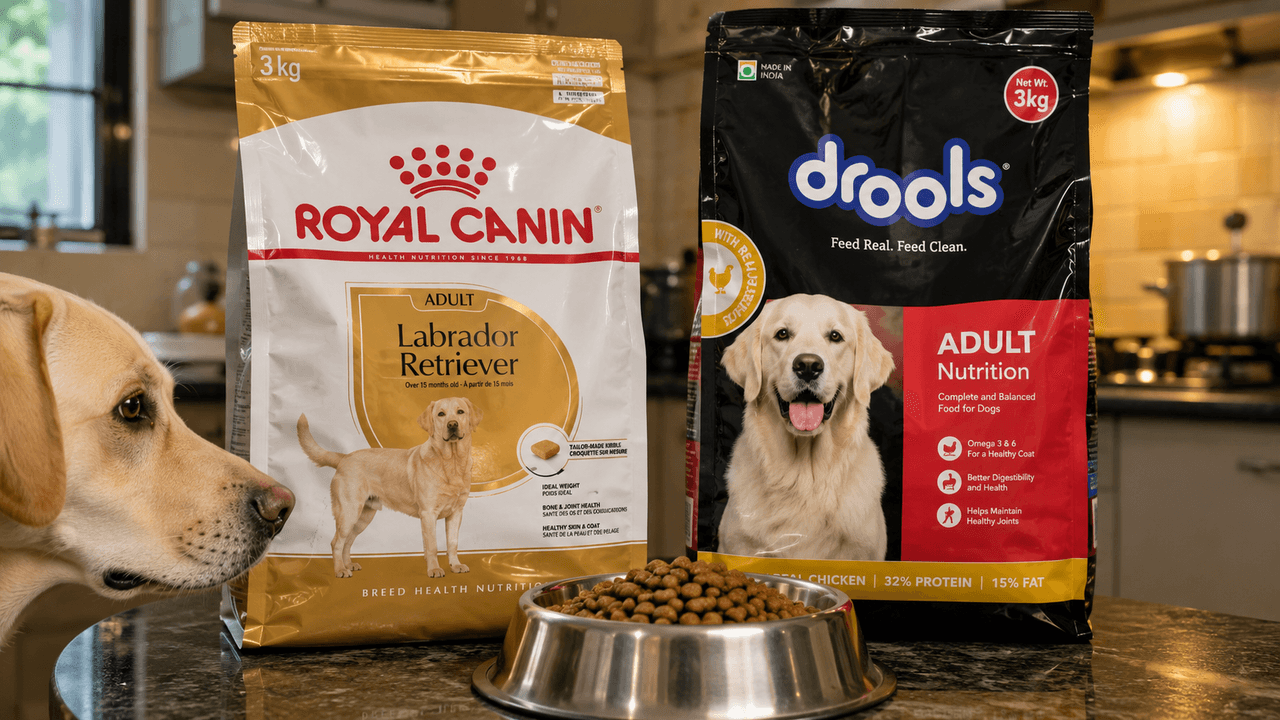
Royal Canin is a premium, breed-specific dog food from Mars Petcare, priced around ₹600–₹1,200 per kg in India. Drools is a Made-in-India mid-tier brand from IB Group, priced around ₹250–₹500 per kg. Royal Canin wins on formulation depth and consistency; Drools wins on price and availability. Both meet basic complete-and-balanced standards; the right pick genuinely depends on your dog and your budget.
Why this matters in India
"Which dog food is best?" is probably the single most-asked question in any Indian vet consult. Royal Canin and Drools are the two most-searched brands in the country, and the choice between them is genuinely consequential: over a Labrador's 10-year life, the gap is roughly ₹2.5–₹4 lakh out of pocket. The internet doesn't help much here, since most comparison content is affiliate-driven and quietly pushes whichever brand pays more. This is the version I actually give clients when they ask, "Doctor, Royal Canin lein ya Drools?", and it calls out exactly where each one earns its price.
Royal Canin vs Drools at a glance
Feature | Royal Canin | Drools |
|---|---|---|
Parent company | Mars Petcare (France / global) | IB Group (India, Vizag) |
Positioning | Premium, breed and life-stage specific | Mid-tier, broadly accessible |
Typical price per kg (India 2026) | ₹600–₹1,200 | ₹250–₹500 |
Breed-specific SKUs | Yes: Labrador, GSD, Pug, Mini, Maxi etc. | Limited, life-stage focused |
AAFCO / international standard claim | Yes (international formulations) | Compliant claims; less granular than Royal Canin |
Veterinary diet range (Hill's / Royal Canin-style) | Yes: kidney, urinary, dermatology etc. | No equivalent prescription range |
Availability in India | Pet stores, vet clinics, online | Pet stores, supermarkets, quick commerce, online |
Recall history (global) | Some, like all global brands | Rare in India |
Ingredients and nutrition compared
Ingredient labels alone are a weak proxy for nutritional quality: what actually matters is whether the food is formulated for a specific life stage (puppy, adult, senior, lactating, large-breed puppy), whether the protein source is named (chicken meal, lamb) rather than hidden behind "meat by-product," whether the brand publishes AAFCO statements or the equivalent, and whether it's been tested through feeding trials rather than just nutrient-profile calculations on paper.
Royal Canin scores higher on all four. Its formulations are breed- and life-stage-specific, protein sources are clearly named, AAFCO compliance is explicit, and many products go through feeding trials at Royal Canin's global R&D centres. The breed-specific kibble shape and size (a Labrador kibble versus a Pug kibble versus a Mini Adult kibble) isn't just marketing either; it genuinely affects chew rate, dental cleaning and bite suitability.
Drools meets complete-and-balanced standards for its life stages and costs significantly less. Ingredient transparency is decent, the chicken-and-egg lines are honest about protein sources, and India's recall history for the brand has stayed clean. The trade-off is fewer breed-specific options, less granular formulation, and no veterinary diet depth to speak of.
Royal Canin vs Drools for puppies
For a Labrador, Pug, German Shepherd or Beagle puppy, where breed-linked growth issues are real, whether that's joint development, brachycephalic constraints, or large-breed bone growth, Royal Canin's breed-specific puppy lines have a genuine edge. The Labrador Junior, Mini Puppy, Maxi Puppy and GSD Puppy formulas adjust calcium-phosphorus ratios, omega-3 content and kibble physics to the breed, and that actually matters for the first 6–18 months.
For an Indian Pariah puppy, a Pomeranian, or a generic mixed-breed puppy, Drools Focus Puppy or Drools Optimum Puppy is genuinely good food at a fraction of the cost. "Best puppy food in India" is a breed-dependent answer, not a brand-loyalty one.
Royal Canin vs Drools for adult dogs
This is where the price gap bites hardest. A 25 kg Labrador eats roughly 12–14 kg of kibble a month: on Royal Canin Labrador Adult at around ₹900/kg, that's ₹10,800–₹12,600 a month; on Drools Adult at around ₹350/kg, that's ₹4,200–₹4,900.
For most healthy adult dogs without breed-specific medical needs, a quality mid-tier kibble (Drools, Pedigree, Purepet, see our [Purepet review](/articles/purepet-review-india)) plus occasional fresh additions (eggs, curd, boiled chicken under vet guidance) is a perfectly defensible nutrition plan. Royal Canin earns its premium in dogs with known sensitivities (skin, gut, joint, urinary) where the prescription range can genuinely change clinical outcomes.
When Royal Canin is genuinely worth the premium
Three situations where the extra spend earns its keep: a breed with known issues (Labrador prone to obesity, German Shepherd prone to joint disease, Pug prone to dermatology and brachycephalic struggles, Dachshund prone to spinal issues); a life stage where formulation genuinely matters, like a large-breed puppy where the wrong calcium curve causes lifetime joint problems, or a senior with kidney or joint changes; and a specific veterinary diet need. Hill's Prescription Diet and Royal Canin Veterinary Diet are the two ranges Indian vets actually prescribe for renal, urinary, dermatology and weight management; Drools doesn't have a comparable prescription line yet.
When Drools is the smarter choice
For a healthy adult Indian Pariah or mixed-breed dog with no specific health issues, for a multi-dog household where the price gap multiplies fast (you can't reasonably feed three indies on Royal Canin), for tier-2 city access where Drools shows up on Blinkit and Zepto faster than Royal Canin's distribution can match, and for puppies without breed-specific medical needs, Drools is the sensible default.
What the price gap actually buys
Over a Labrador's 10-year adult lifespan, at roughly 12 kg a month, Royal Canin Labrador Adult runs to about ₹13 lakh in lifetime food cost against roughly ₹5 lakh for Drools Adult, a difference of about ₹8 lakh. For a healthy Labrador with no dermatology, joint or weight issues, that's a genuinely difficult cost-benefit case to make. For a Labrador with known orthopaedic issues or chronic skin problems, the cost difference is easier to justify against reduced vet bills down the line. The honest answer here is dog-specific, not brand-loyal.
Hybrid feeding: what most vets actually recommend
In Indian small-animal practice, the advice that keeps coming up in long, honest consultations is hybrid feeding for healthy dogs: 70–80% complete-and-balanced kibble (Drools, Purepet, Pedigree, or mid-tier Royal Canin) as the reliable base, and 20–30% fresh additions under vet guidance (eggs, curd, boiled chicken or fish, plain rice, dog-safe vegetables) for variety and palatability. This isn't BARF or a homemade-only diet, both of which carry real risk without a veterinary nutritionist's input. A balanced kibble base with considered fresh toppers is the realistic middle ground that respects Indian household food culture without abandoning nutrition science.
What to avoid in any dog food choice
Steer clear of brands with no AAFCO or equivalent statement, brands that won't name a protein source beyond "meat by-product," brands recalled internationally with no visible Indian response, and sudden food switches; always transition over 7–10 days. Skip free-feeding (leaving food out all day) in favour of portioned meals twice daily for adult dogs, and keep masala-heavy human food, milk, raw cooked bones, onion, garlic and chocolate well away from the bowl.
FAQ
Royal Canin ya Drools: kaunsa better hai mere dog ke liye? (रॉयल कैनिन या ड्रूल्स, कौन-सा बेहतर है?)
Healthy adult dog ke liye Drools kaafi acha aur sasta option hai. Lekin agar aapke dog ko breed-specific issues hain (Labrador ka weight, Pug ki saans, GSD ka joint), ya specific medical diet chahiye (kidney, urinary, skin), toh Royal Canin formulation depth ki wajah se zyada paisa-vasool hai. Apne vet se poochhiye.
Is Drools as good as Royal Canin?
For most healthy adult dogs, genuinely yes: it meets complete-and-balanced standards and has a clean Indian recall record. Royal Canin's edge shows up specifically in breed-specific lines and the veterinary prescription range. For a generic healthy dog, Drools is the smarter spend; for breed-linked issues or prescription needs, Royal Canin earns its premium.
What is the cheapest premium dog food in India?
Drools, Purepet and Pedigree all sit at the genuinely affordable end while still meeting complete-and-balanced standards. Among these, Drools tends to have the strongest formulation transparency. Royal Canin is effectively the floor of "premium" pricing; there's no cheap Royal Canin SKU.
Can I mix Royal Canin and Drools?
Yes, but transition between brands gradually over 7–10 days to avoid gut upset. Some owners feed one brand in the morning and another in the evening, and that works fine as long as both are complete-and-balanced and the daily total stays within the dog's calorie need. Avoid it if your dog has known food sensitivities.
Is Royal Canin worth it for an Indian Pariah dog?
Usually not. Indies are remarkably robust eaters and rarely have the breed-specific issues Royal Canin formulates around. A mid-tier complete-and-balanced kibble plus fresh additions is the sensible default for a healthy [Indian Pariah dog](/articles/indian-pariah-dog). If your indie develops specific health issues later, that's the point to reconsider a prescription diet.
How long does a Royal Canin or Drools bag last?
For a 20 kg adult dog, a 10 kg bag of either typically lasts about a month at recommended feeding rates. A 4 kg Pomeranian on a small-breed formulation will stretch a 4 kg bag to 3–4 months. Always store kibble sealed and dry, since Indian humidity is unforgiving on an opened bag.
Sources
AAFCO (Association of American Feed Control Officials) pet food nutrient profiles and feeding-trial standards; WSAVA Global Nutritional Guidelines; Royal Canin India official product pages; IB Group / Drools official product pages and ingredient panels.
A note from Critzo (please read): This article is general educational information written and reviewed by qualified veterinary professionals for Indian pet parents. It is not a substitute for an in-person consultation with your own veterinarian, who knows your pet, their history, and their current clinical state. Pets are individuals — breed, age, weight, pre-existing conditions, medications, and local disease patterns all change what is safe and what is not. Do not start, stop, or change any medication, vaccination schedule, diet, or treatment based on what you read here without first speaking to a registered veterinary practitioner. If your pet is showing emergency signs — collapse, seizure, severe bleeding, suspected poisoning, breathing difficulty, bloated abdomen, repeated vomiting or no urination for more than 12 hours — stop reading and go to the nearest 24-hour veterinary hospital immediately. You follow any guidance from this article at your own risk and at your pet's risk. Critzo, its authors, and its reviewers accept no liability for outcomes arising from decisions made without veterinary supervision.