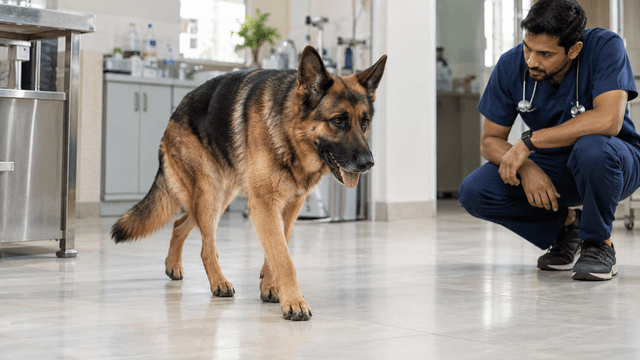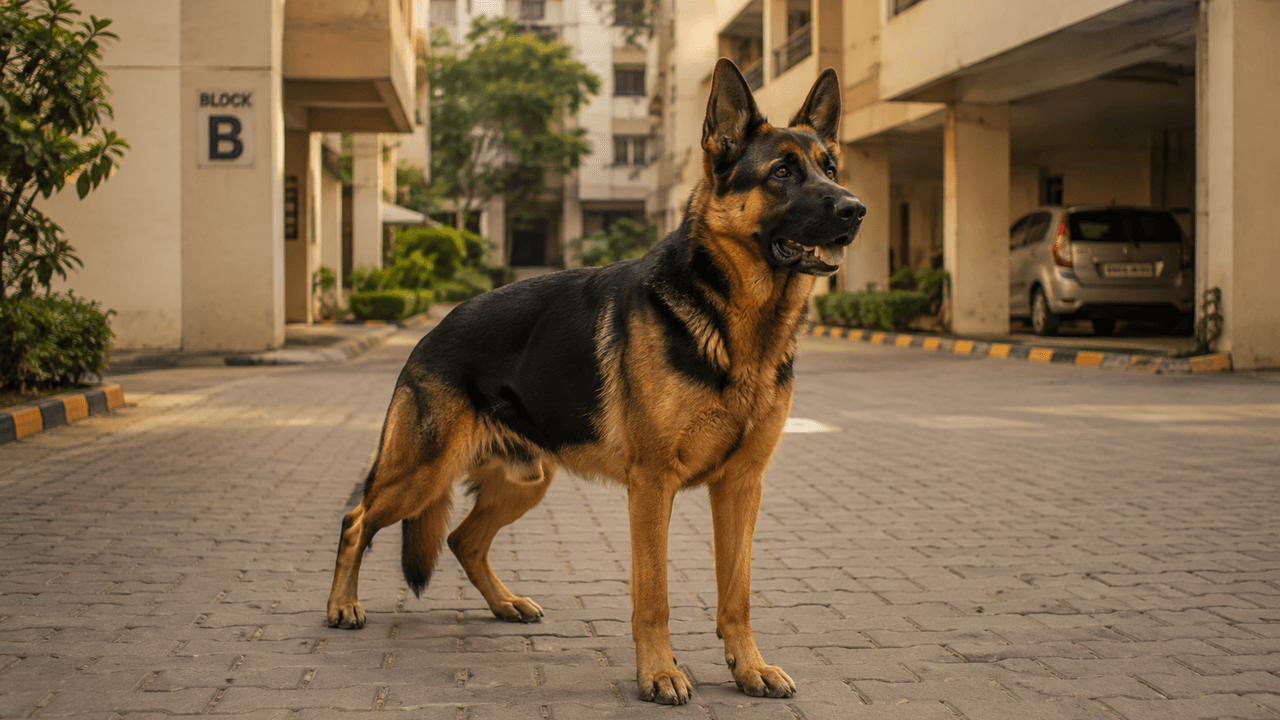
A German Shepherd puppy in India costs roughly ₹15,000–₹60,000 in 2026: metros typically ₹25,000–₹60,000 and tier-2 cities ₹15,000–₹35,000 for pet-quality. KCI-papered show-line and import working-line bloodlines cross ₹70,000–₹1,50,000+. Plan ₹4,500–₹9,000 monthly upkeep with hip-screening and joint care as critical lifetime investments.
Why this matters in India
The German Shepherd has been India's serious dog for fifty years: RAW, Army, Police, security details, family-protection dogs. The breed sits at the intersection of high search demand and significant misinformation. The single biggest issue first-time GSD owners face in India is over-angulated show-line dogs from inexperienced breeders, sold cheap, and developing serious hip and elbow disease by year three. The honest cost and care of a German Shepherd in India is genuinely different from what most online price guides suggest. This guide walks through the real numbers, the bloodline differences and what you should budget over the dog's 8–10 year lifespan.
German Shepherd price in India by city
City | Pet-quality (₹) | Show / Working line (₹) | Notes |
|---|---|---|---|
Mumbai | 25,000–55,000 | 60,000–1,50,000+ | Premium catteries and imports |
Delhi NCR | 22,000–50,000 | 55,000–1,40,000 | Largest market, due diligence essential |
Bengaluru | 22,000–48,000 | 55,000–1,30,000 | Strong show-line presence |
Hyderabad | 20,000–42,000 | 50,000–1,20,000 | Steady demand |
Pune | 20,000–42,000 | 50,000–1,15,000 | Metro-adjacent pricing |
Chennai | 18,000–38,000 | 45,000–1,10,000 | Steady |
Kolkata | 16,000–35,000 | 40,000–95,000 | Lower mean |
Jaipur / Lucknow / Ahmedabad | 14,000–30,000 | 35,000–80,000 | Tier-2 baseline |
A GSD advertised at ₹5,000–₹10,000 is almost always either a Lab-GSD cross, a backyard-bred non-vaccinated dog, or a sale being made before health problems become obvious. The breed is famously expensive to keep well; saving on the puppy is rarely the right economy.
Show line vs working line German Shepherd
This is the single most important pre-purchase decision and the one most often skipped:
Show line (German / American show line): the dog you most likely picture when you hear "German Shepherd". Heavily angulated rear, sloping back, dramatic gait. Bred primarily for the show ring. Pros: striking looks, often calmer temperament for pet life. Cons: substantially higher orthopaedic problem rates if poorly bred; the over-angulated rear is the cause of much of the breed's hip-elbow burden in India.
Working line (DDR, West German working, Czech working): more balanced, more athletic, less angulated. Bred for police, military, schutzhund. Pros: typically better hips and elbows, longer-lasting joints, more drive. Cons: high exercise and engagement needs; not all working lines suit family pet life; serious training commitment.
Indian "GSD": a wide middle band of mixed lineage of variable quality. This is most of what you will see in the Indian SERP. Quality varies enormously.
For most Indian families, a moderately built, hip-screened show-or-working-cross GSD from a known breeder is the realistic choice: neither extreme show angulation nor extreme working drive.
What affects the GSD puppy price?
- KCI registration and parents' pedigree: the biggest lever
- Hip and elbow scores of the parents: OFA, BVA or KCI hip scores; ED (elbow dysplasia) clearances
- Bloodline (show vs working vs balanced): import-line dogs command 2–3x premium
- Coat type: long coat (stock coat) and standard double coat sit at different price points; long-coat purists pay more
- Coat colour: saddle black-and-tan is mid; solid black, sable, white GSDs higher in some markets
- Sex: males slightly higher in many catteries
- Age: younger within the 8-week minimum
- Vaccination status: properly vaccinated puppies higher and worth it
- Breeder reputation and early socialisation programme
Are German Shepherds good for Indian climate?
Honest answer: they tolerate, they do not love. The GSD's double coat was bred for Central European winters, not Pune summers. With management:
- Indoor AC during peak summer (April–June)
- Walks only in cool hours
- Hydration support
- Daily brushing in shedding season
- Avoid intense exercise during the hottest hours
Long-coat GSDs handle Indian heat slightly worse than standard double-coat dogs. Coastal humidity (Chennai, Mumbai) adds ear infection risk because of the breed's relatively narrow ear canals. Tier-2 dry-heat cities are more workable than coastal humid metros for GSDs.
How much does a German Shepherd cost monthly in India?
Cost head | Metro (₹) | Tier-2 city (₹) |
|---|---|---|
Monthly food (large-breed kibble + fresh additions) | 4,500–8,000 | 3,200–6,000 |
Year-1 vaccinations / annual booster | 4,500–8,000 / 1,500–3,000 | 3,000–6,000 / 1,000–2,500 |
Annual deworming + tick-flea preventives | 4,000–7,000 | 2,800–5,000 |
Hip / elbow X-ray screen (12–18 months, repeat as advised) | 4,000–9,000 | 2,800–6,500 |
Group training classes (recommended) | 22,000–55,000 (course) | 15,000–35,000 (course) |
Periodic grooming during shedding | 800–2,500/visit | 500–1,800/visit |
Optional pet insurance | 1,000–8,000/yr | 1,000–8,000/yr |
For food brand context see [Royal Canin vs Drools](/articles/royal-canin-vs-drools). For training see [how to train a Labrador puppy](/articles/how-to-train-a-labrador-puppy): many of the principles apply to GSDs, with the caveat that working-drive GSDs need more structured engagement.
Common German Shepherd health issues in India
- Hip and elbow dysplasia: the breed's signature orthopaedic concern; buy from screened parents
- Degenerative myelopathy (DM): late-onset spinal cord disease; genetic test available in parent dogs
- Exocrine Pancreatic Insufficiency (EPI): genetic predisposition; managed with enzyme replacement
- GI sensitivity and chronic diarrhoea: common in some lines; food trials may help
- GDV (bloat): large deep-chested breed; feed two smaller meals, no heavy exercise around meals
- Skin allergies, particularly in some show-line dogs
- Ear infections: monsoon-driven, manage with weekly checks
A correctly bred, hip-screened GSD with a good diet, controlled exercise progression as a puppy, and lean body condition has a meaningfully better musculoskeletal future than a poorly bred one. The buying decision matters more in GSDs than in almost any other breed.
German Shepherd temperament
A correctly bred, well-socialised GSD is:
- Highly intelligent and trainable: top-3 trainability of any breed
- Bonded to one or two family members strongly; aloof with strangers
- Watchful and protective without random aggression when properly socialised
- High exercise need until 7–8 years
- Vocal in alert mode: they tell you when something changes
- Demanding in a way Labradors are not: they need engagement, not just exercise
GSDs are not first-puppy dogs for owners with no time or no training experience. They are wonderful family dogs for owners who commit to socialisation, structure and 60+ minutes of real daily exercise.
German Shepherd vs Labrador vs Rottweiler
Trait | German Shepherd | Labrador | Rottweiler |
|---|---|---|---|
Trainability | Top-tier, intense | Top-tier, eager | High, calm |
Climate tolerance India | Moderate | Moderate | Heat-sensitive (black coat) |
Coat shedding | Heavy | Moderate | Moderate |
Apartment suitability | Yes with exercise | Yes with exercise | Yes with exercise |
Lifespan India | 8–10 years | 9–11 years | 8–11 years |
First-year health screen cost | Higher (hip/elbow/DM) | Moderate | Higher (hip/elbow) |
RWA optics 2026 | Moderate scrutiny | Lowest | Higher scrutiny |
All three are committed-owner dogs. Each has a niche. The GSD is the right choice for owners who want a thinking, watchful working-style dog and are willing to invest in training.
When to call the vet
Promptly for any GSD with:
- Lameness lasting more than 24 hours, especially in back legs
- Sudden bloating with retching: emergency, possible GDV, go now
- Chronic soft stool or diarrhoea (possible EPI)
- Difficulty rising from rest, particularly in dogs over 4
- Pelvic limb weakness or knuckling (possible DM)
- Persistent ear smell or head shaking
- Skin lesions or recurring hot spots
Adult GSDs should have an annual vet check from age 2; six-monthly from age 6. See [senior dog care in India](/articles/senior-dog-care-india).
FAQ
German Shepherd ka real price kya hota hai India mein?
Vaccinated pedigree-papered GSD metros mein ₹25,000–₹55,000 mein milta hai. Tier-2 cities mein ₹15,000–₹35,000. Import-line ya KCI-champion bloodlines ₹70,000 se ₹1,50,000+ ke beech mein. ₹5,000–₹10,000 mein bikta hua "GSD" generally Lab-GSD cross ya backyard-bred hota hai: hip-elbow problems lifetime mein zyada mehnge padte hain.
Is the German Shepherd good for hot Indian cities?
With management, yes: AC indoors during peak summer, walks only in cool hours, daily brushing in shedding season. Long-coat GSDs handle Indian heat slightly worse than standard. Coastal humidity adds ear-infection burden. Tier-2 dry-heat cities are more workable than humid metros.
What is the difference between show line and working line GSD?
Show-line GSDs (especially German show line) are heavily angulated, sloping-back, bred for the show ring; often calmer but with higher orthopaedic burden if poorly bred. Working-line GSDs are more balanced, more athletic, with typically better hips and elbows but higher exercise needs. Balanced moderate dogs suit most Indian families best.
How long do German Shepherds live in India?
8–10 years on average. Hip-screened parents, lean weight, joint protection, prompt response to lameness and avoiding heat stress extend the upper end. Poorly bred over-angulated show-line GSDs often see joint disease by year 4–5, which shortens active lifespan even if total lifespan is similar.
How much exercise does a GSD need?
A minimum of 60–90 minutes of structured daily exercise plus 20–30 minutes of mental work (training, scent games, puzzle feeders): preferably split into two sessions. Working-line GSDs need substantially more. Under-exercised GSDs become destructive, vocal and difficult.
Is a German Shepherd safe with children?
A well-bred, well-socialised GSD is famously gentle with the family's children and watchful around strangers. Early socialisation, structured training, never leaving any dog alone with young children: non-negotiables. Children must respect the dog's food, sleep and space. The breed is not the issue; under-socialisation is.
Sources
- Kennel Club of India (KCI): German Shepherd breed standard.
- WSAVA: nutrition and vaccination guidelines.
- MSD Veterinary Manual: hip/elbow dysplasia, DM, EPI, GDV references.
A note from Critzo (please read): This article is general educational information written and reviewed by qualified veterinary professionals for Indian pet parents. It is not a substitute for an in-person consultation with your own veterinarian, who knows your pet, their history, and their current clinical state. Pets are individuals — breed, age, weight, pre-existing conditions, medications, and local disease patterns all change what is safe and what is not. Do not start, stop, or change any medication, vaccination schedule, diet, or treatment based on what you read here without first speaking to a registered veterinary practitioner. If your pet is showing emergency signs — collapse, seizure, severe bleeding, suspected poisoning, breathing difficulty, bloated abdomen, repeated vomiting or no urination for more than 12 hours — stop reading and go to the nearest 24-hour veterinary hospital immediately. You follow any guidance from this article at your own risk and at your pet's risk. Critzo, its authors, and its reviewers accept no liability for outcomes arising from decisions made without veterinary supervision.