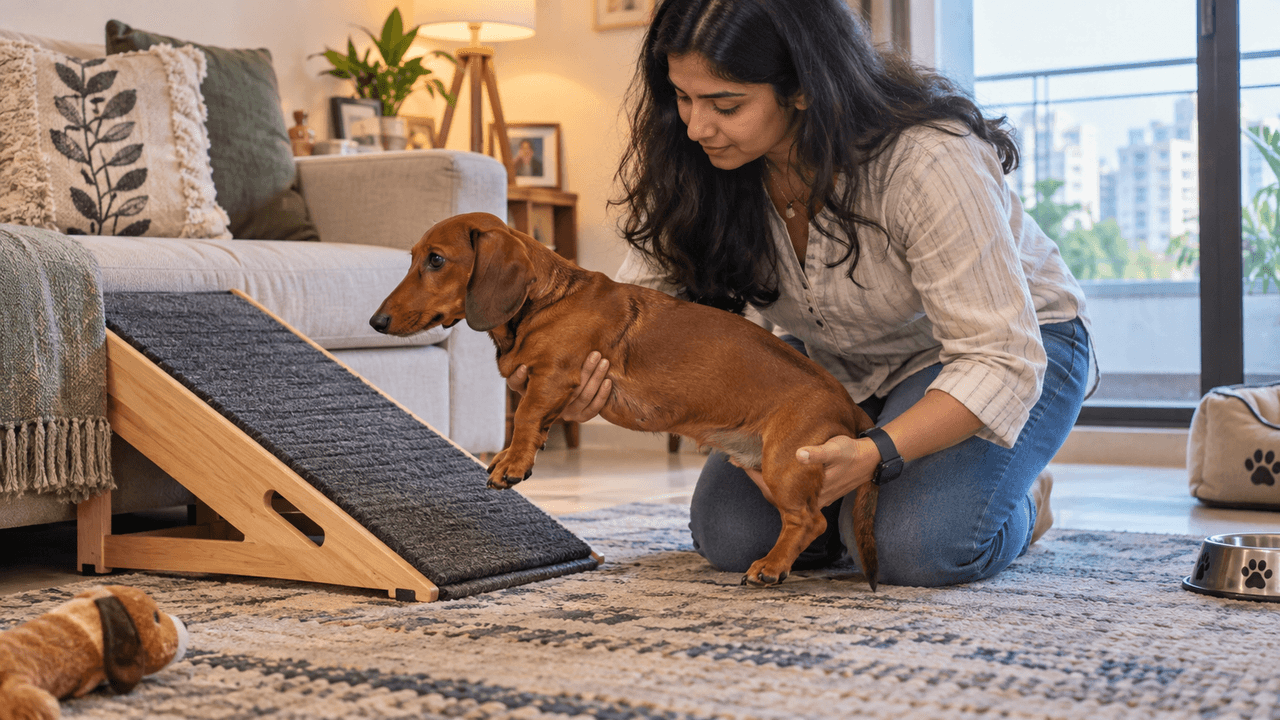
A Dachshund puppy in India costs roughly ₹10,000–₹35,000 in 2026: metros typically ₹18,000–₹32,000 and tier-2 cities ₹10,000–₹22,000 for pet-quality. KCI-papered show bloodlines cross ₹40,000–₹65,000. Plan ₹2,500–₹5,000 monthly upkeep. The defining health reality is intervertebral disc disease (IVDD): no jumping off furniture, weight control and ramps are non-negotiable.
Why this matters in India
The Dachshund is a striking, characterful and underbought breed in India given its apartment suitability. The Indian SERP shows 4–7k monthly searches and most existing content skips the breed's single biggest medical issue: disc disease driven by the long-spine short-leg anatomy. This guide gives you the honest cost band and the spine-protection protocol that genuinely extends a Dachshund's healthy life.
Dachshund price in India by city
City | Pet-quality (₹) | Show-quality (₹) | Notes |
|---|---|---|---|
Mumbai | 22,000–32,000 | 35,000–60,000 | Most reputable breeders |
Delhi NCR | 20,000–30,000 | 32,000–58,000 | Largest market |
Bengaluru | 18,000–28,000 | 30,000–55,000 | Mid-band |
Hyderabad | 16,000–25,000 | 28,000–50,000 | Growing |
Pune | 16,000–25,000 | 28,000–50,000 | Metro-adjacent |
Chennai | 14,000–22,000 | 25,000–45,000 | Steady |
Kolkata | 13,000–20,000 | 22,000–40,000 | Lower mean |
Tier-2 | 10,000–18,000 | 18,000–35,000 | Verify parentage |
A Dachshund under ₹6,000 in any Indian city is almost always either a Beagle-Dachshund mix, an undersized "tweenie" sold as miniature, or a backyard-bred non-vaccinated dog.
What affects the Dachshund puppy price?
- KCI registration and pedigree: the biggest lever
- Size variety (Standard (9–15 kg), Miniature (5–6 kg), Kaninchen / "tweenie") pricing varies; mini commands a premium
- Coat type (smooth, long-haired, wire-haired) long-haired typically commands a slight premium
- Coat colour and pattern: red, black & tan, chocolate & tan, dapple, piebald; rare patterns more expensive
- Age: younger within the 8-week minimum
- Vaccination status
- Breeder reputation and parental spinal/eye screens
The spinal reality: IVDD
Intervertebral disc disease (IVDD) is the defining medical concern in the breed. The mechanism: Dachshunds have a chondrodystrophic skeleton (short legs from cartilage abnormality) that also affects their spinal discs. The discs degenerate earlier than in normal-bodied dogs and can herniate, putting pressure on the spinal cord. Result: back pain, weakness, sometimes paralysis.
Approximately 1 in 4 Dachshunds experiences IVDD at some point in life. The triggers are not always activity-based (discs can rupture spontaneously) but high-risk activities significantly increase the chance:
- Jumping off sofas, beds, balconies
- Stair climbing
- Carrying the dog incorrectly (long axis unsupported)
- Twisting / spinning play
- Overweight body condition
Surgery for IVDD in India costs ₹50,000–₹2,00,000+ depending on severity and city. Insurance enrolment before any IVDD episode is genuinely useful: see [HDFC ERGO Paws n Claws](/articles/hdfc-ergo-paws-n-claws-review).
Spine-protection protocol: what genuinely helps
- No jumping on or off furniture: provide pet steps or a ramp
- No stairs: carry up and down, or block with gates
- Carry with both hands: one supporting chest, one supporting back end; never lift by the front legs alone
- Keep lean: every kilo over ideal weight is significant on a Dachshund's spine
- Use a harness, not a collar with leash pressure: protects the neck spine
- Avoid rough play with larger dogs that may roll or twist them
- Indoor non-slip floors: rugs over tile prevent slips
These rules are not paranoia. They are the difference between a Dachshund with a normal lifespan and one with a young paralysis event.
Are Dachshunds good for Indian apartments?
Yes, in many ways excellent. The breed's small size, low exercise need (45–60 minutes daily, walking-pace), watchful temperament and adaptability to indoor life suit Indian apartments well. The constraints: RWA-relevant vocalisation (Dachshunds are alert barkers), the spine protocol that means furniture jumping must be managed, and a need for owner availability since the breed bonds intensely.
Dachshund temperament
A correctly socialised Dachshund is:
- Bold, alert, watchful: they are big personalities in small bodies
- Devoted to one or two family members
- Vocal alert barker: they tell you about everything
- Stubbornly independent: they were bred to hunt underground; they think for themselves
- Affectionate with family, wary of strangers
- Active despite size: they enjoy walks and sniff games
Not the easiest breed to obedience-train in the Labrador sense, but rewarding for owners who like a thinking small dog.
How much does a Dachshund cost monthly in India?
Cost head | Metro (₹) | Tier-2 city (₹) |
|---|---|---|
Monthly food (small-breed kibble) | 1,200–2,500 | 900–1,800 |
Year-1 vaccinations / annual booster | 3,500–6,000 / 1,500–3,000 | 2,500–4,500 / 1,000–2,500 |
Annual deworming + tick-flea preventives | 2,500–4,500 | 1,800–3,500 |
Grooming (smooth coat low; long-haired/wire higher) | 500–1,500/visit | 400–1,200/visit |
Dental cleaning (every 2–3 years) | 6,000–15,000 | 4,000–10,000 |
Ramps, harness, gates, pet steps | 3,000–8,000 (one-time) | 2,000–5,500 |
Optional pet insurance | 500–7,500/yr | 500–7,500/yr |
Common Dachshund health issues in India
- IVDD: the defining breed concern
- Patellar luxation: kneecap slipping; watch for skipping gait
- Dental disease: small jaw, crowded teeth
- Obesity: small breed but big appetite
- Eye conditions: PRA, cataracts
- Lafora epilepsy: heritable, particularly in wire-haired lines
When to call the vet: Dachshund-specific decision rules
Emergency (go now):
- Sudden back pain, yelping when picked up or touched along the back
- Reluctance or refusal to walk
- Dragging of back legs, knuckling, weakness
- Loss of bladder or bowel control
- Sudden inability to stand
These are signs of IVDD and the speed of veterinary intervention directly affects recovery odds. A Dachshund with sudden back-end weakness should be seen at a 24-hour vet hospital within 4 hours.
Same-day vet visit:
- New limp or skipping gait
- Persistent eye discharge or redness
- Refusal to eat for over 12–24 hours
- Coughing or breathing change
Adult Dachshunds benefit from annual vet checks; six-monthly from age 7. See [senior dog care in India](/articles/senior-dog-care-india).
FAQ
Dachshund ka real price kya hota hai India mein?
Vaccinated pedigreed pet-quality Dachshund metros mein ₹18,000–₹30,000 mein milta hai. Tier-2 cities mein ₹10,000–₹18,000. Miniature Dachshund slightly zyada padta hai. ₹6,000 ke neeche wala "Dachshund" generally Beagle ya undersized mix hota hai: parents verify kar lijiye.
Is the Dachshund good for Indian apartments?
Yes: small size, low-to-moderate exercise need, adaptable to indoor life. The catches are vocal alert barking (RWA-relevant) and the strict no-jumping protocol for spine protection. With those managed, a Dachshund is one of the more suitable small breeds for Indian apartment life.
How long do Dachshunds live in India?
12–16 years on average. Spine protection (no jumping, harness, lean weight) and dental care are the biggest controllable longevity levers. A Dachshund with multiple IVDD episodes typically has shorter healthy life even if total years are similar.
What is IVDD in Dachshunds?
Intervertebral Disc Disease: early disc degeneration in the breed's long spine, causing back pain, weakness or paralysis. Roughly 1 in 4 Dachshunds experiences it. Triggers include jumping, stairs, overweight body condition. Surgery is effective in many cases; cost is significant.
Should I get a smooth, long-haired or wire-haired Dachshund?
Coat is largely a personal choice. Smooth-coats are easiest to groom. Long-haired Dachshunds shed less than Pomeranians but need daily brushing. Wire-haired Dachshunds have higher Lafora epilepsy predisposition in some lines: screen the parents. Temperament varies more by individual than by coat.
Are Dachshunds good with children?
With older calm children, yes. With toddlers, exercise caution: children must not pick up the dog incorrectly (spine risk) and must not provoke biting. Dachshunds will defend themselves. Socialise heavily from 8–14 weeks; never leave young children unsupervised with any small dog.
Sources
- Kennel Club of India (KCI): Dachshund breed standard.
- WSAVA: vaccination and nutrition guidelines.
- MSD Veterinary Manual: IVDD, patellar luxation, Lafora epilepsy references.
A note from Critzo (please read): This article is general educational information written and reviewed by qualified veterinary professionals for Indian pet parents. It is not a substitute for an in-person consultation with your own veterinarian, who knows your pet, their history, and their current clinical state. Pets are individuals — breed, age, weight, pre-existing conditions, medications, and local disease patterns all change what is safe and what is not. Do not start, stop, or change any medication, vaccination schedule, diet, or treatment based on what you read here without first speaking to a registered veterinary practitioner. If your pet is showing emergency signs — collapse, seizure, severe bleeding, suspected poisoning, breathing difficulty, bloated abdomen, repeated vomiting or no urination for more than 12 hours — stop reading and go to the nearest 24-hour veterinary hospital immediately. You follow any guidance from this article at your own risk and at your pet's risk. Critzo, its authors, and its reviewers accept no liability for outcomes arising from decisions made without veterinary supervision.