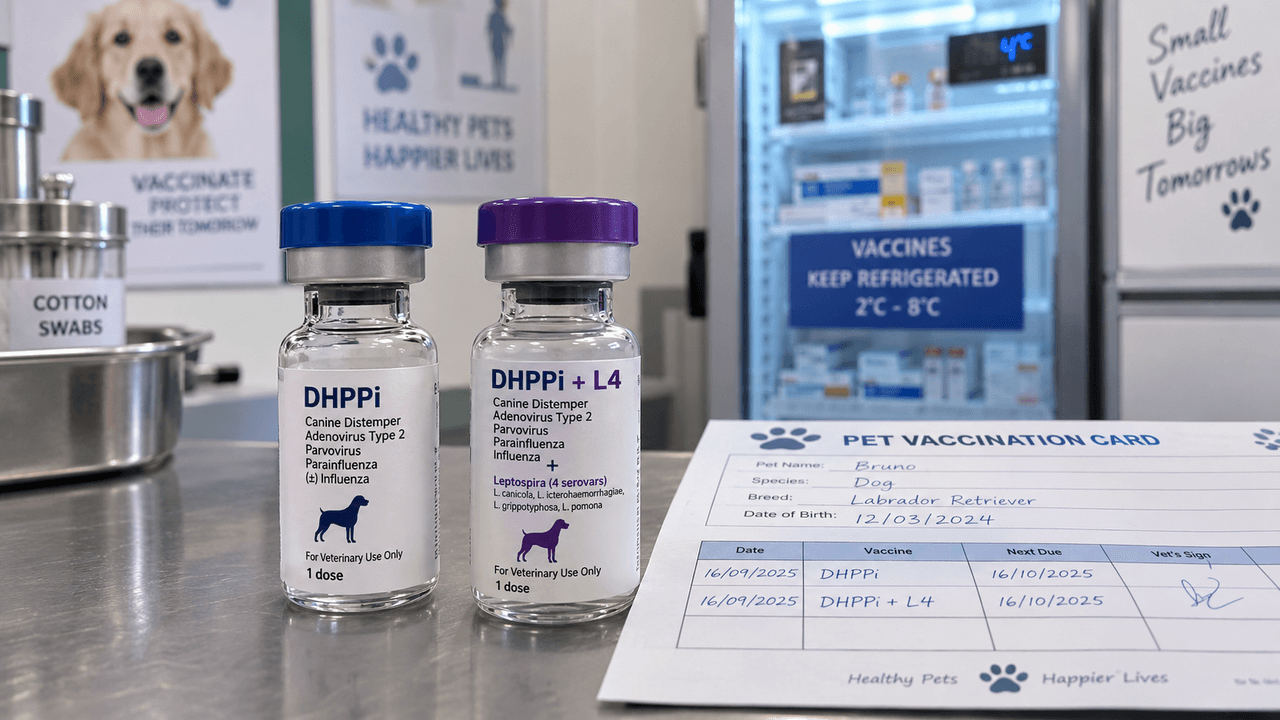
The 7-in-1 dog vaccine in India typically covers DHPPi (Distemper, Hepatitis, Parvovirus, Parainfluenza) plus 3 Leptospira serovars, or DHPPi + 3 strains of Lepto by some brand definitions; the 9-in-1 expands the Leptospira coverage to 4 or more serovars. In practical Indian vaccination, 9-in-1 (commonly labelled DHPPi+L4) gives broader Lepto protection: important in monsoon-prone India where Leptospirosis is endemic. Your vet's choice should be based on local Lepto strain pressure.
Why this matters in India
"7-in-1 vs 9-in-1" is one of the most-googled vaccination questions by Indian dog owners, and the most-mis-explained. The numbering does not mean what most online sources claim: it refers to how many distinct disease components / Leptospira serovars are bundled, not to "7 vs 9 diseases". Add to that the brand variations (Nobivac, Canigen, Biocan, Eurican, indigenous brands), and you get genuine confusion. This guide is the Indian vet-practice explanation: what each vaccine actually covers, when 9-in-1 matters, and how to read your dog's vaccination card.
The core question: what does each vaccine cover?
The naming conventions in India typically reflect this approximate framework:
Common name | Typical components |
|---|---|
5-in-1 / DHPPi | Distemper, Hepatitis (Adenovirus), Parvovirus, Parainfluenza (4 antigens; the "5th" varies: sometimes Coronavirus is added) |
7-in-1 / DHPPi + L | DHPPi components + Leptospira (typically 2–3 serovars) |
9-in-1 / DHPPi + L4 | DHPPi components + Leptospira (typically 3–4 serovars, broader coverage) |
Rabies | Separate single-component vaccine |
Kennel Cough | Separate (often intranasal Bordetella + Parainfluenza) |
Note carefully: the exact pathogens count varies by manufacturer. A "9-in-1" by one brand may not be the same as "9-in-1" by another. What matters is which Leptospira serovars and which DHPPi components are included on the label of the specific vaccine your vet uses. Ask to see the brand and dose record on your puppy's vaccination card.
What is Leptospira and why does India care?
Leptospirosis is a bacterial disease caused by various serovars of *Leptospira interrogans*, transmitted through water and soil contaminated by infected animal urine, particularly rodents, livestock and other dogs. It causes acute kidney and liver failure in dogs and is zoonotic, humans can also be infected.
India's monsoon and post-monsoon conditions (June–October) are optimal for Leptospira transmission, standing water, urban rodent populations and free-ranging dog populations together make this one of the highest-priority canine infections to protect against.
The serovars most commonly involved in Indian canine leptospirosis include: Canicola, Icterohaemorrhagiae, Pomona, Grippotyphosa, Bratislava, and others. A 9-in-1 vaccine covering 4 serovars provides broader cross-protection than a 7-in-1 covering 2–3 serovars. This is the main practical reason 9-in-1 is increasingly the Indian default for the second and third puppy boosters.
DHPPi: the rest of the vaccine breakdown
The DHPPi components common across both 7-in-1 and 9-in-1:
- D (Distemper virus) multisystemic viral disease, often fatal, particularly in puppies; widespread in India
- H (Hepatitis (Canine Adenovirus type 1)) liver disease; well-controlled by vaccination
- P (Parvovirus) viral GI disease, high mortality in unvaccinated puppies; endemic across India
- Pi (Parainfluenza virus) respiratory disease, contributor to kennel cough complex
These four are core, non-negotiable, and present in every Indian DHPPi-based vaccine.
The standard Indian puppy schedule with vaccine choice
Following our full [puppy vaccination schedule India](/articles/puppy-vaccination-schedule-india) protocol:
Week of life | Vaccine typically used |
|---|---|
6–8 weeks | DHPPi (sometimes DHPPi+L): first dose |
10–12 weeks | DHPPi + L (7-in-1 or 9-in-1): second dose |
14–16 weeks | DHPPi + L (typically 9-in-1) (third dose + Rabies) first dose |
Annually | DHPPi + L + Rabies |
Many Indian vets now use 9-in-1 (DHPPi + L4) for the second and third doses to maximise Leptospira coverage, with the first dose being DHPPi-only or a lower-Lepto component depending on the puppy's age and origin. Your vet picks the brand and component count based on local strain pressure and the specific puppy.
Brands of 7-in-1 and 9-in-1 vaccines in India
The vaccines you will most commonly see on Indian vaccination cards:
Brand | Manufacturer | Typical India offering |
|---|---|---|
Nobivac | MSD Animal Health | DHPPi, DHPPi+L, DHPPi+L4 |
Eurican / Canigen | Boehringer Ingelheim / Virbac | Various DHPPi+L formulations |
Biocan | Bioveta | DHPPi+L formulations |
Indigenous Indian brands | Various local manufacturers | DHPPi+L formulations |
The vet picks the brand. What matters is that the vaccine is in-date, has been cold-chain maintained (refrigerated correctly), and is administered correctly. Brand brand-loyalty is less important than the schedule being followed.
Cost of 7-in-1 vs 9-in-1 in India (2026)
Vaccine dose | Metro (₹) | Tier-2 city (₹) |
|---|---|---|
DHPPi (5-in-1) | 500–1,200 | 300–900 |
DHPPi + L (7-in-1) | 550–1,300 | 350–1,000 |
DHPPi + L4 (9-in-1) | 600–1,500 | 400–1,100 |
Rabies | 200–600 | 150–450 |
Vet consultation per visit | 400–1,200 | 250–800 |
The price gap between 7-in-1 and 9-in-1 is small (₹50–₹200 per dose) and almost always worth paying for the broader Lepto coverage. The bigger cost line is the vet consultation, not the vaccine itself.
When should I specifically ask for 9-in-1?
In every Indian setting where Leptospira exposure risk exists, which is essentially everywhere in the country at some level. Particularly important if:
- Your dog is in monsoon-active region (most of India during June–October)
- Your dog has outdoor exposure: parks, walks through wet areas, contact with rodents
- Your dog encounters other dogs frequently: daycare, parks, boarding
- Your dog has access to water bodies: lakes, ponds, puddles
For an indoor-only toy-breed dog with minimal outdoor exposure, 7-in-1 may be sufficient: though many Indian vets still prefer 9-in-1 for the cross-protection. Discuss with your vet.
What about Coronavirus, Kennel Cough, Canine Influenza?
These are separate vaccines, not part of DHPPi + L:
- Canine Coronavirus (CCoV): often included in some 6-in-1 / 7-in-1 formulations; the vaccine's necessity is debated, generally non-core per WSAVA
- Kennel Cough (Bordetella + Parainfluenza): separate vaccine, often intranasal; recommended for dogs that attend daycare, boarding, training classes
- Canine Influenza: separate vaccine, where locally available and risk-relevant
Your vet may bundle Kennel Cough with the routine schedule depending on your dog's exposure profile.
Can I switch brands mid-schedule?
Generally yes: Indian vets commonly switch brands when supply changes, as long as the antigen coverage matches. A puppy that started on Nobivac DHPPi+L can continue with Canigen DHPPi+L at the next dose with no protection lost. Brand consistency is preferred but not essential.
What if my dog only received 7-in-1 in the past?
You and your vet can plan to add or substitute 9-in-1 for the next booster, particularly going into monsoon. There is no harm in upgrading coverage at the next scheduled dose; never give two vaccines on top of each other without a vet's specific direction.
Side effects to monitor
Mild and expected with any DHPPi-based vaccine:
- Injection site soreness for 12–48 hours
- Reduced energy and appetite for 24 hours
- Mild low-grade fever
Call the vet if you see:
- Facial swelling / hives
- Vomiting beyond a few hours
- Collapse or seizure
- Persistent fever above 40°C
- Difficulty breathing
Severe vaccine reactions are rare. The Leptospira component is sometimes the most reactive: some toy-breed and known-allergy dogs have more reactions to it. Your vet may pre-medicate or use a different formulation.
When to see a vet about vaccination
- First visit as soon as your puppy is 5–7 weeks old
- Same-day for any suspected vaccine reaction
- Annual for the booster
- Pre-travel if international travel requires a specific protocol
FAQ
7 in 1 vs 9 in 1 vaccine: kya farak hai?
7-in-1 mein DHPPi ke saath 2–3 Leptospira serovars cover hote hain. 9-in-1 mein DHPPi ke saath 3–4 ya zyada Leptospira serovars cover hote hain: yaani Lepto ki broader protection milti hai. India mein monsoon ki wajah se Leptospirosis common hai, isliye most vets 9-in-1 prefer karte hain second aur third puppy booster ke liye. Cost ka farak chhota hai, protection ka farak meaningful hai.
Which is better: 7-in-1 or 9-in-1?
For most Indian dogs, 9-in-1 (DHPPi + L4) gives broader Leptospira coverage and is the practical preference. The cost difference of ₹50–₹200 per dose is small relative to the protection gained, particularly in monsoon-prone India. Discuss with your vet for your specific dog and local strain pressure.
How many vaccines does a dog need in India?
Core schedule: three DHPPi-based doses (6–8 weeks, 10–12 weeks, 14–16 weeks) typically with Leptospira added at the second and third doses, plus Rabies at the third dose. Annual booster of DHPPi+L + Rabies thereafter. Lifestyle non-core vaccines (Kennel Cough, Canine Influenza) added as needed.
What vaccines does an Indian dog absolutely need?
Per WSAVA, DHPPi components (Distemper, Hepatitis, Parvovirus, Parainfluenza) and Rabies are core for all dogs in India. Leptospira is core in any region with monsoon and rodent / water exposure, which is essentially all of India.
Are 9-in-1 vaccines safe for puppies?
Yes: they are widely used in Indian practice from 10–12 weeks of age. The Leptospira component is sometimes the most reactive; toy-breed and known-allergy dogs may have a higher reaction rate. Your vet may pre-medicate or use a different formulation in those cases.
How often do I need to give 9-in-1?
Three doses during the puppy schedule (typically the second and third boosters), then annually as part of the adult booster. Some international guidelines suggest some core components may protect longer than a year; Indian practice generally maintains annual boosting given the local disease pressure.
Can I give Rabies and 9-in-1 on the same day?
Generally yes: vets routinely combine the 14–16 week DHPPi+L + Rabies in the same visit. Two injections in different sites. Some vets prefer to space by 7–14 days for puppies with allergy histories; your vet decides.
Sources
- WSAVA: Vaccination Guidelines for the Owners and Breeders of Dogs and Cats.
- AAHA: Canine Vaccination Guidelines.
- MSD Veterinary Manual: leptospirosis and canine vaccinology references.
- Vaccine manufacturer datasheets: Nobivac, Eurican, Canigen, Biocan, and indigenous Indian brands.
A note from Critzo (please read): This article is general educational information written and reviewed by qualified veterinary professionals for Indian pet parents. It is not a substitute for an in-person consultation with your own veterinarian, who knows your pet, their history, and their current clinical state. Pets are individuals — breed, age, weight, pre-existing conditions, medications, and local disease patterns all change what is safe and what is not. Do not start, stop, or change any medication, vaccination schedule, diet, or treatment based on what you read here without first speaking to a registered veterinary practitioner. If your pet is showing emergency signs — collapse, seizure, severe bleeding, suspected poisoning, breathing difficulty, bloated abdomen, repeated vomiting or no urination for more than 12 hours — stop reading and go to the nearest 24-hour veterinary hospital immediately. You follow any guidance from this article at your own risk and at your pet's risk. Critzo, its authors, and its reviewers accept no liability for outcomes arising from decisions made without veterinary supervision.