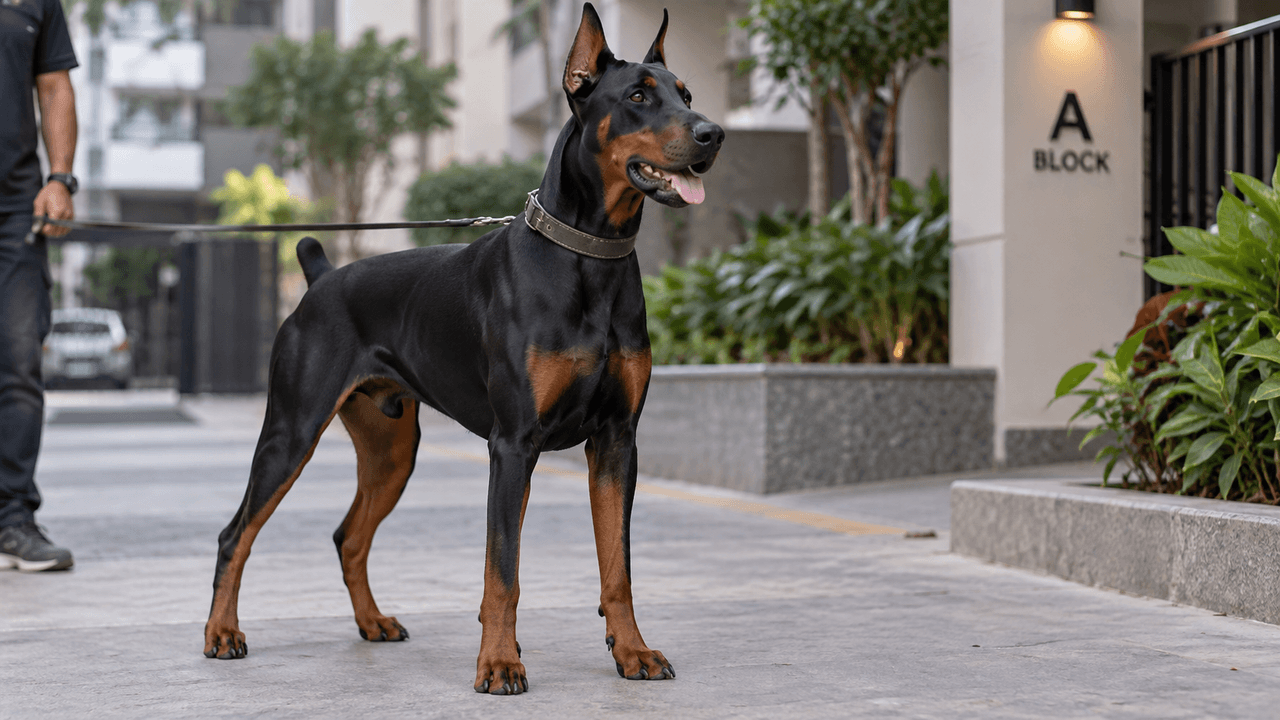
A Doberman puppy in India costs roughly ₹15,000–₹50,000 in 2026: metros typically ₹22,000–₹45,000 and tier-2 cities ₹15,000–₹30,000 for pet-quality. European working line and KCI champion bloodlines cross ₹55,000–₹1,20,000. Plan ₹4,500–₹8,500 monthly upkeep with cardiac screening as the single most important medical investment.
Why this matters in India
The Doberman has had a long, distinguished history as an Indian guard and family dog. The breed sits at the intersection of striking looks, athletic ability and serious commitment, and one significant inherited health concern (Dilated Cardiomyopathy) that most online cost guides skip past. This article gives you the honest cost band, the European-vs-American line distinction and the lifetime medical reality.
Doberman price in India by city
City | Pet-quality (₹) | Show / Working line (₹) | Notes |
|---|---|---|---|
Mumbai | 25,000–45,000 | 50,000–1,20,000 | Premium catteries, imports |
Delhi NCR | 22,000–40,000 | 48,000–1,10,000 | Largest market |
Bengaluru | 22,000–40,000 | 48,000–1,05,000 | Mid-band |
Hyderabad | 20,000–35,000 | 42,000–95,000 | Steady |
Pune | 20,000–35,000 | 42,000–95,000 | Metro-adjacent |
Chennai | 18,000–32,000 | 38,000–85,000 | Steady |
Kolkata | 16,000–30,000 | 35,000–75,000 | Lower mean |
Tier-2 | 15,000–28,000 | 32,000–65,000 | Verify parentage |
A "Doberman" under ₹10,000 is almost always either a Dobie-mix, a backyard-bred non-vaccinated dog, or a dog without parental health screens.
European vs American Doberman
This is the key bloodline distinction:
European working line: heavier-built, broader head, more drive, more protection work pedigree. Pros: sturdier build, often longer-lived if from screened parents, traditional working temperament. Cons: higher exercise and engagement needs.
American show line: leaner, more elegant build, less extreme drive. Pros: slightly easier pet temperament, more readily available in India. Cons: some lines carry higher DCM rates.
Indian "Doberman": middle band of mixed lineage of variable quality. Most of what you will see on Indian classifieds. Quality varies.
For most Indian families, a moderately built dog from a known breeder with cardiac-screened parents is the sensible choice: neither extreme.
What affects the Doberman puppy price?
- KCI registration and pedigree: the biggest lever
- Cardiac (DCM) screened parents: Holter monitoring and echocardiograms within last 12 months
- Bloodline (European working, American show, balanced): imports command 2–3x premium
- Hip and elbow scores of parents
- Coat colour: black & tan (most common), red & tan, blue, fawn (Isabella); rare colours sometimes premium and may have associated coat issues
- Sex: males slightly higher in many catteries
- Age: younger within the 8-week minimum
- Vaccination status
- Breeder reputation and early socialisation programme
Are Dobermans good for Indian climate?
Better than Huskies, comparable to Labradors and German Shepherds. The short single coat actually helps in Indian heat (Dobermans tolerate warmth better than double-coated GSDs. But they are sensitive in winter (no insulating undercoat), so northern India winters require a coat for the dog. Standard management) AC during peak summer, walks in cool hours, hydration support, ear and skin checks.
Doberman temperament: what the breed actually is
A correctly bred and socialised Doberman is:
- Highly intelligent and trainable: top-5 trainability of any breed
- Loyal and bonded to family: devoted, not just obedient
- Watchful and protective: natural guard without random aggression when properly socialised
- High exercise and engagement need: 90+ minutes daily structured activity
- Sensitive to handler tone: does not respond well to harsh correction
- Reserved with strangers initially, friendly with family-approved guests
- People-oriented: does not suit being left alone for very long
A Doberman without socialisation and structure is a problem. A Doberman with both is an exceptional family dog.
How much does a Doberman cost monthly in India?
Cost head | Metro (₹) | Tier-2 city (₹) |
|---|---|---|
Monthly food (large-breed kibble + fresh additions) | 4,500–8,000 | 3,200–6,000 |
Year-1 vaccinations / annual booster | 4,500–8,000 / 1,500–3,000 | 3,000–6,000 / 1,000–2,500 |
Annual deworming + tick-flea preventives | 4,000–7,000 | 2,800–5,000 |
Annual cardiac screening from age 2 | 4,000–10,000/yr | 2,800–7,500/yr |
Hip / elbow X-ray (12–18 months) | 4,000–9,000 | 2,800–6,500 |
Professional training | 22,000–55,000 (course) | 15,000–35,000 (course) |
Optional pet insurance | 1,000–8,000/yr | 1,000–8,000/yr |
The annual cardiac screening line is breed-specific and genuinely important. For training guidance, much of [how to train a Labrador puppy](/articles/how-to-train-a-labrador-puppy) applies with the addition of more structured engagement.
Common Doberman health issues in India
- Dilated Cardiomyopathy (DCM): the defining breed health concern; heritable; annual cardiac screening from age 2 is essential
- Wobblers syndrome (CVI): cervical spinal compression
- Hip dysplasia: present at moderate rate
- Von Willebrand disease, bleeding disorder; DNA test available in parent dogs
- GDV (bloat): deep-chested breed; feed two smaller meals, no heavy exercise around meals
- Hypothyroidism: relatively common
- Skin allergies, particularly in some lines
DCM is the single largest welfare issue in the breed. Buy from a breeder who Holter-monitors and echos parents annually, and continue annual cardiac screening of your own dog from age 2. Insurance enrolment before any cardiac sign appears is genuinely useful: see [HDFC ERGO Paws n Claws](/articles/hdfc-ergo-paws-n-claws-review).
Doberman vs Rottweiler vs German Shepherd
Trait | Doberman | Rottweiler | German Shepherd |
|---|---|---|---|
Climate tolerance India | Better (short coat) | Moderate (black coat heat) | Moderate (double coat) |
Coat care | Very low | Low | High (double-coat shedding) |
Trainability | Top-tier, sensitive | High, calm | Top-tier, intense |
Common health concerns | Cardiac (DCM), Wobblers | Hip/elbow, cruciate, osteosarcoma | Hip/elbow, DM, EPI |
Lifespan India | 9–11 years | 8–11 years | 8–10 years |
RWA optics 2026 | Moderate scrutiny | Higher scrutiny | Lower scrutiny |
Apartment suitability | Yes with daily exercise | Yes with daily exercise | Yes with daily exercise |
All three are committed-owner dogs. Each has a niche. The Doberman is the right choice for owners who want an athletic, deeply bonded family dog and are willing to invest in cardiac monitoring.
How to buy a Doberman puppy safely
- See the puppy with its mother
- Ask for parents' cardiac clearance (Holter + echo) within last 12 months
- Hip and elbow scores of parents
- Von Willebrand DNA test of parents
- Signed vaccination card
- 7-day vet-check return policy
Take to a vet within 48 hours.
When to call the vet
Promptly for any Doberman with:
- Coughing, exercise intolerance, fainting episodes: possible cardiac signs (emergency for sudden onset)
- Sudden bloating with retching: emergency, possible GDV
- Lameness lasting beyond 24 hours, neck stiffness, weakness
- Persistent skin issues
- Sudden weight gain or loss
Adult Dobermans should have annual cardiac screening from age 2; six-monthly from age 6. See [senior dog care in India](/articles/senior-dog-care-india).
FAQ
Doberman ka real price kya hota hai India mein?
Vaccinated pedigreed Doberman metros mein ₹22,000–₹40,000 mein milta hai. Tier-2 cities mein ₹15,000–₹28,000. European working line ya KCI champion bloodlines ₹50,000–₹1,20,000. Cardiac-screened parents wala puppy thoda mehnga padta hai lekin lifetime mein wahi paisa-vasool hai.
Is the Doberman good for Indian climate?
Better than most large breeds: short single coat helps in Indian heat. AC during peak summer still sensible; walks in cool hours; winter sweater for northern India because there's no undercoat. Dobermans handle Indian warmth better than GSDs or Rottweilers.
How long do Dobermans live in India?
9–11 years on average. DCM screening, weight control, joint protection and prompt response to coughing, fainting or exercise intolerance extend the upper end. Many Dobermans live well into 12–13 with good cardiac monitoring; the breed-typical premature death is cardiac.
Are Dobermans safe family dogs?
A well-bred, well-socialised Doberman is one of the gentler large working breeds with family. Early socialisation, structured positive training, never leaving any large dog alone with young children: non-negotiables. The breed bonds intensely and is naturally protective without being randomly aggressive.
Doberman vs Rottweiler: kaunsa lena chahiye?
Donon committed-owner dogs hain. Doberman zyada athletic, low grooming, climate ke saath thoda zyada compatible hai, lekin DCM screening lifetime expense hai. Rottweiler calmer, low-energy indoors, lekin RWA scrutiny zyada hai 2024 advisory ke baad. Apne lifestyle, time aur RWA situation se decide kijiye.
How much exercise does a Doberman need?
90+ minutes of structured daily exercise, ideally split. Mental work (training, scent games, puzzle feeders) for 20–30 minutes additional. Working-line dogs need more. Under-exercised Dobermans become anxious, destructive and difficult: the breed is not a sedentary apartment dog.
Sources
- Kennel Club of India (KCI): Doberman Pinscher breed standard.
- WSAVA: nutrition and vaccination guidelines.
- MSD Veterinary Manual: DCM, Wobblers, von Willebrand references.
A note from Critzo (please read): This article is general educational information written and reviewed by qualified veterinary professionals for Indian pet parents. It is not a substitute for an in-person consultation with your own veterinarian, who knows your pet, their history, and their current clinical state. Pets are individuals — breed, age, weight, pre-existing conditions, medications, and local disease patterns all change what is safe and what is not. Do not start, stop, or change any medication, vaccination schedule, diet, or treatment based on what you read here without first speaking to a registered veterinary practitioner. If your pet is showing emergency signs — collapse, seizure, severe bleeding, suspected poisoning, breathing difficulty, bloated abdomen, repeated vomiting or no urination for more than 12 hours — stop reading and go to the nearest 24-hour veterinary hospital immediately. You follow any guidance from this article at your own risk and at your pet's risk. Critzo, its authors, and its reviewers accept no liability for outcomes arising from decisions made without veterinary supervision.