Flying with a dog in India in 2026 is possible on most major airlines, with small dogs in the cabin and larger dogs in temperature-controlled cargo. Allow at least 10–14 days of preparation: vaccination updates, fit-to-fly certificate, IATA-compliant carrier and airline-specific booking. Expect ₹3,000–₹15,000 in domestic add-on fees and significantly more for international travel.
Why this matters in India
Flying with a pet used to be a niche question in India. It is not any more: every relocation, every long holiday and every cross-country move involves the same set of small, easily-mis-handled decisions. The airline policies in India have evolved fast since 2023, the paperwork requirements are non-trivial, and getting any detail wrong is expensive: pet refused at the boarding gate, missed flights, separated families. This guide is the version I give clients planning a flight, in the order it actually matters.
Step 1: Cabin vs cargo: which does your dog need?
The most important early decision is which compartment your dog will travel in. It depends on size, breed and the specific airline:
Travel mode | Suitable for | What to expect |
|---|---|---|
In-cabin | Small dogs typically under 5–7 kg (carrier + dog combined weight). The dog stays in a soft IATA-compliant carrier under your seat for the flight. | Dog with you; less stress; small space; not all airlines / routes |
Checked baggage (excess) / cargo hold | Medium and large dogs in IATA-compliant hard crates. | Temperature-controlled hold; dog not with you during flight; needs robust pre-flight prep |
Manifested cargo | Very large dogs or international cargo travel; commercial cargo handling. | Specialist pet shipping companies often involved |
Brachycephalic breeds (Pugs, Bulldogs, Boxers, Persian and Himalayan cats) face additional airline restrictions or outright bans on cargo travel because of the higher in-flight respiratory risk. Verify the specific breed and airline policy before booking.
Step 2: Major Indian airline pet policies (2026 spot-check)
Always re-verify on the airline's current pet-policy page before booking: these change.
Airline | Cabin allowed | Checked baggage allowed | Notable |
|---|---|---|---|
Air India | Yes (small dogs, conditional) | Yes (conditional) | Established pet handling |
Vistara (legacy / Tata-merged) | Confirm current policy post-merger | Confirm | Evolving |
IndiGo | Pet-on-board policy expanded 2024: review current rules | Limited | Strong domestic network |
SpiceJet | Limited | Limited | Verify |
Akasa Air | Verify | Verify | Newer player; evolving policy |
Foreign carriers ex-India | Varies by airline and route | Varies | International routes: strict IATA crate rules |
Recommended workflow: call the airline's pet desk after you book the human ticket but before you pay, and confirm in writing.
Step 3: Paperwork checklist
For domestic Indian travel, you typically need:
- Current vaccination card: DHPPi+L within last 12 months and rabies vaccination within last 12 months
- Fit-to-fly certificate from a registered veterinarian, dated within 7–14 days of travel
- Health certificate from the vet noting no signs of infectious disease
- Airline pet declaration / booking confirmation (separate from your human ticket)
- Identification tag on the dog (collar tag with your phone number)
For international travel from India, additional layers:
- All of the above, plus
- NOC from the Animal Quarantine and Certification Service (AQCS): applies for departure
- Rabies titre test (FAVN) from a recognised lab, depending on destination country
- Import permit from the destination country (where required)
- Microchip with ISO-compliant 15-digit number: many destination countries require it
- Endorsed health certificate from a government veterinarian within destination-specified window
- IATA-compliant crate that meets destination airline's specific dimensions
- Country-specific quarantine compliance: UK, Australia, New Zealand and several others have specific protocols
International pet travel from India typically requires 3–6 months of preparation, not weeks. Start early. Specialist pet shipping companies are genuinely worth the fee for international moves.
Step 4, Choosing the right carrier or crate
For in-cabin:
- Soft-sided IATA-compliant carrier
- Underseat-dimensions compliant for your specific airline
- Mesh ventilation on multiple sides
- Leak-proof base
- Comfort pad inside
For checked / cargo:
- Hard plastic IATA Container Requirement 1 (CR1) compliant crate
- Sized so the dog can stand, turn and lie down naturally
- Metal screw fasteners (not plastic clips)
- Live animal stickers and "this way up" arrows
- Absorbent pad inside, water container attached to door
- Owner contact details written on multiple sides
- A familiar-smelling cloth or t-shirt inside
Buy the crate at least 2–3 weeks before travel and let your dog become comfortable in it at home. Cold-introduction at the airport is the most common cause of crate stress.
Step 5: Pre-flight vet preparation
10–14 days before travel:
- Routine health check
- Vaccination boosters as needed
- Deworming and tick-flea preventive update
- Fit-to-fly certificate
- Discuss anxiety, but do not sedate. Most airlines and IATA do not recommend sedation; sedated animals are at higher risk of breathing issues at altitude. Calming behavioural prep is the right approach.
Light meal 4–6 hours before flight. Water available until check-in. Toilet break immediately before check-in.
Step 6: At the airport
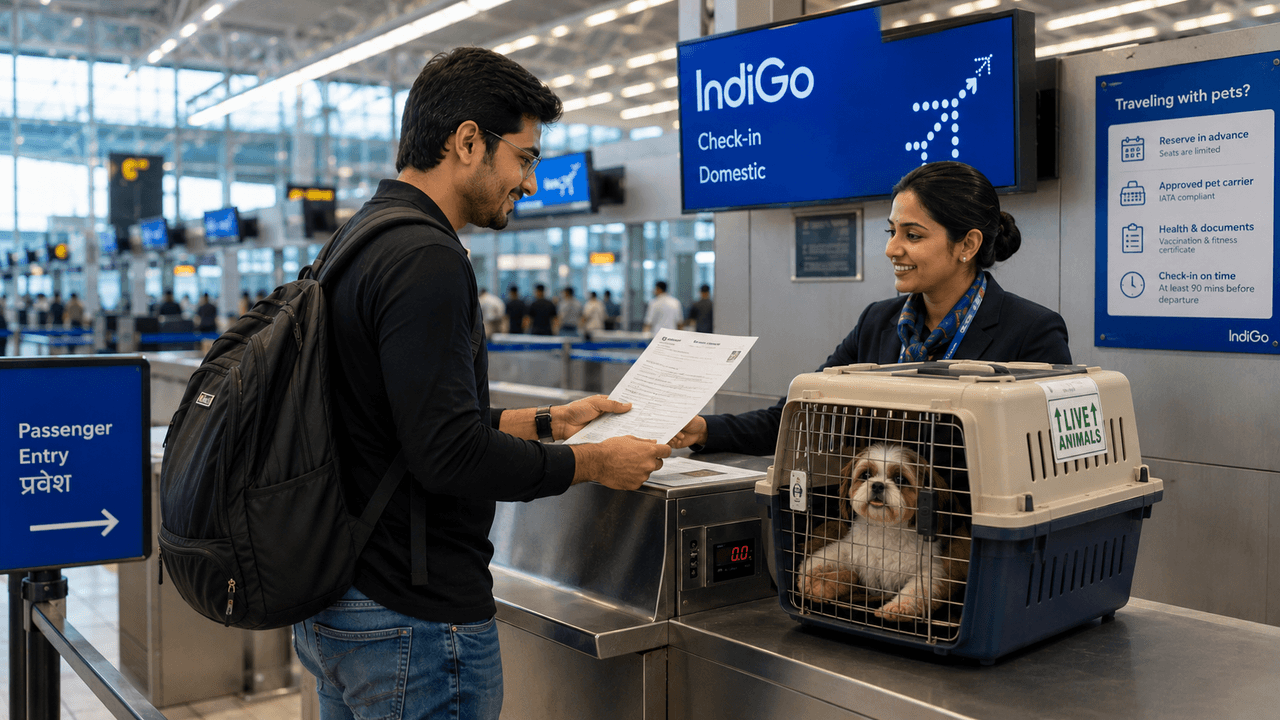
Plan to arrive earlier than normal: pet documentation processing takes additional time. For checked-in cargo travel:
- Veterinary documents shown at check-in
- Crate inspected by airline ground staff
- Crate weighed
- Pet handed over at the cargo door / live animal counter
- Confirm pet has been loaded before boarding (you can ask gate staff)
For in-cabin travel: your pet remains with you through security, with the carrier going through the X-ray with the dog briefly out and harnessed.
Step 7: What it costs
Cost head | Domestic India (₹) | International (₹) |
|---|---|---|
Airline pet fee (in-cabin) | 1,500–6,000 | 8,000–35,000+ |
Airline pet fee (checked / cargo) | 3,000–15,000 | 25,000–1,50,000+ |
Vet fit-to-fly certificate | 800–2,500 | 800–2,500 |
AQCS / quarantine paperwork (intl) | : | 3,000–15,000 |
Rabies titre test (intl) | : | 4,000–8,000 |
IATA crate purchase | 2,500–10,000 | 2,500–10,000 |
Microchip (if not already done) | 800–2,500 | 800–2,500 |
Specialist pet shipper (optional intl) | : | 40,000–2,00,000+ |
Domestic pet travel can be ₹5,000–₹20,000 add-on. International commonly ₹60,000–₹3,00,000+ depending on destination and shipper.
Step 8: Climate and timing
Indian summer is the worst time to fly pets. Brachycephalic breeds in particular can face airline embargoes during May–July because of heat-stress mortality risk in transit.
Best windows:
- November–February: cool, lower risk, easier airline acceptance
- March–April and September–October: workable with care
- May–July, peak monsoon flight delays: avoid where possible for cargo travel
For in-cabin small dogs, climate matters less but still affects gate-area waiting comfort.
When to delay or cancel travel
Postpone if your dog has:
- Active respiratory infection
- Recent surgery (under 30 days)
- Recent vaccinations (under 7 days)
- Pregnancy
- A history of severe anxiety where behavioural prep has not worked
- Senior age combined with cardiac or respiratory conditions
For seniors, see our [senior dog care in India](/articles/senior-dog-care-india): flight stress is genuinely different for an older dog and the decision to fly should be a vet-led conversation.
FAQ
Can I take my dog on an IndiGo flight in India?
IndiGo expanded its pet travel policy in 2024 to allow pets on board on specified domestic routes. The exact rules (eligible routes, in-cabin weight limits, breed restrictions, fees) change with each policy revision. Always check IndiGo's current pet policy page and call their pet desk before booking.
Kya bade dog ko flight mein le ja sakte hain India mein?
Haan, lekin cabin mein nahi (cargo hold mein IATA-compliant crate ke through. Bade dogs ke liye cargo travel arrange karna padta hai, jo zyada paperwork aur planning maangta hai. Brachycephalic breeds (Pug, Bulldog, Boxer) ke liye additional restrictions hote hain) woh garmi mein cargo bhej nahi sakte. Apne specific airline ki current policy confirm kijiye.
How much does it cost to fly a dog within India?
Domestic pet travel add-ons typically ₹3,000–₹15,000 for cargo and ₹1,500–₹6,000 for in-cabin small dogs in 2026. Plus crate purchase, vet fit-to-fly certificate, and vaccination updates. Total domestic budget realistically ₹6,000–₹25,000 depending on dog size and route.
Can I sedate my dog for the flight?
No, generally. Most airlines and IATA do not recommend sedation. Sedated animals face higher risk of respiratory complications at altitude, particularly in cargo travel. Behavioural and crate-conditioning preparation is the right approach. If your dog has severe travel anxiety, discuss alternatives with a veterinary behaviourist well in advance, not on the morning of travel.
Do I need a microchip for my dog to fly?
For domestic travel within India, generally no. For international travel from India to most destinations, yes: an ISO-compliant 15-digit microchip is required by most destination countries and is often a condition of the rabies titre test acceptance. Microchipping is also increasingly required for travel insurance and pet insurance.
Is it safe to fly a senior dog?
Cautiously, with vet clearance. The vibration, cabin pressure changes, temperature variations and stress can be harder on an older dog than a young adult. Short routes, in-cabin where possible, cooler season travel and a thorough pre-flight vet check are the levers. For a frail senior, a one-way road journey or train travel can be the kinder choice.
Sources
- DGCA: Directorate General of Civil Aviation, India.
- Animal Welfare Board of India (AWBI).
- IATA Live Animals Regulations.
- Individual airline pet-travel policy pages: verify current at time of booking.
A note from Critzo (please read): This article is general educational information written and reviewed by qualified veterinary professionals for Indian pet parents. It is not a substitute for an in-person consultation with your own veterinarian, who knows your pet, their history, and their current clinical state. Pets are individuals — breed, age, weight, pre-existing conditions, medications, and local disease patterns all change what is safe and what is not. Do not start, stop, or change any medication, vaccination schedule, diet, or treatment based on what you read here without first speaking to a registered veterinary practitioner. If your pet is showing emergency signs — collapse, seizure, severe bleeding, suspected poisoning, breathing difficulty, bloated abdomen, repeated vomiting or no urination for more than 12 hours — stop reading and go to the nearest 24-hour veterinary hospital immediately. You follow any guidance from this article at your own risk and at your pet's risk. Critzo, its authors, and its reviewers accept no liability for outcomes arising from decisions made without veterinary supervision.