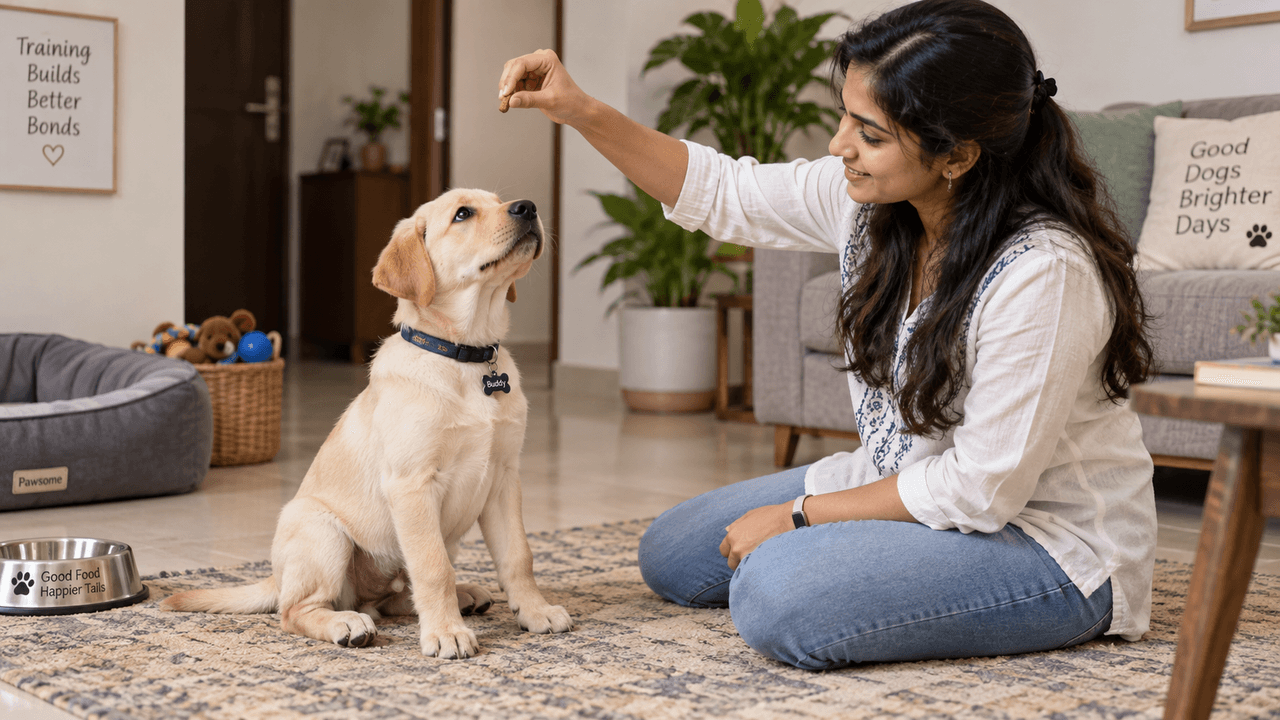
To train a Labrador puppy in India effectively, start the day you bring them home: focus on socialisation (3–14 weeks is the critical window), house training, bite inhibition, lead walking and recall. Use positive reinforcement only. Manage exercise carefully during growth, over-exercise damages joints. Group puppy classes from 8–10 weeks (after the first vaccine) are genuinely worth the money for a Lab.
Why this matters in India
A Labrador puppy in your apartment is the most trainable, the most food-motivated and the easiest socialisable puppy you will ever own, and also the easiest to spoil into a 35 kg pulling-on-the-lead chaos by month six. Most Indian Lab problems start in the first 12 weeks of avoidable mistakes: late socialisation, free-feeding, harsh correction, no recall. This guide is the working protocol I send home with every new Lab parent in clinic, in the order it actually matters.
The first 24 hours
Bring the puppy home calmly. The first day is decompression, not training.
- Set up a small confined "safe space": playpen or one room with a crate
- Soft bedding, water, age-appropriate toys, an old t-shirt from you
- Show them their toilet area (balcony pee pad or outdoor patch) every hour
- Quiet, calm, minimal visitors for 48 hours
- Sleep nearby the first 2–3 nights if possible
Days 2–7: the first protocols
House training:
- Take the puppy out (or to the indoor toilet area) every 2 hours, after every meal, after every nap, after every play session
- Praise instantly when they go in the right place (a small treat works)
- Never punish accidents; clean with an enzymatic cleaner
- Most Labs are mostly house-trained by 4 months
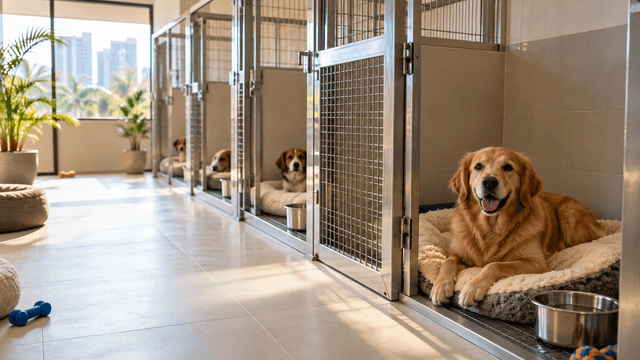
Crate and confinement:
- Crate is positive, not punitive
- Feed inside the crate; toss treats in
- Build crate time gradually: 5 minutes, 10, 20
- Crate door closed for short periods only at first
Name recognition:
- Say the name, treat, repeat 10–20 times a day
- Never use the name for correction
- Use the name + come (the foundation of recall)
The critical socialisation window (3–14 weeks)
This is the single most important developmental window in a dog's life. What a puppy is exposed to between 3 and 14 weeks shapes their adult temperament. Most behavioural problems trace back to under-socialisation here.
In safe ways (meaning controlled, calm, positive) expose the puppy to:
- People: different ages, different genders, different clothing, hats, beards, glasses
- Sounds: doorbell, lift, vacuum, traffic at low volume, monsoon thunder, fireworks (recorded, low)
- Surfaces: tile, marble, grass, sand, wood, metal, gravel
- Other vaccinated calm dogs you know
- Vet clinic visits: happy visits with treats, not just vaccination
- Car rides: short, positive
- Handling: paws, ears, mouth, tail; every day briefly
What to avoid until 16–18 weeks (after full vaccination per the [puppy vaccination schedule](/articles/puppy-vaccination-schedule-india)):
- Public dog parks where unvaccinated dogs roam
- Contact with unvaccinated street dogs
- Footpath walks in heavily dog-trafficked areas
Group puppy classes (typically from 8–10 weeks, after the first vaccine, with vet clearance) are a genuinely excellent intervention. The puppy gets controlled socialisation with vaccinated peers under a trainer's supervision. Cost ₹15,000–₹45,000 for a course in Indian metros; ₹10,000–₹28,000 in tier-2.
Bite inhibition
Labrador puppies bite. They are mouthy by breed. The skill is not "no biting": it is soft mouth by adulthood.
The protocol:
- When the puppy bites hard, yelp briefly and disengage for 10–30 seconds
- When they bite soft or release, resume play / treat
- Redirect to a chew toy
- Never play tug-of-war with a teething puppy in a way that encourages hard biting
Most Labs have a soft mouth by month 4–5 with consistent shaping.
Lead walking
A grown Labrador pulling on the lead can drag a 60 kg adult down the road. Train loose-lead walking from week one of leash introduction.
- Use a flat collar or front-clip harness (no choke, no prong, no slip)
- Reward walking close to you with treats
- Stop walking when the puppy pulls; resume when the lead is slack
- Practice in quiet corridor first, then quieter outdoor area
- Build distraction tolerance gradually
This is one of the hardest skills to teach an adult Lab and one of the easiest to teach a 10-week-old puppy.
Recall: the off-lead lifeline
A reliable recall is the difference between an off-lead Lab and a lead-bound Lab for life. Teach early:
- Say "come" + the dog's name
- Reward instantly with a high-value treat when they arrive
- Never call the dog for something they will dislike (bath, lead-on, end of fun)
- Never punish a dog after a recall, even slow
- Practice in increasingly distracting environments
- Use a long-line in early outdoor training
Exercise: protect the growing joints
Labradors are at risk of hip and elbow dysplasia, and over-exercise during growth is one of the modifiable risks. The 5-minute rule is a useful planning heuristic:
- 5 minutes per month of age, twice a day of structured exercise until growth plates close
- e.g. a 4-month-old Lab gets two 20-minute structured walks max
- Free play in safe environments is separate and self-regulating
- No jumping off sofas, stairs run-ups, balcony jumps until 12+ months
- No long-distance running with the dog until 12–18 months
- Avoid hot-surface walks: Indian summer roads burn paw pads
Feeding the Labrador puppy
A breed-appropriate large-breed puppy kibble fed in measured portions. Free-feeding a Lab is the single most common reason Indian Labs become overweight by year two. See [best dog food in India](/articles/best-dog-food-in-india) for brand picks and [Royal Canin vs Drools](/articles/royal-canin-vs-drools) for the head-to-head.
Feeding schedule:
- 8–12 weeks: 4 meals a day
- 12 weeks–6 months: 3 meals a day
- 6 months+: 2 meals a day
Measure portions exactly from the bag chart and adjust by body condition.
What positive reinforcement actually means
The standard veterinary behaviour position globally (AVSAB, AAHA, WSAVA) is that positive reinforcement methods are both more effective and safer than aversive (correction-based) methods. In practice:
- Reward what you want to see, ignore or redirect what you don't
- Treats, praise, play, life rewards
- No "alpha rolls", no leash jerks, no shock collars, no prong collars
- A force-free professional trainer is worth the money
If a trainer recommends physical correction for a Lab puppy, find a different trainer.
When to call the vet or behaviourist
- Persistent toilet accidents past 5–6 months
- Resource guarding (food, toys) that does not resolve with management
- Severe separation distress
- Hand-shy or fearful behaviour beyond a few weeks
- Hard biting that escalates rather than fades
- Aggression toward people or other dogs
These are addressable, but the earlier you bring in a vet behaviourist, the easier the work.
What it costs in India (first 6 months)
Item | Metro (₹) | Tier-2 city (₹) |
|---|---|---|
Group puppy class course (8–12 sessions) | 15,000–45,000 | 10,000–28,000 |
Private behaviour consultation (initial) | 2,500–7,000 | 1,800–5,000 |
Crate, lead, harness, treats, toys | 6,000–15,000 | 4,500–11,000 |
Treats and training rewards (monthly) | 800–1,800 | 600–1,400 |
The single highest-leverage spend in the first six months is a good group puppy class.
FAQ
Labrador puppy ko kaise train karein?
Pehle din se hi start kijiye. House training har 2 ghante mein toilet area dikhana. Socialisation 3–14 weeks ka window critical hai: log, awaazein, surfaces sab introduce kijiye. Bite inhibition har bite par 10-second disengage. Lead walking flat collar / harness pe shuru kijiye. Sirf positive reinforcement: punishment Lab par work nahi karta aur trust kharab karta hai. 8–10 weeks pe vet-cleared group puppy class lagana paisa-vasool hai.
When can my Labrador puppy go outside?
For controlled socialisation with calm vaccinated dogs you know: from 8 weeks. For public dog environments (parks, footpath walks), after the 16-week vaccine has had 1–2 weeks to take effect, roughly 18 weeks. See [puppy vaccination schedule](/articles/puppy-vaccination-schedule-india).
How long does it take to train a Labrador?
Foundation training (toilet, name, basic sit/down) is largely solid by 4 months. Loose-lead walking and reliable recall by 6–9 months with consistency. Off-lead reliability in distracting environments by 12–18 months. Labs are quick learners but slow to mature emotionally: they are puppies in adult bodies until 2–3 years.
Should I use treats to train my Labrador puppy?
Yes. Labradors are food-motivated, which is a training gift. Use small high-value treats (boiled chicken, plain liver, commercial training treats). Account for treats in the daily calorie budget; do not free-feed kibble on top of treats. Phase out the treat ratio gradually as the behaviour becomes reliable.
Are crate training and confinement cruel?
No, when done correctly. A crate that is positively introduced and never used for punishment is a safe space the dog chooses to enter. Time in the crate should be limited and earned, not used to ignore the puppy for 10 hours.
What is the best age to start training a Lab puppy?
The day they come home: typically 8 weeks. The critical socialisation window closes at 14 weeks. Waiting until "6 months when they are calmer" is the most common Indian Lab parenting mistake. Start now, with calm consistent shaping.
Sources
- WSAVA: global behaviour and puppy socialisation position.
- AAHA: canine behaviour management guidelines.
- AVSAB (American Veterinary Society of Animal Behavior): position statements on positive reinforcement and socialisation.
A note from Critzo (please read): This article is general educational information written and reviewed by qualified veterinary professionals for Indian pet parents. It is not a substitute for an in-person consultation with your own veterinarian, who knows your pet, their history, and their current clinical state. Pets are individuals — breed, age, weight, pre-existing conditions, medications, and local disease patterns all change what is safe and what is not. Do not start, stop, or change any medication, vaccination schedule, diet, or treatment based on what you read here without first speaking to a registered veterinary practitioner. If your pet is showing emergency signs — collapse, seizure, severe bleeding, suspected poisoning, breathing difficulty, bloated abdomen, repeated vomiting or no urination for more than 12 hours — stop reading and go to the nearest 24-hour veterinary hospital immediately. You follow any guidance from this article at your own risk and at your pet's risk. Critzo, its authors, and its reviewers accept no liability for outcomes arising from decisions made without veterinary supervision.