A Siberian Husky puppy in India costs roughly ₹15,000–₹60,000 in 2026: metros typically ₹25,000–₹55,000 and tier-2 cities ₹15,000–₹35,000 for pet-quality. Plan ₹5,000–₹9,000 monthly upkeep. The honest vet view: most Indian climates and most Indian apartment lifestyles are a poor fit for a Husky, and many of the Huskies in Indian rescue today are surrender cases from owners who didn't budget for the reality.
Why this matters in India
The Husky is a striking dog and one of the most-bought Instagram breeds in India. The Indian SERP for Husky pricing has 12k–22k monthly searches and most of the content sells the dog without honesty about whether they should be sold here at all. As a clinician I see too many Huskies in summer heat clinics, too many in rescues by year 2–3, and too many in apartments where the breed's exercise and climate needs were never going to be met. This guide gives you the real cost, the real climate science and an honest gut-check on whether to actually buy.
Husky price in India by city
City | Pet-quality (₹) | Show-quality (₹) | Notes |
|---|---|---|---|
Mumbai | 30,000–50,000 | 55,000–95,000 | Premium catteries, climate-challenged |
Delhi NCR | 28,000–48,000 | 50,000–90,000 | Largest market |
Bengaluru | 25,000–45,000 | 48,000–85,000 | Cooler climate advantage |
Hyderabad | 22,000–42,000 | 45,000–80,000 | Steady demand |
Pune | 22,000–42,000 | 45,000–80,000 | Metro-adjacent |
Chennai | 20,000–38,000 | 42,000–75,000 | Worst climate fit |
Kolkata | 18,000–35,000 | 38,000–70,000 | Lower mean |
Hill stations (Shimla, Manali, Dharamshala) | 20,000–45,000 | 48,000–90,000 | Best Indian climate match |
Tier-2 plains | 15,000–32,000 | 32,000–65,000 | Climate-challenged |
A Husky under ₹10,000 is almost always either a Husky-mix, a backyard-bred non-vaccinated dog, or a sale being made before climate-driven issues become obvious.
The climate truth
The Siberian Husky was bred over millennia by Chukchi people in Arctic Siberia to pull sleds in -40 to -60°C temperatures. The dog has:
- Dense double coat with insulating undercoat
- Tightly furred ears and paws
- Compact body that conserves heat
- High metabolic efficiency in cold conditions
In Indian conditions, every one of these traits becomes a liability:
- Heat stroke risk: significantly elevated above other breeds in 35°C+ summers; severe in 40°C+
- Coat does not adapt fully to tropical climate even after years of acclimatisation
- Cooling is metabolically expensive: the dog spends energy panting rather than playing
- Summer activity windows narrow to dawn and late evening only
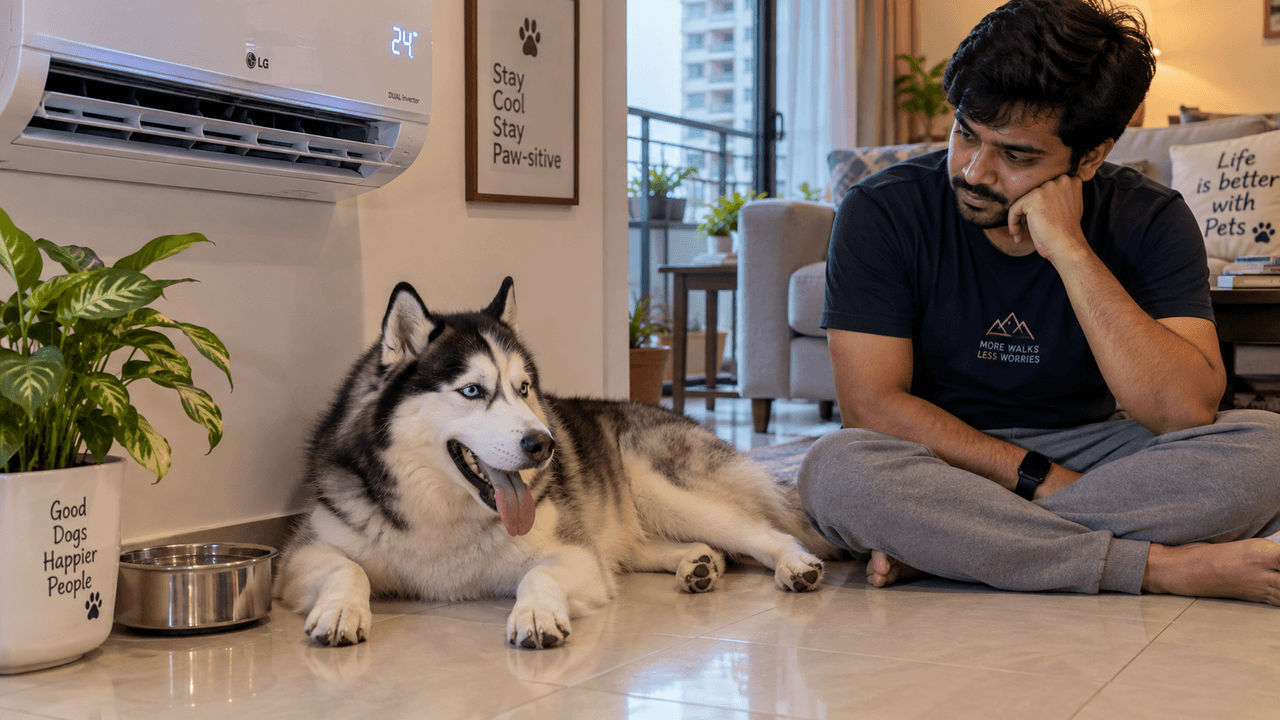
For a Husky in India to live well, you typically need: air-conditioned indoor space during March–October in most of the country, cool tile floors, fresh water in multiple stations, and an honest accounting that summer afternoons outdoors are non-negotiably off the table. In Mumbai, Chennai, Hyderabad, Delhi, Kolkata: this is a substantial daily commitment, not an optional improvement.
The escape, exercise and vocalisation reality
Beyond climate, the Husky brings three further challenges most Indian buyers underestimate:
- Escape artist: Huskies dig, climb, jump and squeeze through openings most other breeds don't notice. Apartments with balconies, gates, lifts all need active management.
- High exercise need: 90+ minutes of structured daily exercise. A Husky in a sedentary apartment is a destructive Husky.
- Howling and vocalisation: they don't bark much; they howl. RWAs notice. Neighbours notice. Build management into the plan, not as a surprise.
Husky temperament
A correctly bred and socialised Husky is:
- Friendly with people: generally not guarding dogs
- High social drive: wants company, suffers when alone
- Independent and stubborn: Huskies are not eager-to-please like Labradors
- High prey drive: risky around small dogs, cats, rabbits
- Bonded to the pack: does well with another dog
- Not naturally obedient: recall is famously unreliable; many Huskies must remain on-lead for life
This is a dog that needs structure, exercise and engagement, not just love. Most behavioural problems trace back to under-exercise and boredom.
How much does a Husky cost monthly in India?
Cost head | Metro (₹) | Tier-2 city (₹) |
|---|---|---|
Monthly food (large-breed kibble + fresh additions) | 4,500–8,000 | 3,200–6,000 |
AC running cost during summer | Significant; varies | Significant; varies |
Year-1 vaccinations / annual booster | 4,500–8,000 / 1,500–3,000 | 3,000–6,000 / 1,000–2,500 |
Annual deworming + tick-flea preventives | 4,000–7,000 | 2,800–5,000 |
Grooming (deshedding twice a year + monthly) | 1,500–3,500/visit | 1,000–2,500/visit |
Training (essential) | 22,000–55,000 (course) | 15,000–35,000 (course) |
Hip / elbow X-ray screen | 4,000–9,000 | 2,800–6,500 |
Optional pet insurance | 1,000–8,000/yr | 1,000–8,000/yr |
The grooming and climate-management lines are significantly higher than for most other breeds. For food brand context see [best dog food in India](/articles/best-dog-food-in-india).
Common Husky health issues in India
- Heat-related issues: heat stroke, exercise intolerance during summer
- Hip dysplasia: present but lower rate than Labradors and GSDs
- Eye conditions: juvenile cataracts, progressive retinal atrophy, corneal dystrophy
- Hypothyroidism: relatively common
- Skin and coat issues in poorly adapted Indian climate
- GI sensitivity in some lines
The biggest single risk for an Indian Husky is heat, and it is almost entirely owner-controllable.
Husky vs Labrador vs Indian Pariah for Indian families
Trait | Husky | Labrador | Indian Pariah |
|---|---|---|---|
Climate tolerance India | Poor | Moderate | Excellent |
Trainability | Independent, stubborn | Very high, eager | High, independent |
Exercise need | 90+ min daily structured | 60–90 min daily | 45–60 min daily |
Apartment suitability | Difficult | Yes with effort | Yes with ease |
Lifespan India | 11–13 years if well-managed | 9–11 years | 13–16 years |
Honest first-year cost | High | High | Low |
Heat stroke risk | Highest | Moderate | Lowest |
For most Indian families and most Indian climates, the [Labrador](/articles/labrador-price-in-india) is an easier large dog, and the [Indian Pariah dog](/articles/indian-pariah-dog) is the genuinely climate-matched alternative.
When buying a Husky is the right call
Honest scenarios where a Husky genuinely works:
- You live in a hill station or genuinely cool climate
- You have committed AC during peak summer and the budget to run it
- You exercise 90+ minutes daily without negotiation
- You have a securely fenced compound or genuinely Husky-proof apartment
- You have prior experience with stubborn working breeds
- You have time for daily training and engagement
- You can accept howling as part of life
If any of these is uncertain, choose differently. The Indian rescue networks are full of Huskies whose owners couldn't make it work.
When to call the vet
Promptly for:
- Heavy panting that does not resolve with rest and cooling
- Lethargy during or after warm-weather exercise: heat stroke is an emergency, go now
- Eye redness or visible cloudiness
- Lameness lasting beyond 24 hours
- Sudden weight loss or chronic loose stool
- Skin lesions or hot spots
Adult Huskies benefit from annual vet checks; six-monthly from age 7. See [senior dog care in India](/articles/senior-dog-care-india).
FAQ
Husky ka real price kya hota hai India mein?
Vaccinated pedigreed Husky metros mein ₹25,000–₹55,000 mein milta hai. Tier-2 cities mein ₹15,000–₹35,000. KCI show-quality ₹55,000–₹95,000. ₹10,000 ke neeche wala "Husky" zyadatar mix ya backyard-bred hota hai. Husky par paisa bachana lifetime mein zyada mehnga padta hai.
Is the Husky good for hot Indian cities?
Honestly, no, not without serious owner commitment. The breed was built for Arctic cold and Indian summer is its biological opposite. Mumbai, Chennai, Hyderabad, Delhi summers are particularly hard. AC during March–October is non-negotiable. Hill stations and cool tier-2 cities are workable. Choose differently if any of this is uncertain.
How long do Huskies live in India?
11–13 years with committed climate management, exercise and prompt response to heat or eye issues. Without those, lifespan can be substantially shorter: heat-related complications, obesity from under-exercise and behavioural surrender to rescues are common premature endings in India.
Are Huskies good with children?
Yes, generally: they are friendly and social with people. The caveats are prey drive (cats, small dogs, sometimes toddlers running can trigger chase) and exercise need (an under-exercised Husky is harder for a family to manage). Socialise heavily from 8–14 weeks.
Husky ko Indian garmi mein kaise rakhein safe?
AC ya cool tile floor zaroor chahiye peak summer mein. Walks subah jaldi (6 AM se pehle) aur raat ko late (9 PM ke baad). Pani har taraf available rakho. Cool sleeping spots dijiye. Khoon mein kabhi car mein akele mat chodo. Heavy panting, lethargy, jaldi-jaldi saans: yeh heat stroke ke signs hain, turant vet ke pass jaaiye.
Should I get a Husky or a different breed in India?
For most Indian homes and most Indian climates, choose differently. The Husky's beauty is real but the commitment is enormous and the failure rate (owners surrendering to rescues by year 2–3) is high in India. Indies, Labradors and Pomeranians serve most family needs at a fraction of the climate and exercise stress.
Sources
- Kennel Club of India (KCI): Siberian Husky breed standard.
- WSAVA: global welfare guidance.
- MSD Veterinary Manual: breed health and heat stroke references.
A note from Critzo (please read): This article is general educational information written and reviewed by qualified veterinary professionals for Indian pet parents. It is not a substitute for an in-person consultation with your own veterinarian, who knows your pet, their history, and their current clinical state. Pets are individuals — breed, age, weight, pre-existing conditions, medications, and local disease patterns all change what is safe and what is not. Do not start, stop, or change any medication, vaccination schedule, diet, or treatment based on what you read here without first speaking to a registered veterinary practitioner. If your pet is showing emergency signs — collapse, seizure, severe bleeding, suspected poisoning, breathing difficulty, bloated abdomen, repeated vomiting or no urination for more than 12 hours — stop reading and go to the nearest 24-hour veterinary hospital immediately. You follow any guidance from this article at your own risk and at your pet's risk. Critzo, its authors, and its reviewers accept no liability for outcomes arising from decisions made without veterinary supervision.