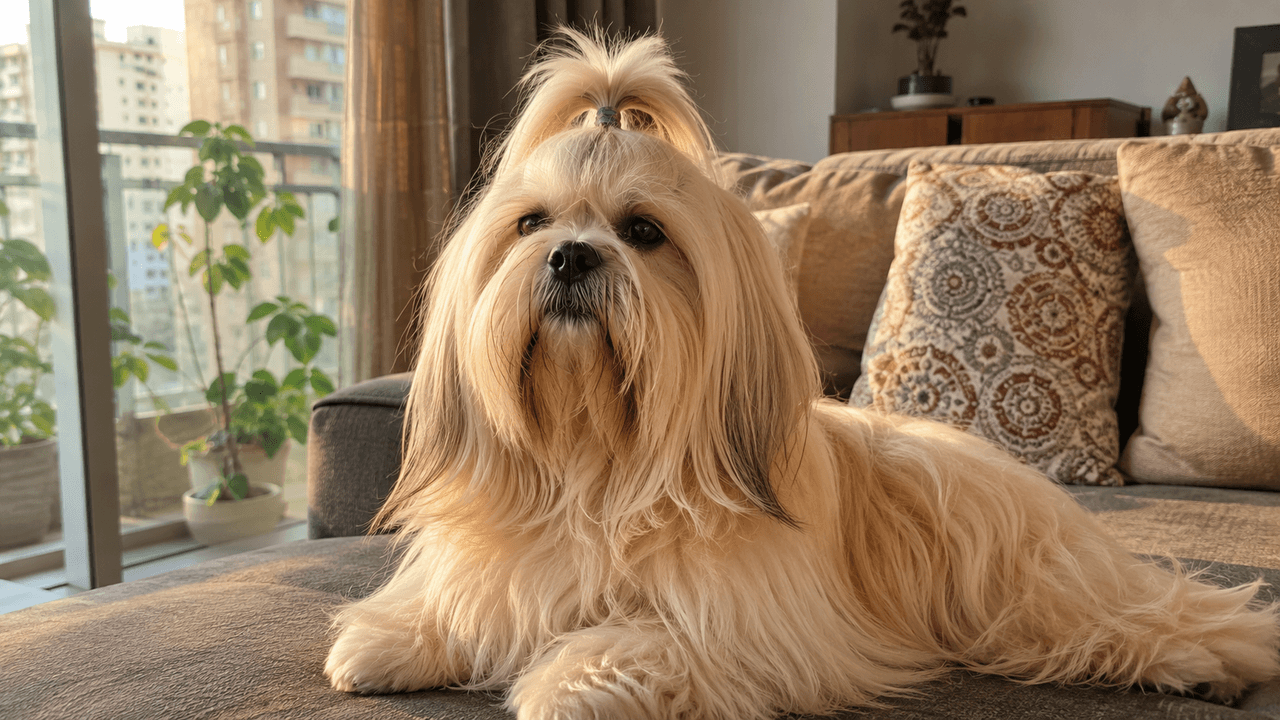
A Lhasa Apso puppy in India costs roughly ₹8,000–₹35,000 in 2026: metros typically ₹15,000–₹30,000, tier-2 cities ₹8,000–₹20,000, for pet-quality. KCI-papered show-quality dogs cross ₹35,000–₹60,000. Plan on ₹2,500–₹5,000 a month for upkeep, with grooming being the single biggest recurring cost on this breed.
Why this matters in India
The Lhasa Apso is genuinely the unsung small dog of urban India. They're smaller than most people assume, calmer than a Pomeranian, more apartment-suitable than a Pug, and surprisingly hardy compared to most other toy breeds. The two reasons they get consistently under-bought: confusion with the [Shih Tzu](/articles/lhasa-apso-price-in-india) (they're genuinely different dogs) and a perceived grooming burden that's real but very manageable once you know what you're signing up for. This guide walks through what a Lhasa Apso actually costs in India in 2026, the climate and grooming realities day to day, and whether the breed genuinely suits your home.
Lhasa Apso price in India by city
City | Pet-quality (₹) | Show-quality (₹) | Notes |
|---|---|---|---|
Mumbai | 18,000–32,000 | 32,000–55,000 | Wide supply, reputable breeders |
Delhi NCR | 17,000–30,000 | 30,000–52,000 | Largest market |
Bengaluru | 15,000–28,000 | 28,000–48,000 | Steady demand |
Hyderabad | 14,000–26,000 | 26,000–45,000 | Growing |
Pune | 12,000–24,000 | 24,000–42,000 | Tier-2 pricing, metro demand |
Chennai | 12,000–22,000 | 22,000–40,000 | Steady |
Kolkata | 10,000–20,000 | 20,000–38,000 | Lower mean |
Jaipur / Lucknow / Ahmedabad | 8,000–18,000 | 18,000–32,000 | Tier-2 baseline |
A Lhasa Apso priced under ₹6,000 anywhere in India is almost always either a misrepresented Shih Tzu/Lhasa mix or a non-vaccinated backyard-bred puppy. Whatever you're paying, verify the parents and the vaccination record before you hand over cash.
What affects the Lhasa Apso puppy price?
- KCI registration and pedigree: the single biggest lever on price
- Bloodline and breeder reputation: established catteries charge a premium, and they usually earn it
- Coat colour: golden, cream, sand, and black-with-white-markings sit in the mid-range; rarer colours push into premium territory
- Age: younger puppies, within the 8-week minimum, tend to cost more
- Vaccination status: a properly vaccinated puppy costs more and is worth the difference
- Sterilisation policy: some breeders sell on a neuter contract at a lower upfront price
- Show potential, covering confirmation, bite, and gait: confirmed show prospects run 2–3 times pet-quality pricing
Are Lhasa Apsos good for Indian apartments?
Yes, arguably one of the better-matched small breeds for apartment life in India, and here's why honestly.
Size works in their favour: an adult sits around 6–8 kg, comfortably manageable in a 1BHK. Energy is calm indoors; two 20-minute walks plus some indoor play is genuinely plenty for this breed. Temperament is independent and dignified: alert without turning into the nuisance-barker some other toy breeds become. Heat tolerance is better than most toy breeds because the Lhasa's coat is a single flat coat rather than the dense double coat a Pomeranian carries, though summer management is still necessary. And on adaptability, Lhasas descend from Tibetan monastery dogs, which means they're mentally built to live indoors with limited stimulation, provided they get their two real walks a day.
The one genuine caveat is grooming. The long, flowing coat that defines the breed needs daily brushing and a professional groom every 4–6 weeks. Most pet owners, sensibly, opt for a "puppy cut" or "teddy bear cut" that keeps the coat at 2–3 cm, which is easier to maintain and considerably friendlier for the Indian climate.
How much does a Lhasa Apso cost monthly in India?
Cost head | Metro (₹) | Tier-2 city (₹) |
|---|---|---|
Monthly food (small-breed kibble + fresh additions) | 1,400–2,800 | 1,000–2,000 |
Grooming (essential: daily brush + groom every 4–6 weeks) | 800–2,200/visit | 500–1,800/visit |
Annual vaccinations (year 1 / annual booster) | 3,500–6,000 / 1,500–3,000 | 2,500–4,500 / 1,000–2,500 |
Annual deworming + tick-flea preventives | 2,500–4,500 | 1,800–3,500 |
Dental cleaning (every 2–3 years) | 6,000–15,000 | 4,000–10,000 |
Optional pet insurance | 500–7,500/yr | 500–7,500/yr |
For mobile grooming options, see our [mobile dog grooming in India](/articles/mobile-dog-grooming-india) guide. For insurance, see [HDFC ERGO Paws n Claws](/articles/hdfc-ergo-paws-n-claws-review).
Common Lhasa Apso health issues in India
- Dental disease: a small jaw with crowded teeth means daily brushing and periodic professional dental cleaning both matter more than owners expect
- Patellar luxation: the kneecap slipping out of place; watch for a skipping gait
- Cherry eye: the gland of the third eyelid prolapses and typically needs surgical correction
- Progressive retinal atrophy (PRA): gradual vision loss that can be screened for in parent dogs before you buy
- Skin and ear issues: the long coat traps moisture, especially through monsoon
- Sebaceous adenitis: a coat condition seen in certain breeds; uncommon in Lhasas but worth knowing about
Lhasa Apso vs Shih Tzu
The two breeds get confused constantly, including in Indian classifieds listings. Here's what's actually different between them.
Trait | Lhasa Apso | Shih Tzu |
|---|---|---|
Origin | Tibet (monastery sentinel) | China (imperial companion) |
Build | Slightly longer body, more substantial | Slightly more compact |
Muzzle | Longer, narrower | Shorter, flatter (brachycephalic risk) |
Temperament | Independent, aloof with strangers | More uniformly affectionate, friendlier with all |
Climate suitability India | Better (single coat, normal muzzle) | Slightly worse (flatter face means more heat sensitivity) |
Grooming needs | High (long coat) | High (long coat) |
For the Indian climate specifically, the Lhasa Apso has a real structural advantage in its less brachycephalic face. Either breed makes a fine apartment companion, as long as you actually know which one you're buying.
Lhasa Apso temperament
A correctly socialised Lhasa Apso tends to be confident and self-possessed: these were temple sentinels once, and they seem to know it. They're aloof with strangers but devoted to their own family; don't expect the everyone-is-my-best-friend energy of a Labrador. They're alert and quietly vocal, making them reliable little watchdogs despite the size. They're independent, thinking before they obey, which gets misread as stubbornness more often than it deserves. And they're patient with children when socialised early, though supervision with toddlers is still non-negotiable.
They're not a beginner's velcro dog. Think of them more as a beginner's thinking dog.
When to see a vet
Go now if you notice sudden loss of vision or your dog bumping into furniture it normally avoids, since this can signal a PRA-related event or another urgent eye issue, and shouldn't wait.
Book within 24 hours for a skipping gait or lameness in a back leg, excessive eye discharge or redness, a visible "cherry" of pink tissue in the corner of the eye, persistent head shaking or an ear smell, refusal to eat for more than 12–24 hours, or vomiting and diarrhoea lasting beyond a day.
Monitor at home only if your dog seems entirely normal otherwise (eating, playing, no discharge or discomfort), and even then, a quick call to your vet costs nothing if you're unsure.
FAQ
Lhasa Apso ka real price kya hota hai India mein? (ल्हासा एप्सो की असली कीमत भारत में क्या है?)
Pet-quality Lhasa Apso metros mein ₹15,000–₹30,000, tier-2 cities mein ₹8,000–₹20,000 mein milta hai. KCI-registered show-quality usse zyada. ₹6,000 ke neeche wala "Lhasa" mostly Shih Tzu mix ya backyard-bred non-vaccinated puppy hota hai; vaccination card aur parents check karna zaroori hai.
Is the Lhasa Apso good for hot Indian cities?
Yes, with some management: the Lhasa has a single coat and a normal muzzle, both of which help against Indian heat compared to a Pug or a Pomeranian. Morning and evening walks, AC during peak summer, good hydration, and a sensible "puppy cut" through April–June make the climate genuinely workable for this breed.
How long do Lhasa Apsos live?
Lhasa Apsos are among the longest-lived small breeds: well-cared-for dogs commonly reach 13–17 years. Dental care, weight control, eye monitoring, and a prompt response to lameness or vision changes are the levers that actually protect that lifespan.
Are Lhasa Apsos good with children?
With older, calm children, yes. With toddlers or very young children, exercise real caution, since Lhasas are dignified dogs who will defend themselves if mishandled. Socialise the puppy with children between 8 and 14 weeks, and teach kids to respect the dog's space from the start. Never leave any small dog alone with a young child.
How much grooming does a Lhasa Apso need?
If you keep the full traditional coat, that's daily brushing plus a professional groom every 4–6 weeks. If you keep a sensible puppy cut at 2–3 cm, twice-weekly brushing and a groom every 6–8 weeks is enough. Most pet-owner Lhasas are genuinely happier and easier to manage in a clipped coat. Skipping grooming leads to matting and, underneath that, skin problems.
Lhasa Apso ko kya khilana chahiye? (ल्हासा एप्सो को क्या खिलाना चाहिए?)
Small-breed complete-and-balanced kibble, age-appropriate, sabse safe option hai. Adult ko din mein do baar khilaaiye, puppy ko 3–4 baar chhote portions mein. Doodh, masala-bhara human food, cooked bones, chocolate, onion, garlic: bilkul nahi dena chahiye. Fresh additions jaise boiled chicken, egg, curd vet ki guidance mein dene mein koi harm nahi hai.
Sources
Kennel Club of India (KCI) Lhasa Apso breed standard; WSAVA vaccination and nutrition guidelines; MSD Veterinary Manual reference data on patellar luxation, cherry eye and PRA.
A note from Critzo (please read): This article is general educational information written and reviewed by qualified veterinary professionals for Indian pet parents. It is not a substitute for an in-person consultation with your own veterinarian, who knows your pet, their history, and their current clinical state. Pets are individuals — breed, age, weight, pre-existing conditions, medications, and local disease patterns all change what is safe and what is not. Do not start, stop, or change any medication, vaccination schedule, diet, or treatment based on what you read here without first speaking to a registered veterinary practitioner. If your pet is showing emergency signs — collapse, seizure, severe bleeding, suspected poisoning, breathing difficulty, bloated abdomen, repeated vomiting or no urination for more than 12 hours — stop reading and go to the nearest 24-hour veterinary hospital immediately. You follow any guidance from this article at your own risk and at your pet's risk. Critzo, its authors, and its reviewers accept no liability for outcomes arising from decisions made without veterinary supervision.