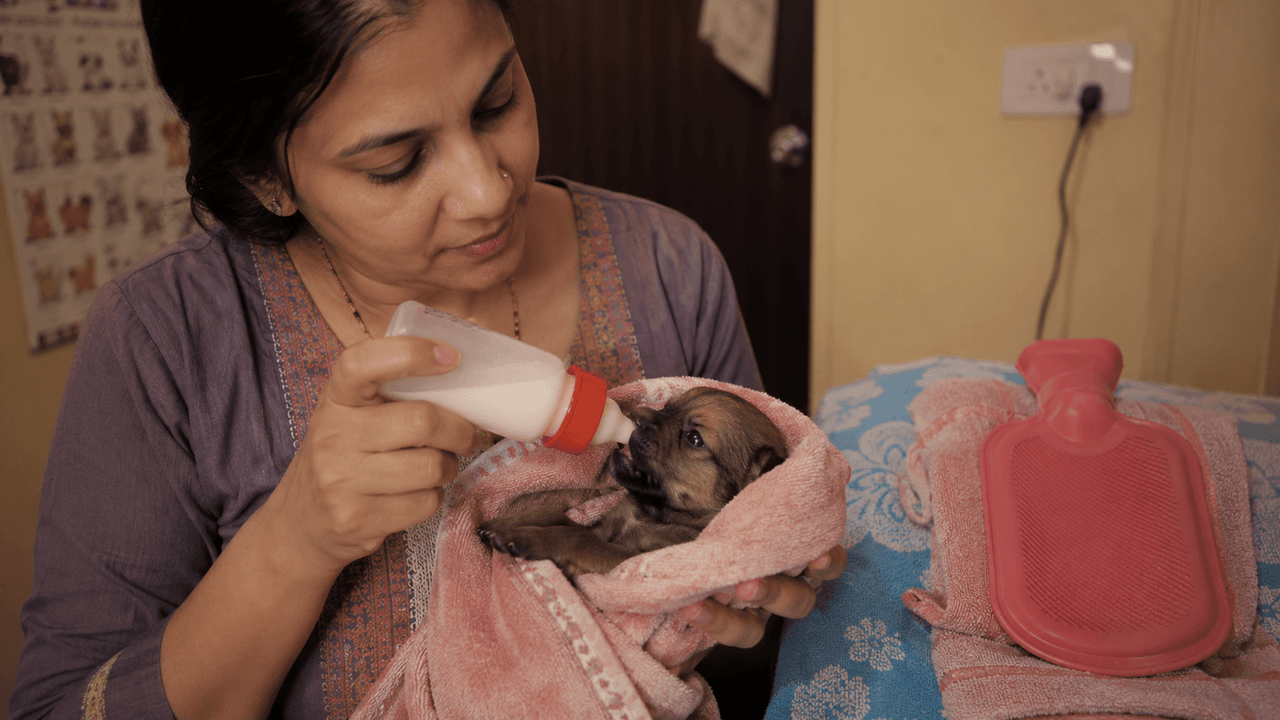
If you've just found a stray puppy in India, keep it warm and dry first, then offer warm puppy formula (never cow's milk) and get to a vet within 24 hours for deworming, a parasite check, and a vaccination plan. Cow's milk causes diarrhoea in puppies and can genuinely kill them. Hypothermia and dehydration are the two biggest killers of young puppies in that first week.
Why this matters in India
Picking up a street puppy in India is one of the kindest things you can do, and also one of the most fragile. The puppy you just found by the side of the road has often already lost a littermate, is dehydrated, carrying a heavy parasite load, and immune-vulnerable in ways that aren't obvious just by looking at it. The first 72 hours decide whether that puppy thrives or fades. This guide is the protocol I walk first-time rescuers through in the clinic, in the order it actually matters in. None of it replaces an actual vet visit: that's step one of the protocol itself, not an afterthought.
Step 1: Warmth before everything
A young puppy can't regulate its own body temperature yet. Hypothermia is the single most common reason rescued newborn-to-3-week puppies die in the first 24 hours, more common than most people expect.
What to do:
- Wrap the puppy in a soft, warm towel
- Place a warm, not hot, hot-water bottle wrapped in a second towel near the puppy
- Keep the room's ambient temperature around 28–30°C for the first week
- Don't rely on a bare cardboard box on a cool floor; line it heavily with soft fabric
The puppy should feel warm and pink, not cold and grey. A cold, listless puppy is a medical emergency, full stop.
Step 2: Feeding by age
Cow's milk is unsafe for puppies. It causes osmotic diarrhoea and electrolyte imbalance, and it's the single most common avoidable mistake first-time rescuers make, usually out of good intentions.
Estimated age | What to feed | Frequency |
|---|---|---|
0–3 weeks (eyes closed, can't walk) | Puppy milk replacer formula (Royal Canin Babydog Milk, Petlac, Esbilac) warmed to 37–38°C, by feeding bottle | Every 2–3 hours including night |
3–4 weeks (eyes open, beginning to walk) | Puppy milk replacer + slurry of soaked puppy kibble | Every 3–4 hours |
4–6 weeks | Wet puppy food / soaked kibble | 4 times a day |
6–8 weeks | Good complete puppy kibble, lightly soaked initially | 4 times a day |
8+ weeks | Complete puppy kibble (Drools Focus Puppy, Royal Canin Mini Puppy, etc.) | 3–4 times a day |
For brand and feeding context, see our [Royal Canin vs Drools comparison](/articles/royal-canin-vs-drools). If you genuinely can't source puppy formula within the next hour, warm goat's milk is a reasonable emergency substitute, since it's closer to a dog's natural milk composition than cow's milk is, but treat it strictly as a stop-gap, not an actual plan.
Step 3: Hydration check
Pick up the skin behind the puppy's neck gently. If it springs back instantly, hydration is fine. If it stays tented for a second or more, the puppy is dehydrated and needs vet attention urgently, not home remedies.
Light dehydration in a slightly older puppy (6+ weeks) can be supported with an oral rehydration solution between feeds. Severe dehydration in any puppy needs IV fluids, which means a vet visit; this isn't something to manage at home.
Step 4: First vet appointment
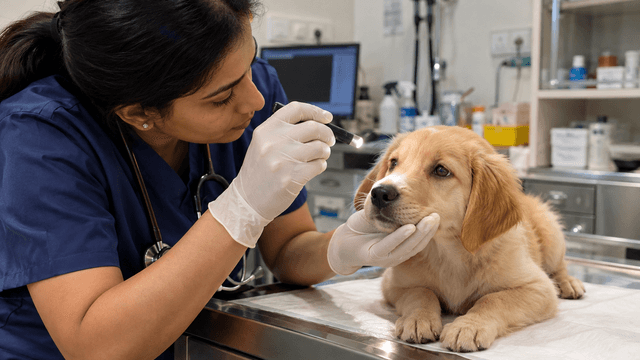
Book this within 24 hours of finding the puppy. At that visit, the vet will estimate age based on tooth eruption and physical development, examine for trauma such as fractures, wounds or congenital issues, deworm with an age-appropriate dewormer (pyrantel pamoate from 2 weeks, fenbendazole later, or a combination product depending on what the vet decides), check for fleas, ticks, mites and ear mites, test for parvo if there are GI signs and the puppy is 4+ weeks old, discuss vaccination timing (typically DHPPi+L starting at 6–8 weeks), and flag any congenital issues that need attention.
Plan for roughly ₹2,500–₹6,000 for this first visit including diagnostics, depending on city tier and what the puppy actually needs.
Step 5: Deworming and parasite control
A street puppy is essentially always carrying worms, so assume it and plan accordingly. The typical protocol runs: dose 1 at the first vet visit, dose 2 fourteen days later, dose 3 another fourteen days after that, then monthly through to 6 months of age, then quarterly to annual through adult life.
Tick-flea preventives (topical or oral options like Bravecto, NexGard or Frontline) come in at a vet-defined age. Some preventives carry minimum weight or age thresholds, so don't improvise here; let the vet pick the product and timing.
Step 6: Vaccination schedule for rescued puppies
For a healthy puppy of estimated age, the standard Indian protocol runs like this:
Week of life | Vaccine |
|---|---|
6–8 weeks | DHPPi (Distemper, Hepatitis, Parvovirus, Parainfluenza), first dose |
10–12 weeks | DHPPi+L (now including Leptospira), booster |
14–16 weeks | DHPPi+L, final puppy booster + Rabies vaccination |
Annually thereafter | DHPPi+L + Rabies booster |
Kennel Cough (Bordetella, Parainfluenza) and Canine Influenza are optional, depending on lifestyle and what your vet advises. Don't socialise an unvaccinated puppy in public dog parks or around unvaccinated street dogs until the schedule is at least 75% complete, since this is exactly the window where parvo strikes hardest.
Step 7: Signs of trouble
Take the puppy to a vet immediately for any of the following:
- Watery diarrhoea, especially if it's bloody (possibly parvo), and this is an emergency
- Repeated vomiting
- Refusal to eat for more than 6–8 hours in puppies under 6 weeks, or 12–24 hours in older puppies
- Lethargy, weakness, or cold to the touch
- Pale gums (they should be pink and moist)
- Laboured breathing or a persistent cough
- Bloody urine or no urination at all
Parvo remains the single most common cause of death in young Indian street puppies. It shows up as watery, often bloody diarrhoea, vomiting, lethargy and refusal to eat. Survival improves dramatically with early IV fluid support and supportive care; every hour genuinely matters here, so don't wait to see if it settles on its own.
Step 8: Socialisation while keeping safe
The critical socialisation window for puppies runs roughly from 3 to 14 weeks. The goal is gentle, controlled exposure (sounds, surfaces, people, calm vaccinated adult dogs you already know) while keeping the puppy away from parvo risk in public parks and around unknown dogs.
Do carry the puppy to safe environments, invite calm people over gently and in small numbers, get them used to the vacuum, doorbell and traffic sounds at low volume, handle paws, ears and mouth gently every day, and reward calm behaviour when you see it.
Don't take the puppy to public dog parks before vaccination is complete, let it meet unvaccinated street dogs, overwhelm it with crowds in the first 2–3 weeks, or use harsh corrections of any kind.
For broader first-month logistics, see [how to adopt a stray dog in India](/articles/how-to-adopt-a-stray-dog) and the [Indian Pariah dog](/articles/indian-pariah-dog) guide for what to expect over the breed's lifetime.
What it costs in India (2026)
Category | Price range (₹) | Notes |
|---|---|---|
Puppy milk replacer (if needed, 2–4 weeks) | 1,500–4,000 | Metro upper end, tier-2 lower end |
Vet visits and diagnostics, first 8 weeks | 3,500–12,000 | Depends on city tier and what the puppy needs |
Deworming + parasite preventive | 1,000–3,500 | Ongoing through the first 8 weeks |
Puppy kibble | 1,000–3,500/month | Metro higher, tier-2 lower |
Vaccination course | 2,500–6,000 | Full puppy series through 14–16 weeks |
Bed, bottle, kit | 1,000–3,500 | One-time setup cost |
First 8 weeks total | 10,000–32,000 | Metro ₹15,000–32,000; tier-2 ₹10,000–22,000 |
For pet insurance options once the puppy is settled (most insurers accept enrolment from 3 months), see [HDFC ERGO Paws n Claws](/articles/hdfc-ergo-paws-n-claws-review).
When to see a vet
Go now if you see watery or bloody diarrhoea, repeated vomiting, lethargy with cold extremities, pale gums, laboured breathing, or no urination: any of these in an unvaccinated puppy should be treated as parvo until proven otherwise, and every hour matters.
Book within 24 hours for the puppy's very first check-up regardless of how it looks on the surface: age estimation, trauma check, deworming and a vaccination plan all need to start early, even in a puppy that seems fine.
Monitor at home only if the puppy is eating, active, warm to the touch, and passing normal stool, and even then, keep the 24-hour vet visit on the calendar rather than skipping it because things look okay for now.
FAQ
Sadak ka chhota puppy mil gaya, sabse pehle kya karoon? (सड़क का छोटा पिल्ला मिल गया, सबसे पहले क्या करूं?)
Sabse pehle warmth: soft towel mein lapet ke gunguna hot water bottle paas rakhiye. Cow's milk mat dijiye, woh diarrhoea karta hai aur puppy ki jaan ja sakti hai. Goat milk warm karke chamach ya bottle se de sakte hain stop-gap mein. 24 ghante ke andar vet ke paas le jaaiye: deworming, parasites aur vaccination plan sab urgent hain.
Can I give a stray puppy cow's milk?
No. Cow's milk causes osmotic diarrhoea in puppies because of its lactose content and protein composition; this dehydrates the puppy quickly and can kill it. Use a commercial puppy milk replacer such as Royal Canin Babydog Milk, Petlac or Esbilac. In a genuine emergency with nothing else available, warm goat's milk is a better stop-gap than cow's milk, though still not a substitute for the real thing.
How do I estimate a stray puppy's age?
As a rough guide: eyes closed with no teeth means under 2 weeks; eyes open and beginning to walk means 2–3 weeks; small sharp teeth with walking and exploring means 4–6 weeks; and reliably eating solids means 6–8 weeks. A vet can estimate this more precisely from the tooth eruption pattern at the first visit.
When should I vaccinate a rescued puppy?
The standard Indian schedule runs DHPPi at 6–8 weeks, DHPPi+L at 10–12 weeks, DHPPi+L plus Rabies at 14–16 weeks, then annual boosters after that. Vaccination before 6 weeks generally isn't done because maternal antibodies still interfere with the vaccine's effect. If the puppy is in a high-parvo environment, your vet may advise an earlier vaccine and shorter intervals, but that call is theirs to make, not a DIY decision.
What if the puppy has diarrhoea?
Mild soft stool in an otherwise settled puppy may just be diet transition. Watery, frequent or bloody diarrhoea is a vet emergency: possibly parvo, intestinal parasites, or bacterial gastroenteritis. Lethargy, vomiting and bloody diarrhoea together in any unvaccinated puppy should be treated as parvo until proven otherwise. Go to the nearest 24-hour vet hospital rather than waiting.
How do I keep a newborn puppy warm without a heating pad?
Wrap a hot-water bottle (warm, not hot) in two layers of towel and place it next to the puppy in a deep box lined with soft fabric. Keep the room's ambient temperature at 28–30°C. Check the puppy's body temperature by touch: it should feel pleasantly warm, not cold or uncomfortably sweaty-hot. Replace the hot-water bottle every few hours as it cools.
Sources
WSAVA global vaccination guidelines for puppies and dogs; AWBI (Animal Welfare Board of India) guidance; MSD Veterinary Manual reference data on parvo, neonatal puppy care and fluid therapy.
A note from Critzo (please read): This article is general educational information written and reviewed by qualified veterinary professionals for Indian pet parents. It is not a substitute for an in-person consultation with your own veterinarian, who knows your pet, their history, and their current clinical state. Pets are individuals — breed, age, weight, pre-existing conditions, medications, and local disease patterns all change what is safe and what is not. Do not start, stop, or change any medication, vaccination schedule, diet, or treatment based on what you read here without first speaking to a registered veterinary practitioner. If your pet is showing emergency signs — collapse, seizure, severe bleeding, suspected poisoning, breathing difficulty, bloated abdomen, repeated vomiting or no urination for more than 12 hours — stop reading and go to the nearest 24-hour veterinary hospital immediately. You follow any guidance from this article at your own risk and at your pet's risk. Critzo, its authors, and its reviewers accept no liability for outcomes arising from decisions made without veterinary supervision.