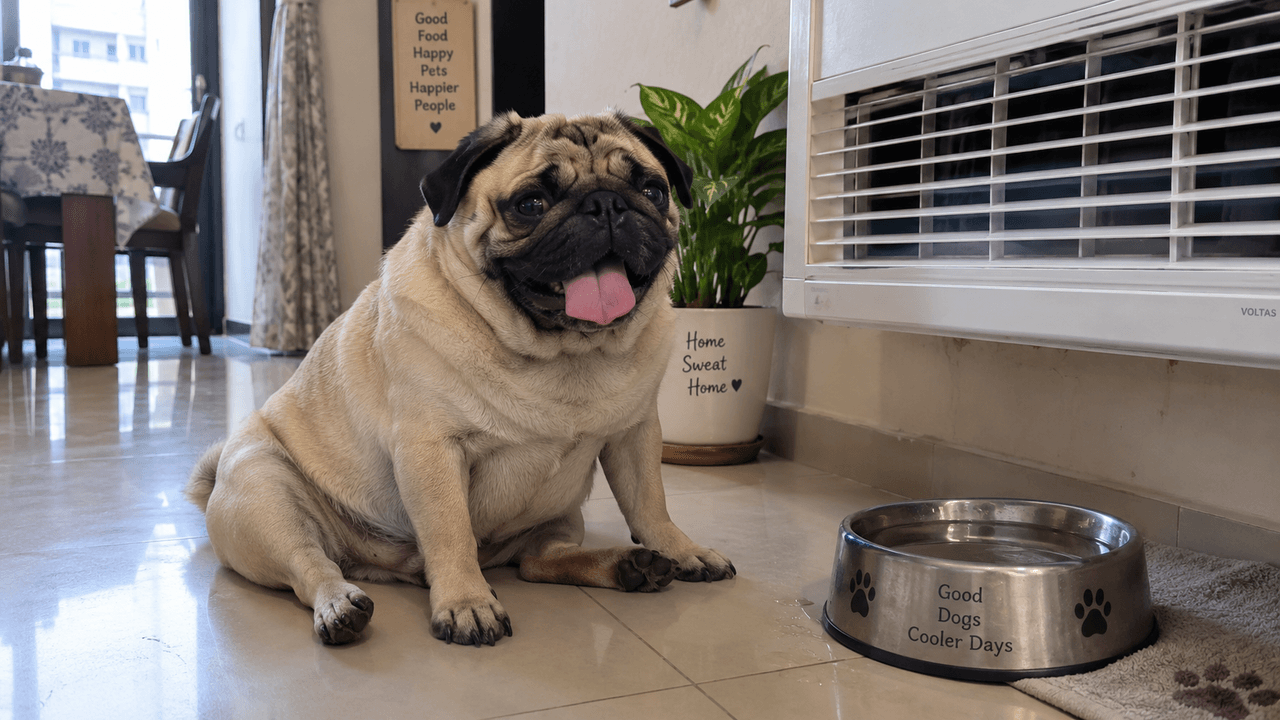
A Pug puppy in India costs roughly ₹10,000–₹30,000 in 2026: metros typically ₹16,000–₹30,000 and tier-2 cities ₹10,000–₹20,000 for pet-quality. Plan ₹3,500–₹6,500 monthly upkeep. Pugs are wonderful, loving family dogs but their brachycephalic anatomy genuinely struggles in Indian climate: AC is not optional, summer afternoons outdoors are dangerous, and lifetime vet costs are higher than most other small breeds.
Why this matters in India
The Pug remains one of India's most-bought small dogs, driven by the famous Vodafone ad legacy and decades of family-dog reputation. The breed is loving, devoted and visibly content with apartment life, and also one of the most climate-challenged dogs you can own in this country. Indian summers and the Pug's anatomy do not get along, and most online cost guides skip past this. This article is the version I wish every first-time Pug owner read before signing: honest cost, honest climate, honest vet bills.
Pug price in India by city
City | Pet-quality (₹) | Show-quality (₹) | Notes |
|---|---|---|---|
Mumbai | 18,000–28,000 | 30,000–55,000 | Most reputable breeders |
Delhi NCR | 16,000–26,000 | 28,000–52,000 | Largest market |
Bengaluru | 15,000–24,000 | 26,000–48,000 | Mid-band, cooler-climate advantage |
Hyderabad | 14,000–22,000 | 24,000–45,000 | Steady |
Pune | 14,000–22,000 | 24,000–45,000 | Metro-adjacent |
Chennai | 13,000–20,000 | 22,000–42,000 | Coastal humidity challenge |
Kolkata | 12,000–18,000 | 20,000–38,000 | Lower mean |
Tier-2 | 10,000–18,000 | 18,000–35,000 | Verify parentage |
A "Pug" advertised at ₹4,000–₹6,000 is almost always either a backyard-bred non-vaccinated dog or a mix. Verify parents.
The brachycephalic reality
Pugs are brachycephalic: they have a shortened skull and compressed muzzle, which creates a set of predictable health problems collectively called Brachycephalic Obstructive Airway Syndrome (BOAS). The mechanisms:
- Stenotic nares: narrow nostrils restrict airflow
- Elongated soft palate: partly blocks the back of the throat
- Everted laryngeal saccules: tissue obstruction
- Hypoplastic trachea: narrow windpipe in some dogs
The result: noisy breathing, snoring, exercise intolerance, heat sensitivity, occasional collapse during exertion. Many Pugs benefit significantly from surgical correction (nares widening, soft palate resection) by an experienced vet. This is not "just a quirk", it is a welfare issue and a frequent reason for emergency vet visits in Indian summers.
Are Pugs good for the Indian climate?
Honest answer: they are one of the worst-suited popular breeds for Indian climate. The combination of brachycephalic airway, dense double coat and high body mass relative to surface area makes the Pug one of the breeds at highest risk of heat stroke in India. The non-negotiables:
- Air-conditioned indoor environment during April–June peak summer (often longer in coastal cities)
- Walks only in cool hours: early morning before 7 am, evening after 7 pm
- No exercise during the hottest part of the day
- No long walks: Pugs cannot regulate heat well
- Constant fresh water access
- Humid coastal cities are harder than dry tier-2 cities
If you cannot provide consistent AC during summer months, the kind decision is to choose a different breed: see [Indian Pariah dog](/articles/indian-pariah-dog) for the climate-tolerant alternative.
Pug temperament
A Pug is one of the easiest temperaments in the dog world:
- Affectionate, devoted, family-oriented: they want to be with you
- Patient with children when socialised early
- Low to moderate exercise needs: apartment-friendly by activity level
- Not aggressive or territorial
- Vocal in alert mode but generally not a nuisance barker
- Slow to mature emotionally
This is the dog you want for a calm, indoor, climate-controlled Indian apartment household.
How much does a Pug cost monthly in India?
Cost head | Metro (₹) | Tier-2 city (₹) |
|---|---|---|
Monthly food (small-breed kibble + fresh additions) | 1,500–3,000 | 1,100–2,200 |
AC running cost during summer months | Significant; varies | Significant; varies |
Year-1 vaccinations / annual booster | 3,500–6,000 / 1,500–3,000 | 2,500–4,500 / 1,000–2,500 |
Annual deworming + tick-flea preventives | 2,500–4,500 | 1,800–3,500 |
Grooming (skin fold cleaning, light bath) | 500–1,500/visit | 400–1,200/visit |
BOAS evaluation / surgery (one-time, where indicated) | 25,000–80,000 | 18,000–55,000 |
Periodic vet visits for eye/skin/breathing | More than average | More than average |
Optional pet insurance | 700–7,500/yr | 700–7,500/yr |
The single biggest non-routine cost owners often underestimate is BOAS surgery if recommended. Other recurring costs are not radically higher than other small breeds, but climate-management infrastructure (AC running cost) is real. For food choices see [best dog food in India](/articles/best-dog-food-in-india).
Common Pug health issues in India
- Brachycephalic Obstructive Airway Syndrome (BOAS): the defining issue
- Heat stroke: high risk during Indian summers
- Skin fold dermatitis: moisture trapped in facial folds; daily wipe-down with vet-recommended cleaner
- Eye issues, protruding eyes are prone to corneal ulcers and dry eye
- Pug Dog Encephalitis (PDE): heritable inflammatory brain disease, breed-specific, often fatal
- Hemivertebrae and spinal issues: screw-tail dogs may have spinal abnormalities
- Hip dysplasia: present despite the breed's small size
- Obesity: Pugs love food and tip into overweight fast in apartments
The Pug is a higher-vet-bill breed than most small dogs. Insurance enrolment before pre-existing conditions develop is genuinely worth considering: see [HDFC ERGO Paws n Claws](/articles/hdfc-ergo-paws-n-claws-review).
How to buy a Pug puppy safely
The five non-negotiables: modified for the breed's brachycephalic profile:
- See the puppy with its mother
- Listen to the puppy's breathing at rest: heavy noisy breathing in a young puppy at rest is a yellow flag
- Ask about parents' BOAS surgery history if any
- Verify pedigree papers if claimed (KCI)
- Confirm a 7-day vet-check return policy including airway assessment
Take the puppy to a vet within 48 hours.
When to call the vet: Pug-specific decision rules
Emergency (go to a 24-hour hospital immediately):
- Open-mouth breathing that does not resolve with rest
- Tongue or gums turning blue or grey
- Collapse during exertion or heat
- Bulging eye out of socket (proptosis)
- Sudden inability to stand or walk
Same-day vet visit:
- Persistent noisy breathing change
- Refusal to eat for more than 12 hours
- New skin fold redness or smell
- Eye discharge, redness or visible ulcer
- Sudden lameness
Adult Pugs benefit from annual vet checks; six-monthly from age 6.
FAQ
Pug ka real price kya hota hai India mein?
Vaccinated pedigreed pet-quality Pug metros mein ₹16,000–₹26,000 mein milta hai. Tier-2 cities mein ₹10,000–₹18,000. ₹5,000 ke neeche wala "Pug" zyadatar backyard-bred ya mix hota hai: parents aur vaccination verify kar lijiye.
Is the Pug good for Indian climate?
Honestly: the Pug is one of the worst-suited popular breeds for Indian climate. Brachycephalic anatomy means high heat stroke risk during summer. Without committed AC during April–June peak summer and walks only in cool hours, the breed suffers visibly. Tier-2 cooler-climate cities are workable; humid coastal metros are hard.
How long do Pugs live in India?
10–13 years on average, with climate management, weight control and prompt response to breathing or skin issues. Heat stroke and untreated BOAS are the main contributors to premature death. Insurance for emergency care is genuinely worth considering for the breed.
Fawn vs black Pug: kaunsa lena chahiye?
Coat colour mein behaviour ka koi farak nahi padta. Fawn aur black donon Pugs ki temperament same hota hai. Black Pugs slightly garmi mein zyada heat absorb karte hain coat colour ki wajah se, lekin practical difference small hai. Apne puppy ke parents ki health aur breeder ki reputation ko colour se zyada importance dijiye.
What is BOAS in Pugs?
Brachycephalic Obstructive Airway Syndrome: a set of anatomical problems caused by the shortened skull and muzzle. Includes narrow nostrils, elongated soft palate, narrow trachea. Causes noisy breathing, exercise intolerance, heat sensitivity. Many Pugs benefit significantly from surgical correction by an experienced vet.
Should I get a Pug or a different breed in India?
Get a Pug if: you have consistent AC during summer, you understand the breed's medical commitments, you have budgeted for higher-than-average vet bills and you can be home enough for a velcro dog. Choose differently if any of those is uncertain. Indies, Lhasa Apsos and Beagles are easier on the climate side. The Pug's temperament is wonderful; the anatomy is the challenge.
Sources
- Kennel Club of India (KCI): Pug breed standard.
- WSAVA: brachycephalic dog welfare position.
- MSD Veterinary Manual: BOAS, skin fold dermatitis, PDE references.
A note from Critzo (please read): This article is general educational information written and reviewed by qualified veterinary professionals for Indian pet parents. It is not a substitute for an in-person consultation with your own veterinarian, who knows your pet, their history, and their current clinical state. Pets are individuals — breed, age, weight, pre-existing conditions, medications, and local disease patterns all change what is safe and what is not. Do not start, stop, or change any medication, vaccination schedule, diet, or treatment based on what you read here without first speaking to a registered veterinary practitioner. If your pet is showing emergency signs — collapse, seizure, severe bleeding, suspected poisoning, breathing difficulty, bloated abdomen, repeated vomiting or no urination for more than 12 hours — stop reading and go to the nearest 24-hour veterinary hospital immediately. You follow any guidance from this article at your own risk and at your pet's risk. Critzo, its authors, and its reviewers accept no liability for outcomes arising from decisions made without veterinary supervision.