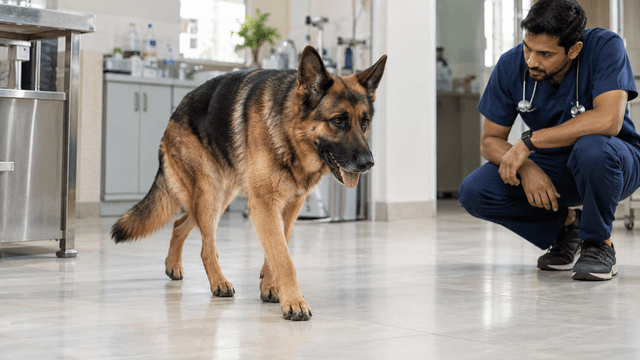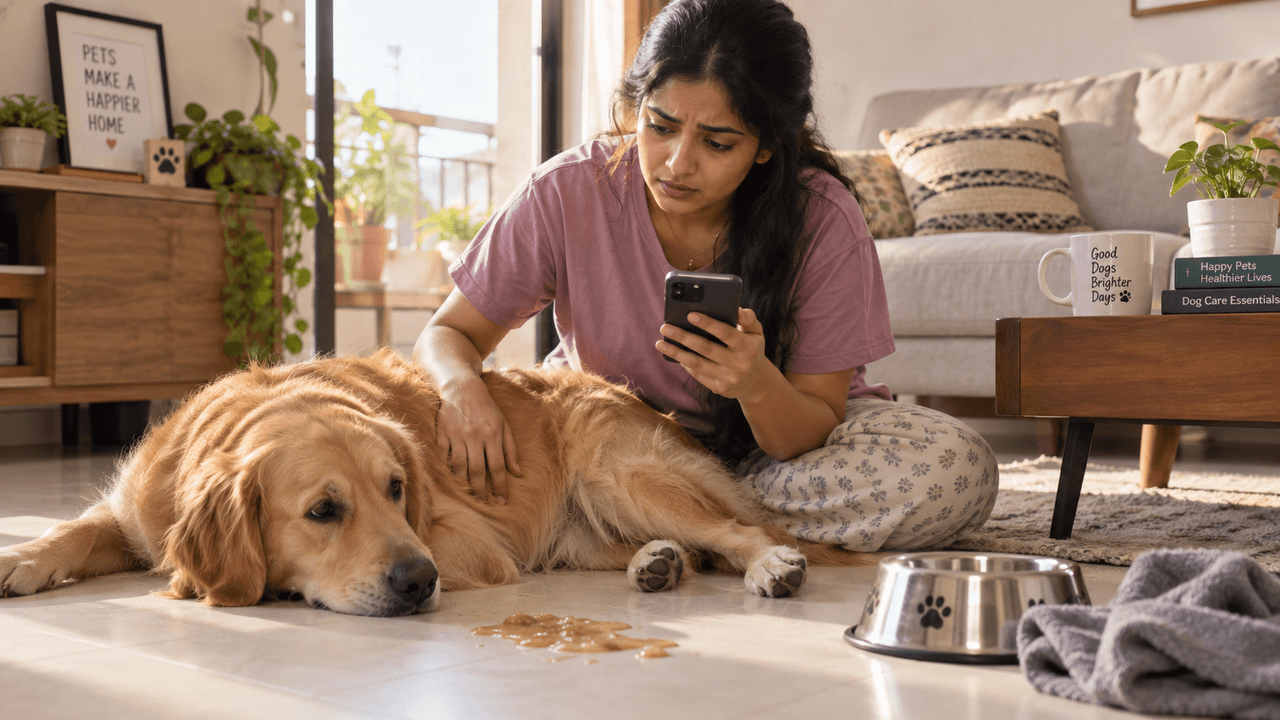
A dog vomiting white foam once or twice with an otherwise normal demeanour is usually empty-stomach vomiting or mild irritation, not an emergency. Repeated foamy vomiting, bloated abdomen, lethargy, blood in the vomit, or distress is a vet emergency, particularly for large breeds where bloat (GDV) can be fatal within hours. Always count the episodes in 6 hours; more than 2–3, or any one severe episode, is a vet call.
Why this matters in India
"Kutte ko safed ulti ho rahi hai" is one of the most common emergency-line questions Indian vets get. The honest answer depends on context: a single episode in an otherwise bright dog is rarely worrying, but the same symptom in a lethargic large breed with a swollen abdomen is a 30-minute window emergency. This guide walks through the causes, the decision rules and the next 5 minutes for each scenario.
In the next 5 minutes: what to do
- Look at the dog: bright and alert vs lethargic and dull
- Look at the abdomen: normal vs distended/swollen
- Look at the gums: pink moist vs pale, blue, or sticky-dry
- Count episodes: single vs repeated
- Look at the vomit: clear/white foam vs bloody vs containing food
- Ask yourself: any recent toxin exposure, foreign-body access, or food change
The answers to these five observations decide what to do next.
What does white foam in vomit actually mean?
White foamy vomit is a mix of saliva, mucus and gastric fluid. It typically signals:
- Empty-stomach vomiting: most common, often early morning before breakfast
- Mild gastric irritation: recent food change, eating grass, stress
- Bilious Vomiting Syndrome: bile reflux from gut into empty stomach
- Early viral or bacterial gastroenteritis
- Foreign body partially obstructing the stomach
- Severe nausea from systemic illness
White foam is descriptive, not diagnostic. The accompanying signs decide the urgency.
Common causes of dog vomiting in India
Cause | Typical context | Severity |
|---|---|---|
Empty stomach / Bilious vomiting | Early morning, otherwise well | Low: manage with smaller more frequent meals |
Mild gastric irritation | Ate grass, ate something new | Low: usually self-resolves |
Food allergy / sensitivity | Repeated, often with skin or stool issues | Moderate: vet visit |
Dietary indiscretion | Ate spoiled food, raided bin | Variable: observe, vet if persistent |
Gastroenteritis (viral/bacterial) | Often with diarrhoea, sometimes fever | Moderate to severe: vet visit |
Parvo (in puppies) | Unvaccinated puppy with diarrhoea | EMERGENCY: see [parvo symptoms in puppy](/articles/parvo-symptoms-in-puppy) |
Toxicity (chocolate, onion, grape, xylitol) | Recent ingestion | EMERGENCY: see [dog ate chocolate](/articles/dog-ate-chocolate) |
Foreign body | Often after access to toys, bones, fabric | EMERGENCY: surgery may be needed |
Pancreatitis | Often after high-fat meal | Moderate to severe: vet visit |
GDV / bloat | Large deep-chested breed, distended abdomen, retching unproductively | EMERGENCY: 30-minute window |
Kidney or liver disease | Older dog, ongoing illness | Vet visit |
Pyometra | Unspayed female, often middle-aged or older | EMERGENCY: surgery |
Megaoesophagus | Regurgitation, food back up undigested | Vet visit |
Cancer | Older dog, weight loss, persistent | Vet visit |
GDV / bloat: the 30-minute emergency
Gastric Dilatation-Volvulus (GDV) is the single most time-critical cause of vomiting in dogs. The mechanism: the stomach fills with gas and twists on its axis, cutting off blood supply. Without surgical intervention within hours, the dog dies.
Classic GDV signs:
- Large deep-chested breed (Great Dane, Doberman, GSD, Boxer, Labrador, Standard Poodle)
- Sudden onset, often within 2–3 hours after a large meal or vigorous activity
- Visibly distended/bloated abdomen
- Repeated unproductive retching: the dog tries to vomit but nothing comes up, or only small amounts of foamy saliva
- Restlessness, pacing
- Drooling
- Weakness, collapse
If you suspect GDV: go to a 24-hour vet hospital immediately. Do not wait, do not call first, just drive. Treatment is decompression of the stomach and emergency surgery. Survival depends on the time between symptom onset and surgical intervention.
What does the colour and content of vomit tell you?
Vomit appearance | Likely meaning |
|---|---|
Clear / white foam | Empty stomach, mild irritation, early illness |
Yellow / bilious | Bile reflux, empty stomach for too long |
Food, undigested | Recent ingestion; megaoesophagus if regurgitation rather than vomiting |
Food, digested | Digestion has started; less alarming |
Bright red blood | Bleeding from upper GI: vet today |
Dark / coffee-ground | Digested blood from stomach: vet today |
Greenish | Bile-stained, often empty stomach |
Smelly / faecal | Possible intestinal obstruction: emergency |
Worms visible | Heavy parasite load: vet visit, deworming |
A single episode of clear white foam in an otherwise normal dog with no other signs is rarely an emergency. The risk lies in repeated episodes, accompanying signs, or any of the breed/age/exposure risk factors above.
When to call the vet: decision rules
Emergency (go to a 24-hour vet hospital NOW):
- Distended abdomen with retching but nothing coming up: suspect GDV
- Repeated vomiting (>3 episodes in 6 hours)
- Bloody vomit (bright red or coffee-ground)
- Vomiting combined with diarrhoea in any unvaccinated puppy: suspect parvo
- Vomiting with known toxin exposure
- Lethargy, collapse, weakness, pale gums
- Suspected foreign-body ingestion (toy, bone, cloth) with vomiting
- Unspayed female with vomiting and any discharge: suspect pyometra
- Vomiting with refusal to drink water
Same-day vet visit:
- Vomiting >2 times in 24 hours in an otherwise normal dog
- Vomiting in a puppy under 6 months even if mild
- Vomiting in a senior dog with any chronic condition
- Persistent appetite loss with even mild vomiting
- Yellow bilious vomiting more than twice a week
Monitor at home:
- Single episode of white foam, dog otherwise bright, eating, drinking normally
- Brief empty-stomach vomiting once in the morning that resolves with smaller more frequent meals
- Mild bilious vomiting after a long stretch without food
What to do at home: for mild non-emergency vomiting
If the dog is otherwise well and you have ruled out emergency signs:
- Withhold food for 6–12 hours (not water: small amounts of water often)
- After the fasting period, offer a small portion of bland diet: boiled chicken (no salt, no spice) and plain boiled rice in a 1:2 ratio, small portions every 3–4 hours
- Continue bland diet for 24–48 hours
- Gradually transition back to regular food over 3–5 days
- Monitor for any new symptoms
For chronic intermittent bilious vomiting: feed smaller meals 3–4 times a day instead of one or two; a small snack before bed often resolves morning empty-stomach vomiting.
What NOT to do
- Do not give human anti-vomiting medication (Ondansetron, Domperidone) without vet direction; dosing and contraindications matter
- Do not give large volumes of water at once: small frequent sips
- Do not force feed a vomiting dog
- Do not give milk: many dogs are lactose-intolerant, worsens GI signs
- Do not "wait and see" in a young puppy, an unvaccinated dog, or a large deep-chested breed with abdominal distension
- Do not assume home remedies (ORS, lemon, ash, hingu) substitute for veterinary care
Special situations
- Puppies, vomiting is more dangerous because of small body size and rapid dehydration. Always lower the threshold to call. See [parvo symptoms in puppy](/articles/parvo-symptoms-in-puppy) and [stray puppy care in India](/articles/stray-puppy-care-india).
- Large deep-chested breeds (Lab, GSD, Doberman, Great Dane, Boxer): bloat is a real risk; abdominal distension + retching = emergency
- Senior dogs, vomiting more often signals systemic illness (kidney, liver, cardiac, cancer); same-day vet visit
- Pregnant females, vomiting in late pregnancy or post-partum can signal eclampsia; same-day vet visit
- Recent surgery or medication, vomiting may be drug-related; inform the prescribing vet
What the vet will do
For a vomiting dog presenting to a clinic, standard work-up:
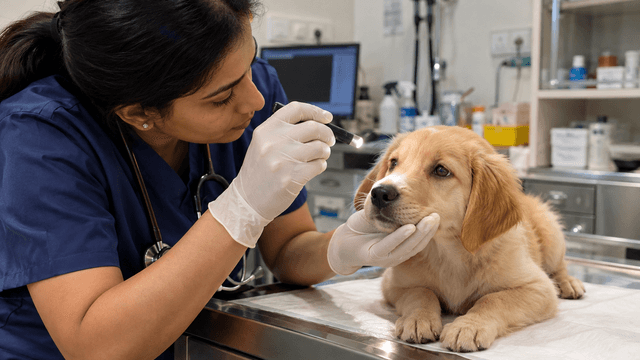
- History and physical examination: palpate abdomen, check hydration, mucous membrane colour
- CBC and biochemistry: kidney, liver, electrolytes, glucose
- Abdominal X-ray: looks for foreign bodies, obstruction, GDV
- Abdominal ultrasound: soft-tissue detail
- Anti-emetic medication: typically maropitant (Cerenia) or metoclopramide
- IV fluid support: if dehydrated
- Specific tests as indicated: parvo SNAP, pancreatic lipase, etc.
Cost typically ₹2,500–₹8,000 for outpatient assessment in metros; ₹1,800–₹6,000 in tier-2. Hospitalisation adds significantly. Coverage of vomiting investigations varies by pet insurance policy: see [HDFC ERGO Paws n Claws](/articles/hdfc-ergo-paws-n-claws-review).
FAQ
Kutte ko safed ulti aa rahi hai: kya karoon?
Pehle dog ko dekhiye (alert hai ya thaka hua? Pet bhula hua hai ya normal? Gums pink hain ya pale? Ek baar ki ulti aur baki sab normal toh aaram se observe kar sakte hain) 6 ghante khana band kijiye, phir bland diet (boiled chicken + rice) chhote portions mein. Lekin baar-baar ulti, pet bhula hua + retching, ya lethargy hai toh turant 24-hour vet hospital jaaiye. Bade dogs (Lab, GSD, Dane) mein bloat 30-minute emergency hai.
What does it mean when my dog vomits white foam in the morning?
Most commonly it is bilious vomiting syndrome: empty-stomach acid and bile irritate the gastric lining after a long fasting overnight. Easy fix, feed a small portion before bed, or split meals into 3–4 smaller portions per day instead of 1–2 large ones. If it persists or worsens, vet visit.
When should I take my dog to the vet for vomiting?
Same-day vet visit for: more than 2 episodes in 24 hours, vomiting in a puppy under 6 months, vomiting with lethargy or appetite loss, bloody vomit, vomiting combined with diarrhoea. Emergency: distended abdomen with retching (GDV), repeated vomiting more than 3 times in 6 hours, vomiting with collapse, vomiting with suspected toxin exposure.
Can dogs vomit because of stress?
Yes: anxiety, travel, separation distress and excitement can all trigger vomiting in dogs. It is typically a single episode that resolves once the trigger ends. Persistent stress-related vomiting may need behavioural support and sometimes anti-emetic medication for specific trigger events (e.g. car travel).
Is dog vomiting white foam a sign of bloat?
It can be. In a large deep-chested breed (Lab, GSD, Doberman, Great Dane, Boxer) with a distended abdomen and unproductive retching of white foam, GDV / bloat is the top differential and requires immediate veterinary attention. In smaller breeds without abdominal distension, white foam alone is rarely bloat-related.
Should I give my dog water after vomiting?
Yes, small amounts. Withhold food for 6–12 hours but offer small frequent sips of water. Large gulps often trigger another vomiting episode. If the dog refuses water for more than a few hours, that itself is a vet visit signal.
Can puppies recover from vomiting at home?
Sometimes, but the threshold to call the vet is much lower in puppies. A puppy under 6 months can dehydrate dangerously fast. Even 2 episodes of vomiting in an unvaccinated puppy is a same-day vet visit. Watery or bloody diarrhoea with vomiting is a parvo emergency. See [parvo symptoms in puppy](/articles/parvo-symptoms-in-puppy).
Sources
- WSAVA: global vomiting management guidance.
- AAHA: GDV consensus statements.
- MSD Veterinary Manual, vomiting and gastric disease chapters.
A note from Critzo (please read): This article is general educational information written and reviewed by qualified veterinary professionals for Indian pet parents. It is not a substitute for an in-person consultation with your own veterinarian, who knows your pet, their history, and their current clinical state. Pets are individuals — breed, age, weight, pre-existing conditions, medications, and local disease patterns all change what is safe and what is not. Do not start, stop, or change any medication, vaccination schedule, diet, or treatment based on what you read here without first speaking to a registered veterinary practitioner. If your pet is showing emergency signs — collapse, seizure, severe bleeding, suspected poisoning, breathing difficulty, bloated abdomen, repeated vomiting or no urination for more than 12 hours — stop reading and go to the nearest 24-hour veterinary hospital immediately. You follow any guidance from this article at your own risk and at your pet's risk. Critzo, its authors, and its reviewers accept no liability for outcomes arising from decisions made without veterinary supervision.